
[NOTICE: The AHRC has developed this automatic letter-sending system using the “button” below. Please click the button for your participation. We also encourage you to send your appeal letters via fax or post to those people. Fax numbers and postal addresses of the Pakistan authorities are attached below with this appeal. Thank you.]
Dear friends,
The Asian Human Rights Commission (AHRC) has received updated information that due to a bullet wound and removal of one kidney, Dr. Afia Siddiqui health is in a serious condition, but no medical assistance has been provided to her whilst she has been in American custody in New York.
UPDATED INFORMATION:
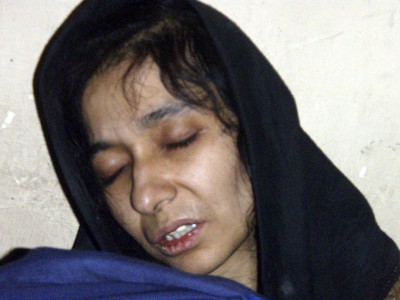 After the case of Dr. Afia was issued (AHRC-UAC-167-2008) and became part of public discourse, the government of the United States claimed that she was arrested on 17 July 2008, which does nothing to explain her whereabouts since March 2003.
It is reported that she was brought to Pakistan in February 2008 to convince her to become a government witness against Khalid Shiek Mohammad – a high profile Al-Quaida leader and allegedly one of the masterminds of the September 11 attacks, who has been detained in Guantanamo Bay prison. As the case against Khalid Shiekh Mohammad is about to start the American forces need the assistance of Dr. Afia Siddiqui to convict him. Dr. Afia was allegedly severely tortured in Karachi, Pakistan in order to secure her compliance.
She was produced before a New York court where she had to be assisted into the hearing. It is reported that her health is in a serious condition due to the bullet wound she suffered after reportedly trying to attack one of her guards, but no medical assistance has been provided to her while she has been in American custody in New York.
According to the information received from a local human rights organisation in Pakistan, her kidney was removed while she was in custody in the United States. A closer look at the picture shows evidence of the years of physical abuse; there are dark circles under her eyes, and her nose was apparently broken at some stage and has been badly set. It is a picture of a severely dehydrated person in desperate need of medical attention.
In addition, although one son is with Dr. Afia but the whereabouts of her two other children still remain unknown. All three of her children were kidnapped along with Dr. Afia when she was taken by Pakistani intelligence officers on March 30, 2003. Her two children who remain missing were not with her when she was shifted to a governor’s house in Afghanistan, for a brief stop over prior to her journey to New York, under heavy security. When she was being taken aboard a special plane there was no female security officer to provide support or assistance to her, and it was reported she fell down at least two times.
SUGGESTED ACTION:
Please write letters to the following mentioned authorities and urge them to immediately release Dr. Afia Siddiqui and her child who is with her. Please also demand both governments to reveal the whereabouts of the other two children.
Please be informed that the AHRC has written separate letters to the UN Special Rapporteur on the Question of Torture calling for intervention in this case.
To support this case, please click here: SEND APPEAL LETTER
SAMPLE LETTER
Dear __________,
PAKISTAN/USA: Dr. Afia’s health is in a serious condition and two of her children remain missing
Name of victim:
Dr. Afia Siddiqui and her three children, Block 7, Gulshan e Iqbal, Karachi, Sindh-Pakistan; currently detained at American custody in New York, USA
Name of alleged perpetrators:
Federal Bureau of Investigation (FIB), USA, United States Army Warrant Officer, United States Army Captain, and United States military interpreters stationed at Ghizni province, Afghanistan
I am shocked to know that Dr. Afia Siddiqui, a Pakistani female scientist, who has been missing along with her three children for five years after her arrest by Pakistani intelligence agencies, has not been provided any medical treatment since ‘turning up’ in an Afghanistan detention centre in American custody. This is despite the formal announcement of her arrest by the FBI.
Furthermore, I am appalled that the whereabouts of two of her children remains unknown. Dr. Afia and her three children were kidnapped by Pakistani intelligence agents in March 2003.
I have been informed that Dr. Afia’s heath is a serious concern and that she is extremely weak after having been shot by an American army officer while allegedly trying to escape. How anyone who can barely walk could attempt to overpower an armed American soldier has yet to be explained. It is also reported that one of Dr. Aafia Siddiqui’s kidneys was removed while she was in the custody of the United States Authorities. A close look at the picture shows the years of physical abuse: there are dark circles under her eyes, and her nose was apparently broken at some stage and has been badly set. It is a picture of a severely dehydrated person in desperate need of medical attention.
The whereabouts of two of her children remain unknown and only one son is with her. All three of her children were kidnapped along with Dr. Afia when she was taken by Pakistani intelligence officers on March 30, 2003. The two children who remain missing were not with her when she was shifted to a governor’s house in Afghanistan, for a brief stop over prior to her journey to New York, under heavy security. When she was being taken aboard a special plane there was no female security officer to provide support or assistance to her, and it was reported she fell down at least two times.
I have been also informed that Dr. Afia was tortured and kept in custody for more than five years only to obtain a confessional statement against Khalid Umer Shaikh, allegedly a high profile Al-Qaida master mind of the September 11 incident. She was even brought back to Pakistan to become a government witness against Khalid Umer.
My concern is that during this whole process Dr. Afia may lose her life because of a lack of proper care as envisaged in the UN Universal Declaration on Human Rights. She also has the right to know what has happened to her missing children.
Accordingly, I appeal to you to provide all medical assistance to her and take proper action to discover the whereabouts of her two missing children, so that the family can be reunited. Dr. Afia must be provided immediate access to legal assistance of her choice and free access to the media.
Yours truly,
—————
PLEASE SEND YOU LETTERS TO:
1. Chief
Allied Joint Force Command
Head Quarters Brunssum,
Public Affirs office, P.O. BOX 270
6440, AG, Brunssem
THE NETHERLANDS
Tel. No.: +31 45 526 2409
E-mail: pio@jfcbs.nato.intHeadquart
2. Mr. George W. Bush
President of the United State of America (USA)
The White House
1600 Pennsylvania Avenue NW,
Washington, DC 20500
USA
E-mail: presidents@presidentsusa.net
3. Mr. Hamid Karzai
President of Afghanistan
Gul Khana Palace
Presidential Palace
Kabul
AFGHANISTAN
E-mail: president@afghanistangov.org
4. General Pervez Musharraf
President of Pakistan
President’s Secretariat
Islamabad
PAKISTAN
Fax: +92 51 922 1422 / 4768; 920 1893 or 1835
E-mail: (please see: http://www.presidentofpakistan.gov.pk/WTPresidentMessage.aspx)
5. Mr. Syed Yousaf Raza Gillani
Prime Minister
Prime Minister House, Islamabad,
PAKISTAN
Fax: +92 51 922 1596
Tel: +92 51 920 6111
E-mail: webmaster@infopak.gov.pk or infominister@pak.gov.pk
6. Mr. Farooq Naik
Minister of Law, Justice and Human Rights
S Block Pakistan Secretariat
Islamabad
PAKISTAN
Fax: +92 51 920 2628
E-mail: minister@molaw.gov.pk
7. Mr. Rehman Malik
Advisor for Ministry of Interior
Room No. 404, 4th Floor, R Block,
Pak Secretariat
Islamabad
PAKISTAN
Fax: +92 51 920 2624
Tel: +92 51 921 2026
E-mail: minister@interior.gov.pk
Thank you.
Urgent Appeals Programme
Asian Human Rights Commission (ua@ahrchk.org)
