
Dear friends,
The Asian Human Rights Commission (AHRC) has issued regular updates on the case of Mrs. Shahin Sultana Santa, a pregnant woman who was brutally tortured and whose unborn child was killed by police after she became caught up in a political demonstration. One witness has been killed, and at least two others have been arrested and detained under false charges. The victim’s case was dismissed by the Fourth Special Tribunal for Prevention of Women and Children Repression of Dhaka, and after three years her challenge, via a revision petition, has been heard. In September, a court of Dhaka ordered the Dhanmondi police station to register the torture as a criminal case. The victim and her family continue to be threatened by perpetrators among the police.
UPDATED INFORMATION:
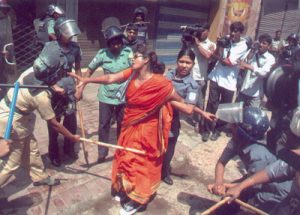 On 12 March 2006, Shahin Sultana Santa, diabetic and pregnant, suffered two fractures and severe injuries to her thighs, lower abdomen, back, waist and hips, after an extended assault by police. Among other methods of torture, officers tied a rope around her abdomen and pulled it tight, kicked her genitalia and walked on top of her body in the police van until she fainted; she lost her child. She had been waiting for her son outside his school. Please see the victim’s photos [photo1], [photo2] and [photo3].
As described in various special reports and updates since then (linked below), her case has seen continual, often openly corrupt setbacks. This has included fabricated complaints being lodged against her family by members of the police; threats, offers of bribes and physical attacks officers; a weak judicial probe and primary court case; and threats being made against those willing to testify on her behalf.
Witness intimidation: Of the key witnesses, one has died mysteriously; Mr. Ripon, an electrician by trade, was killed in a trap allegedly set by police and a source in Mohakhali, Dhaka in 2007; and another, Mr. Omar Faruk Keru has spent two months in Noakhali Jail and five months in Dhaka Central Jail, where he was reportedly tortured and faced with ten fabricated charges. Santa’s husband and lawyer Mr. Atiur Rahman has claimed that various charges have been systematically fabricated against him over the last three years.
Judicial flaws: We have been informed that on 21 May 2006, despite strong evidence, the Fourth Special Tribunal for Prevention of Women and Children Repression, Dhaka, dismissed the torture allegations and dropped the charges of molestation and sexual abuse. The judge ruled that the police did not molest and sexually abuse the victim deliberately. The abuse had been proven by a judicial probe commission headed by Metropolitan Magistrate of Dhaka, Mr. Shafique Anwar (for further details, please click here: UP-112-2006).
On 30 October 2006 Santa registered a Revision Petition with the Metropolitan Sessions Court of Dhaka, which challenged the tribunal’s cancellation of her torture case. The complaint has been pending for almost three years, with nineteen successive hearings called, and delayed.
Police action and inaction: On 27 September 2009, the Court of Fourth Additional Sessions Judge of Dhaka heard the Revision Petition. This was file by Santa to challenge the order of dismissal given by the Chief Metropolitan Magistrate of Dhaka. The judge granted Santa’s Revision Petition and cancelled the previous order of the Magistrate Court. The Chief Judicial Magistrate then ordered the police to record the complaint (at this point still a petition, instead of a First Information Report (FIR) due to the abuse of the system by police).
That same evening at 8:05pm the Dhanmondi Police Station of the DMP finally registered the complaint as a FIR as case no. 47 (under Sections 341, 323, 325, 326, 354, 394, 506, 109 and 34 of the Penal Code of 1860). It had taken three years.
Santa’s petition complaint (No. 312/2006) of torture was lodged with the Chief Metropolitan Judicial Magistrate’s Court (formerly known as the Chief Metropolitan Magistrate’s Court) of Dhaka on 14 March 2006, against the police. It cited former Deputy Commissioners of the Dhaka Metropolitan Police (DMP) Mr. Kohinoor Mian and Mr. Mazharul Haque, an inspector, along with 25 other police personnel. The case had ended with the release of a final report by Mr. Kawsar Haidary, an officer of the Criminal Investigation Department (CID).
The FIR recorded under the non-bailable sections of the penal law, yet no arrests have been made. The DMP claims that it has since made several unsuccessful attempts to arrest the alleged perpetrators, particularly Mian (currently a SI of Police attached to the Rajshahi Range) and Haque (who was promoted to Additional DIGeneral of Police and became the Vice Principal at the Sarda Police Training Academy). Officers say that both are in hiding. Mr. Nur Hossain, Police Inspector of the detective branch of the Dhaka Metropolitan Police (DMP) has been appointed as Investigating Officer (IO).
In anticipation of their arrest Mian and Haque have reportedly filed a writ petition with a bench of the High Court Division of the Supreme Court of Bangladesh on 1 October 2009 seeking ad interim bail. They were suspended from service after the case was registered, under orders given from the Minister of Home Affairs Ms. Sahara Khatun.
The police headquarters has also reportedly started a ‘Departmental Proceeding’ against the alleged police officers, helmed by a Mr. Md. Humayan Kabir, a Joint Commissioner of the DMP. Six witnesses from Santa’s case testified before him on 30 November 2009, and on the same occasion the witnesses statements were recorded by the IO of the case inspector, Hossain.
This case is becoming a landmark trial for the flaws it has exposed in the criminal justice system. Please find case analysis in our special report in periodical, Article 2: Lawless law-enforcement and the parody of judiciary in Bangladesh (Vol.5, no. 4, August 2006) or follow the progression of the case through our original appeal and updates: UA-105-2006, UP-058-2006, UP-062-2006, UP-083-2006, UP-096-2006, UP-101-2006, UP-112-2006, UP-114-2006, UP-181-2006, UP-207-2006, UP-026-2007 and UP-040-2007.
ADDITIONAL COMMENTS:
It should be noted that The Fourth Special Tribunal for the Prevention of Women and Child Repression is one of many tribunals set up in each of Bangladeshs district headquarters, and was partly established in response to the country’s ratification of the Convention on the Elimination of All forms of Discrimination Against Women (CEDAW) in 1995. To ratify this international law, a country must not only change discriminatory laws but also introduce new gender-sensitive laws and policies to ameliorate and adjust unequal power balances between men and women. The case of Shanta begs the embarrassing question of its usefulness, and its power. Its inability to either protect or support a woman whose genitals was beaten and whose child was killed while inside her body by law enforcers, speaks of both a lack of understanding of the convention, and a lack of will to take it seriously.
SUGGESTED ACTION:
Please write to the relevant Bangladesh authorities listed below and demand their urgent intervention into this case. Please also urge them to provide safe environment to the victim and her family as well as the witnesses of the torture case in no time.
The Asian Human Rights Commission has written separate letters to the UN Special Rapporteurs on Question of Torture and Violence against Women urging their interventions into this case.
To support this case, please click here: SEND APPEAL LETTER
SAMPLE LETTER
BANGLADESH: Court orders police to record a torture case after three years, authorities avoid arresting alleged perpetrator-police officers
Name of the victims:
1. Mrs. Shahin Sultalna Santa; wife of Mr. Atiur Rahman; resident of 7/A, road no. 10, Mohammadia Housing Society, under the Mohammadpur police station in Dhaka
2. Mr. Atiur Rahman, a lawyer by profession and husband of Mrs. Shahin Sultana Santa, who was tortured by the police in Dhaka; resident of7/A, road no. 10, Mohammadia Housing Society, under the Mohammadpur police station in Dhaka
Alleged perpetrators of the original incident of torture:
1. Mr. Mazharul Haque, a former deputy commissioner (South Zone), Dhaka Metropolitan Police (DMP); reportedly a fugitive at present.
2. Mr. Kohinur Mian, a former deputy commissioner (West Zone), Dhaka Metropolitan Police (DMP), reportedly a fugitive at present.
3. Mr. Ruhul Amin, a former police constable of the Dhaka Metropolitan Police (DMP)
4. 20 to 25 police personnel of the Dhaka Metropolitan Police (DMP)
Place of the incident: Dhaka, Bangladesh
Date of the latest Incident: 27 September 2009 (original incident on 12 March 2006)
I am once again seriously concerned about the manner in which the prosecution of the alleged torturers of Mrs. Shahin Sultana Santa is being handled by the courts, and the Bangladesh police. The victim was pregnant when she was beaten by police on 12 March 2006, in an incident well publicized by local media. Ms. Santa was left with grave injuries and lost her unborn child.
According to the latest information that I have received, after more than a three year-legal battle by the victim, the Chief Metropolitan Judicial Magistrates’ Court of Dhaka ordered Santa’s case be filed as a First Information Report (FIR) on 24 September 2009. The police recorded it as an FIR (No. 47) at the Dhanmondi branch of the Dhaka Metropolitan Police (DMP) on 27 September.
While I welcome the news that the Home Ministry has suspended two senior police officers Mr. Mazharul and Mr. Kohinur since then, I wonder why the police have failed to arrest them. Two months have now passed. The police authorities have claimed that the two men are in hiding, yet I am extremely skeptical of the efforts being deployed in the attempt to arrest them. This is when considering the impunity that has so far coloured the case, and the fact that the victim has had to lodge a Revision Petition with the Metropolitan Sessions Court of Dhaka, simply to file an FIR.
The victim, her family, and witnesses to her case complain of continued harassment and threats from police, including their use of illegal arrests and fabricated charges. One witness, Mr. Omar Faruk Keru has spent months in detention and has faced ten fabricated charges since the incident.
I call on the government to investigate how the registration of Mrs. Santa’s torture could have been denied her for more than three years, and identify and punish the officials responsible. Ms Santa’s revision petition itself was called and delayed nineteen times. The alleged perpetrators must be prosecuted in fast track courts without any further delay. The victim, her lawyer and witnesses should be provided with adequate compensation, and the significant flaws in the judicial process must come under investigation.
This case illustrates the depth of the policing problems in Bangladesh, and the continued vulnerability of those whether victims, witnesses or lawyers that try to bring them to light. I urge the authorities of Bangladesh to form a judicial probe commission made of judges of the Supreme Court, to investigate the prevalence of torture at the hands of the law-enforcing agencies in the country. A thorough investigation is needed to explore the dynamics of the problem, and to teach the nation more about the immediate need for police reform.
Yours sincerely,
————-
PLEASE SEND YOUR LETTER TO:
1. Mrs. Sheikh Hasina
Prime Minister
Government of the People’s Republic of Bangladesh
Office of the Prime Minister
Tejgaon, Dhaka
BANGLADESH
Tel: +880 2 882 816 079 / 988 8677
Fax: +880 2 811 3244 / 3243 / 1015 / 1490
E-mail: pm@pmo.gov.bd or ps1topm@pmo.gov.bd or psecy@pmo.gov.bd
2. Mr. M. M. Ruhul Amin
Chief Justice
Supreme Court of Bangladesh
Supreme Court Building
Ramna, Dhaka-1000
BANGLADESH
Tel: +880 2 956 2792
Fax: +880 2 956 5058
3. Barrister Shafique Ahmed
Minister
Ministry of Law, Justice & Parliamentary Affairs
Bangladesh Secretariat
Dhaka-1000
BANGLADESH
Tel: +880 2 7160627
Fax: +880 2 7168557
E-mail: info@minlaw.gov.bd
4. Ms. Sahara Khatun MP
Minister
Ministry of Home Affairs
Bangladesh Secretariat
Dhaka-1000
BANGLADESH
Tel: +880 2 7169069
Fax: +880 2 7160405, 880 2 7164788
Email: minister@mha.gov.bd
5. Mr. Mahbubey Alam
Attorney General of Bangladesh
Office of the Attorney General
Supreme Court Annex Building
Ramna, Dhaka-1000
BANGLADESH
Tel: +880 2 956 2868
Fax: +880 2 956 1568
6. Justice Amirul Kabir Chowdhury
Chairman
National Human Rights Commission
6/3 Lalmatia, Block-D
Dhaka-1207
BANGLADESH
Telefax: +880 2 9137743
7. Mr. Nur Mohammad
Inspector General of Police (IGP)
Bangladesh Police
Police Headquarters’
Fulbaria, Dhaka-1000
BANGLADESH
Tel: +880 2 956 2054 / 717 6451 / 717 6677
Fax: +880 2 956 3362 / 956 3363
E-mail: ig@police.gov.bd
8. A K M Shahidul Hoque
Commissioner
Dhaka Metropolitan Police
DMP Headquarter
36, Shahid Captain Monsur Ali Road
Ramna, Dhaka-1000
BANGLADESH
Tel: +880 2 9331555 /88-02-8322746
Fax: +880 2 8322746
Mobile: +8801711538313
E-mail: complain@dmp.gov.bd / emergency@dmp.gov.bd / commissioner@dmp.gov.bd
Thank you.
Urgent Appeal Programme
Asian Human Rights Commission (ua@ahrc.asia)
