
Dear All,
The Asian Human Rights Commission has earlier informed you about the attack on FMA Razzak instantiated by army officer, Major Mustafizur Rahman Bokul and his family, who attempted to gouge out Razzak’s eyes. The right leg and hand were broken with several bones suffered fractures. The police have not yet started a credible investigation into the matter that will ultimately narrow down the path of getting justice for the wounded human rights defender.
For further details, please see: http://www.humanrights.asia/campaigns/attack-on-fma-razzak.
UPDATED INFORMATION:
The AHRC sent observers to Bangladesh to visit Razzak in hospital and inquire about the situation. We have now received their observations which we quote below.
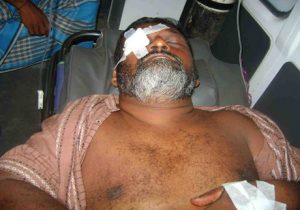 As seen from these observations the situation is very serious from the point of view of his medical condition and also the security of Mr. Razzak and his family. AHRC therefore renews its appeal,
• To call for investigations into the incident and for arrest of Major Mustafizur Rahman Bokul, his brother Mokhlesur Rahman Kazol and others who participated in this brutal attack
• For the Government of Bangladesh to appoint independent police investigation team to investigate into this incident
• To immediately record a statement from Mr. Razzak and to cause a judicial medical examination of his injuries
• To provide security to Mr. Razzak, his family and all witnesses.
We urge you also to provide financially support for medical, legal and security costs on his behalf.
For further details kindly see comments from our observers:
“We (team from the AHRC) met Razzak at a hospital in Dhaka for the first time. As expected, he is broken, mentally and physically. He is at the moment at the Trauma Centre, from where he would be discharged tomorrow or the day after. Razzak’s relatives have found a house to rent near Dhaka, where they could stay, so that they could be safer than in a village and also possible to return to the hospital for regular treatment. It is pretty clear that the family cannot afford to pay the hospital bills and the house rent and further maintain daily expenses, now that they have literally lost everything. Mr. Razzak informs us that his entire property has been damaged, including standing crops back at the village (paddy fields have been ploughed by the culprits, the areca nut palms and other trees cut and destroyed, and the house completely damaged), that not only supported Razzak’s family, but also his aged parents. Razzak on these terms is not only traumatised by the event, but also due to his concern that the family has nothing to look up to. In fact they do not have a house to go back to in the village.
Concerning his health, the doctors have dressed his wounds that include fractures in his right leg and right arm and plastered them for the bones to set. After about six months or so as the bones get ready to cure, they will insert steel rods in his leg and then Mr. Razzak can undertake physiotherapy to slowly recover from the fractures to the extent a recovery is possible. Mr. Razzak informs us that the doctor has advised him that the whole process may take two years, unless his diabetic condition causes problems in recovery.
Razzak has suffered not only fractures on his leg, but also flesh wounds from the assault on his right leg. The medical approach is to give priority for his fracture to heal, for which the leg needs to be plastered as otherwise the bones will not set, also considering his age. But this poses a problem with his flesh wounds on the same leg since the plaster cast would cause serious hindrances for his flesh wounds to cure, a condition that could be aggravated due to his diabetics.
It is very hot and humid at the hospital and Razzak can hardly turn or change his position in the hospital bed. He cries due to extreme pain on his right leg and arm from the fracture and the wounds, if he tries to turn his body. He cannot turn his body to the left side also since he has suffered injuries on the left side of his body. The right upper arm muscles are so stiff, skin black in colour and the arm swollen from the blunt trauma injury that he can hardly move his right arm. It is a terrible experience to watch him struggling to move his body to avoid his under body from being heated up due to prolonged periods of laying down in the same position. At the moment, he cannot move without two or three persons helping him and suffering severe pain on his leg and arms.
As for Razzak’s vision, he says that he has 70% vision in his left eye and 25% vision in his right eye. This is in fact what the doctor has reportedly informed him. But when we were talking, one of his close friends were with him, at about four feet from his bed. He could however not realise his friend’s face or realise that he was close to him, which gives us an impression that his injuries to the eyes are more serious than what he thinks that he has suffered. However, we saw a document issued by the eye doctor that says more or less what Mr. Razzak now believes. Further clarification can be gathered once there will be an opportunity to meet the doctor along with Mr. Razzak.
We had opportunity to meet a group of inhabitants of Paikgachha, who have formed a committee to fight for justice and protection for FMA Razzak. From the discussion with the members of the committee comprising freedom-fighters, journalists and businessmen, it is clear that the land dispute was only an excuse for them to attack Mr. Razzak. There have been more than five previous occasions where the persons associated with Mr. Razzak and his work have been abused, threatened and assaulted by the very same group, in an attempt to isolate him in the village. Those who were assaulted have filed at least two complaints with the police in April, against which no actions are taken so far. The Officer-in-Charge of Paigachha Police Station Mr. Enamul Haque and the Sub-Inspector of Police of Paigachha Police Station Mr. Idris Ali are two officers who fully support this Amzad and his children and the Major and his brothers in the locality.
On the other hand, the police have registered false cases against Mr. Razzak, his brother and his wife, and some of his relatives against which some even have arrest warrants pending against them. One journalist named Mr. Alauddin Raja has already been detained in prison in one of the fabricated cases. The two officers have apparently helped Amzad and the army major’s family plentifully out of the way, that there is no hope for any case to succeed in favour of Mr. Razzak or for his safety in the village. The tension has been simmering intensely in the locality for a while before the final incident. While the inhabitants all agree in one voice that if Mr. Razzak stays away from the village there would not be further serious events; they are all certain that if he returns in any near future, he may not survive more than a few hours in the village or his wife and kids would be finished off by the criminal gang that is involved in the incident. In any case the family has nothing to return to in the village at the moment.
It is also clear that the Assistant Superintendent of Police, Mr. Nasir Uddin of Dakope Circle of Khulna also has played an active role in supporting Amzad in his deeds. For instance, on 27 April this year, when Kajol, one of the main perpetrators and brother to the army major, assaulted Razzak’s brother, he did so in front of the ASP, against which the officer did nothing to stop the assault, but encouraged Kajol to finish him off. This Kajol is a notorious criminal of the locality and is allegedly involved in arms smuggling, drug and human trafficking, of which the local police officers receives bribes. To make matters worse, we believe that the lawyers in Khulna are not up to the task of doing a decent case in support of Mr. Razzak without external support, as they are understandably afraid of the consequences.
Above all, this case is a horrific example how the simple and delicate balance in daily practical life of a family will be shattered when one of the members are tortured. It is evident that the perpetrators are aware of this vulnerability of a human rights defender like Mr. Razzak and has left nothing for a chance. It is also a glaring example how a non-existent justice institution like the one that exists in Bangladesh is of no meaning or purpose should it need to be approached for ensuring basic guarantees in life like security of the person, even in instances of extreme necessity. Mr. Razzak and his family are one more living example of how the equations of an entire family could be shattered if the police and the perpetrators become one and the same and how meaningless are calls for ‘impartial investigation’ and ‘immediate action’ from a distance, and how disconnected is such work in real time, unless such calls are accompanied by thoughtful actions on the ground by the support groups, and above all, the support groups walking closely with the victim in each case. So far not a single local organisation in Bangladesh has extended support to Mr. Razzak, other than for few organisations’ representative talking to Razzak, despite the immense publicity the case has received through the print and electronic media.
Many persons already abused by the police in Mr. Razzak’s area are veteran freedom fighters who had put their life in the line of death for seeking freedom for Bangladesh. Yet, they are tortured, threatened and abused by the local police since they are associated with Mr. Razzak. Many have false cases registered against them and have to run from the very same courts they thought would protect them. The freedom-fighters were in the opinion that there would be hardly any investigation in the case despite all the efforts, since they are convinced that a capable and trustworthy system does not exist in the country. They think that there could be hardly any success in prosecution, since the judiciary is useless, and the police and the military, including the Rapid Action Battalion (RAB) are effectively ruling the country using violence and terror. They asked, what to expect from the local judges in a country where even the Supreme Court judges are corrupt to the core and are politically biased? In such conditions, one should ask what meaning does the word ‘freedom’ carry?”
SUGGESTED ACTION:
Please intervene immediately into the matter and insist the authorities of Bangladesh to arrest and prosecute Major Mustafizur Rahman of the Bangladesh Army, along with brother and other members of the family for masterminding and physically participating in a series of crimes against Mr. Razzak’s family including pressurising the police and civil administration to endanger lives of Mr. Razzak’s family. Ask the authorities of Bangladesh Army to terminate Major Mustafizur Rahman from his service for his continuous lawless involvement in committing crimes. Please insist the Government of Bangladesh to appoint independent police investigation team to investigate into this incident. The authorities must record the statement of FMA Razzak involving a judicial officer immediately and conduct a thorough medico-legal examination of the injuries sustained by Razzak and his brother in the latest attack. They must ensure all necessary treatment to the victims, particularly Mr. Razzak and the other members of his family. The family of Razzak and the witnesses of the latest attack must be protected.
Please note that the AHRC has already written separate letters to the UN Special Rapporteurs on Situation of Human Rights Defenders and on Torture and Other Cruel, Inhuman or Degrading Treatment or Punishment calling for their immediate intervention into this matter.
To support this case, please click here: SEND APPEAL LETTER
SAMPLE LETTER
Dear ___________,
BANGLADESH: Police inaction narrows the path of justice for wounded human rights defender, who needs constant support for survival
Names of victims:
1. Mr. F M Abdur Razzak, aged 44, Editor of the Gonomichhil (a fortnightly newspaper) and President of Human Rights Development Centre (HRDC) of Paikgachha, son of Mr. Nur Ali Fakir
2. Mr. Bodiuzzaman, aged 24, son of Mr. Nur Ali Fakir, a businessman by profession
3. Mr. Abu Bakkar Sana, relative of Mr. F M A Razzak
All are originally inhabitants of Godaipur village under the jurisdiction of the Paikgachha police station in the Khulna district, Bangladesh. They have been homeless for two and half months due to attack on their life, house and other property by the relatives of Major Mustafizur Rahman Bokul.
Alleged perpetrators:
1. Mr. Mustafizur Rahman Bokul, a Major of Bangladesh Army, attached to the Bogra Cantonment at the moment, son of Mr. Abdur Rouf Sarder, hailed from Godaipur village under the Paikgachha police station in the Khulna district
2. Mr. Abdur Rouf Sarder, a teacher of a local madrasa (Muslim religious school), son of late Mr. Gafur Ali Sarder
3. Mr. Abul Kashem Sarder, president of Godaipur Purbopara Baitus Salam Mosque Management Committee, son of late Mr. Nesar Ali Sarder
4. Mr. Kazal Sarder, son of Mr. Abdur Rouf Sarder
5. Mr. Nur Islam Sana, son of late Mr. Kesmat Ali Sana
6. Mrs. Koli Begum, mother of Major Mustafizur Rahman Bokul
All are living in Godaipur village under the Paikgachha police station in the Khulna district
7. Mr. Enamul Haque, Inspector of Police and Officer-in-Charge (OC), attached to the Paikgachha police station of Khulna district
8. Mr. Idris Ali, Sub Inspector of Police, attached to the Paikgachha police station of Khulna district
9. Mr. Nasir Uddin, Assistant Superintendent of Police of the Dakope Circle of Khulna district
Date of latest incident: 29 April 2011
Place of incident: Terminal for Dhaka-bound buses and the house of Major Mustafizur Rahman Bokul at Godaipur village under the jurisdiction of Paikgachha police station, Khulna district
I am writing to express my serious concern over the inaction by the police and other relevant authorities as there have not yet been any credible investigation initiated or any protection mechanism has yet been adopted to protect the family, witnesses of the deadly attack on FMA Razzak in an attempted eye-gouging and fracturing hand and legs, including the victims of the attack. None of the police or judicial officials has yet recorded the statement of the seriously wounded human rights defenders, Mr. FMA Razzak despite three weeks are passing now.
I have learned from the Asian Human Rights Commission, which has sent a team to observe the condition of Mr. FMA Razzak that the team met Razzak at a hospital in Dhaka for the first time. As expected, he was found broken, mentally and physically. He is at the moment at the Trauma Centre, from where he would be discharged tomorrow or the day after. Razzak’s relatives have found a house to rent near Dhaka, where they could stay, so that they could be safer than in a village and also possible to return to the hospital for regular treatment. It is pretty clear that the family cannot afford to pay the hospital bills and the house rent and further maintain daily expenses, now that they have literally lost everything. Mr. Razzak informs us that his entire property has been damaged, including standing crops back at the village (paddy fields have been ploughed by the culprits, the areca nut palms and other trees cut and destroyed, and the house completely damaged), that not only supported Razzak’s family, but also his aged parents. Razzak on these terms is not only traumatised by the event, but also due to his concern that the family has nothing to look up to. In fact, they do not have a house to go back to in the village. The extreme forms of inaction by the police had paved the way for Razzak’s family to be in such a situation.
Concerning his health, the doctors have dressed his wounds that include fractures in his right leg and right arm and plastered them for the bones to set. After about six months or so as the bones get ready to cure, they will insert steel rods in his leg and then Mr. Razzak can undertake physiotherapy to slowly recover from the fractures to the extent a recovery is possible. Mr. Razzak informs the AHRC team that the doctor has advised him that the whole process may take two years, unless his diabetic condition causes problems in recovery.
Razzak has suffered not only fractures on his leg, but also flesh wounds from the assault on his right leg. The medical approach is to give priority for his fracture to heal, for which the leg needs to be plastered as otherwise the bones will not set, also considering his age. But this poses a problem with his flesh wounds on the same leg since the plaster cast would cause serious hindrances for his flesh wounds to cure, a condition that could be aggravated due to his diabetics.
It is very hot and humid at the hospital and Razzak can hardly turn or change his position in the hospital bed. He cries due to extreme pain on his right leg and arm from the fracture and the wounds, if he tries to turn his body. He cannot turn his body to the left side also since he has suffered injuries on the left side of his body. The right upper arm muscles are so stiff, skin black in colour and the arm swollen from the blunt trauma injury that he can hardly move his right arm. It is a terrible experience to watch him struggling to move his body to avoid his under body from being heated up due to prolonged periods of laying down in the same position. At the moment, he cannot move without two or three persons helping him and suffering severe pain on his leg and arms.
As for Razzak’s vision, he says that he has 70% vision in his left eye and 25% vision in his right eye. This is in fact what the doctor has reportedly informed him. But when the AHRC was talking, one of his close friends were with him, at about four feet from his bed. He could however not realise his friend’s face or realise that he was close to him, which gave the AHRC team an impression that his injuries to the eyes are more serious than what he thinks that he has suffered. However, the AHRC team saw a document issued by the eye doctor that says more or less what Mr. Razzak now believes. Further clarification can be gathered once there would be an opportunity to meet the doctor along with Mr. Razzak.
The AHRC team had opportunity to meet a group of inhabitants of Paikgachha, who have formed a committee to fight for justice and protection for FMA Razzak. From the discussion with the members of the committee comprising freedom-fighters, journalists and businessmen, it is clear that the land dispute was only an excuse for the perpetrators to attack Mr. Razzak. There have been more than five previous occasions where the persons associated with Mr. Razzak and his work have been abused, threatened and assaulted by the very same group, in an attempt to isolate him in the village. Those who were assaulted have filed at least two complaints with the police in April, against which no actions are taken so far. The Officer-in-Charge of Paigachha Police Station Mr. Enamul Haque and the Sub-Inspector of Police of Paigachha Police Station Mr. Idris Ali are two officers who fully support this Amzad and his children and the Major and his brothers in the locality.
On the other hand, the police have registered false cases against Mr. Razzak, his brother and his wife, and some of his relatives against which some even have arrest warrants pending against them. One journalist named Mr. Alauddin Raja has already been detained in prison in one of the fabricated cases. The two officers have apparently helped Amzad and the army major’s family plentifully out of the way, that there is no hope for any case to succeed in favour of Mr. Razzak or for his safety in the village. The tension has been simmering intensely in the locality for a while before the final incident. While the members of the committee all agree in one voice that if Mr. Razzak stays away from the village there would not be further serious events; they are all certain that if he returns in any near future, he may not survive more than a few hours in the village or his wife and kids would be finished off by the criminal gang that is involved in the incident. In any case the family has nothing to return to in the village at the moment.
It is also clear that the Assistant Superintendent of Police, Mr. Nasir Uddin of Dakope Circle of Khulna also has played an active role in supporting Amzad in his deeds. For instance, on 27 April this year, when Kajol, one of the main perpetrators and brother to the army major, assaulted Razzak’s brother, he did so in front of the ASP, against which the officer did nothing to stop the assault, but encouraged Kajol to finish him off. This Kajol is a notorious criminal of the locality and is allegedly involved in arms smuggling, drug and human trafficking, of which the local police officers receives bribes. To make matters worse, the AHRC team believes that the lawyers in Khulna are not up to the task of doing a decent case in support of Mr. Razzak without external support, as they are understandably afraid of the consequences.
Above all, this case is a horrific example how the simple and delicate balance in daily practical life of a family will be shattered when one of the members are tortured. It is evident that the perpetrators are aware of this vulnerability of a human rights defender like Mr. Razzak and has left nothing for a chance. It is also a glaring example how a non-existent justice institution like the one that exists in Bangladesh is of no meaning or purpose should it need to be approached for ensuring basic guarantees in life like security of the person, even in instances of extreme necessity. Mr. Razzak and his family are one more living example of how the equations of an entire family could be shattered if the police and the perpetrators become one and the same and how meaningless are calls for ‘impartial investigation’ and ‘immediate action’ from a distance, and how disconnected is such work in real time, unless such calls are accompanied by thoughtful actions on the ground by the support groups, and above all, the support groups walking closely with the victim in each case. So far not a single local organisation in Bangladesh has extended support to Mr. Razzak, other than for few organisations’ representative talking to Razzak, despite the immense publicity the case has received through the print and electronic media.
Many persons already abused by the police in Mr. Razzak’s area are veteran freedom fighters who had put their life in the line of death for seeking freedom for Bangladesh. Yet, they are tortured, threatened and abused by the local police since they are associated with Mr. Razzak. Many have false cases registered against them and have to run from the very same courts they thought would protect them. The freedom-fighters were in the opinion that there would be hardly any investigation in the case despite all the efforts, since they are convinced that a capable and trustworthy system does not exist in the country. They think that there could be hardly any success in prosecution, since the judiciary is useless, and the police and the military, including the Rapid Action Battalion (RAB) are effectively ruling the country using violence and terror. They asked, what to expect from the local judges in a country where even the Supreme Court judges are corrupt to the core and are politically biased? In such conditions, one should ask what meaning does the word ‘freedom’ carry?”
In light of the above, I strongly urge you to:
1. Launch credible investigation into the incident by appointing independent investigation team immediately;
2. Arrest of Major Mustafizur Rahman Bokul, his brother Mokhlesur Rahman Kazol and others who participated in this brutal attack;
3. Record a statement from Mr. Razzak and to cause a judicial medical examination of his injuries immediately
4. Provide security to Mr. Razzak, his family and all witnesses of this case.
I urge you to initiate thorough reforms of the criminal justice system of Bangladesh immediately and making the system accessible and useful for the ordinary citizens of the country.
Yours sincerely,
—————————-
PLEASE SEND YOUR LETTERS TO:
1. Mrs. Sheikh Hasina
Prime Minister
Government of the People’s Republic of Bangladesh
Office of the Prime Minister
Tejgaon, Dhaka
BANGLADESH
Fax: +880 2 811 3244 / 3243 / 1015 / 1490
Tel: +880 2 882 816 079 / 988 8677
E-mail: pm@pmo.gov.bd or ps1topm@pmo.gov.bd or psecy@pmo.gov.bd
2. Mr. Md. Mozammel Haque
Chief Justice
Supreme Court of Bangladesh
Supreme Court Building
Ramna, Dhaka-1000
BANGLADESH
Fax: +880 2 956 5058 /+880 2 7161344
Tel: +880 2 956 2792
E-mail: chief@bdcom.com or supremec@bdcom.com
3. Barrister Shafique Ahmed
Minister
Ministry of Law, Justice & Parliamentary Affairs
Bangladesh Secretariat
Dhaka-1000
BANGLADESH
Tel: +880 2 7160627 (O)
Fax: +880 2 7168557 (O)
Email: info@minlaw.gov.bd
4. Ms. Sahara Khatun MP
Minister
Ministry of Home Affairs
Bangladesh Secretariat
Dhaka-1000
BANGLADESH
Tel: +880 2 7169069 (O)
Fax: +880 2 7160405, 880 2 7164788 (O)
E-mail: minister@mha.gov.bd
5. Mr. Mahbubey Alam
Attorney General of Bangladesh
Office of the Attorney General
Supreme Court Annex Building
Ramna, Dhaka-1000
BANGLADESH
Fax: +880 2 956 1568
Tel: +880 2 956 2868
6. Prof. Mizanur Rahman
Chairman
National Human Rights Commission
10th Floor, Gulfeshan Plaza
8, Journalist Selina Parvin Road
Mogbazar, Dhaka
BANGLADESH
Tel: +88 02 8331492
Fax: +88 02 8333219
E-mail: nhrc.bd@gmail.com
7. Mr. Md. Abdul Mubeen
General and Chief of Army Staff
Bangladesh Army
Army Headquarters
Dhaka Cantonment
Dhaka
BANGLADESH
Tel: +880 2 9870011
Fax: +880 2 8754455
8. Mr. Hassan Mahmud Khandker
Inspector General of Police (IGP)
Bangladesh Police
Police Headquarters’
Fulbaria, Dhaka-1000
BANGLADESH
Fax: +880 2 956 3362 / 956 3363
Tel: +880 2 956 2054 / +880 2 717 6677
E-mail: ig@police.gov.bd
9. Mr. Md. Mokhlesur Rahman
Director General
Rapid Action Battalion
RAB Headquarter
Uttara, Dhaka
BANGLADESH
Tel: + 880 2 8919078/ 880 2 8961101
Mobile: +8801199886600 / 8801713014050/ 8801713374469
Fax: + 880 2 896 2884
Email: dg_rab@rab.gov.bd
10. Mr. Sheikh Hemayet Uddin
Deputy Inspector General of Police (DIG)
Khulna Range
Office of the DIG of Khulna Range
Khulna
BANGLADESH
Tel: +880 41 761823 (O)
Cell: +8801713 374091
Fax: +880 41 761300 (O)
E-mail: digkhulna@police.gov.bd
Thank you.
Urgent Appeals Programme
Asian Human Rights Commission (ua@ahrc.asia)
