
Dear friends,
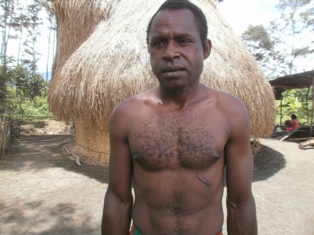 The Asian Human Rights Commission (AHRC) has learnt that on 2 November 2011, seven commanding officers of the Kurulu military sub-district command (danramil Kurulu), arrested and ill-treated three local activists and nine Umpagalo villagers in Kurulu, Papua. This incident occurred without any command letter of authorization, following allegations of rebel activities. The AHRC noted that in Papua, people are frequently victimised based on arbitrary allegations of rebellion, and subsequently tortured. (photo: Kurulu victim)
CASE NARRATIVE:
A Kurulu villager named Alex, who reportedly drank and gambled with members of the pro-Jakarta militia 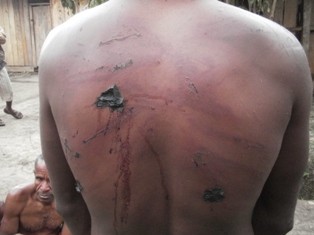 Barisan Merah Putih, provoked Indonesian national military (TNI) officers by claiming there was a meeting between the Free Papua Movement (OPM) and the villagers at Umpagalo on the night of 2 November 2011, at Umpagalo village, Kurulu sub-district, Jayawijaya, Papua without specific evidence. Responding to this vague information, seven armed officers of the Kurulu military sub-district command (danramil Kurulu) prepared to handle the situation without any command letter of authorization (surat izin komando).
After the armed officers came to Umpagalo at around 11pm, they beat three local activists, Melianus Wantik, Edo Doga and Markus Walilo, as well as nine villagers, Pilipus Wantik, Wilem Kosy, Elius Dabi, Lamber Dabi, Othi Logo, Nilik Hiluka, Hukum Logo, Martinus Mabel and Saulus Logo, then stabbed them with bayonets for two hours, forced them to crawl and doused them with water for one hour. The officers also humiliated, beat with big wood sticks, kicked and stepped on them with their boots, pointed their guns and threatened that they would cut their heads, and shot at them four times. After that, the officers 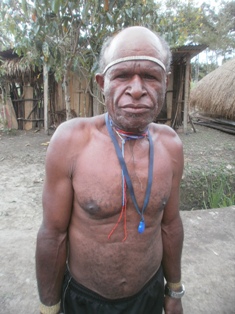 brought all the victims to the 176/ Kurulu military headquarters of Wim Anesili Wamena battalion branch (Pos TNI Batalyon 756 kurulu cabang Batalion Wim Anesili Wamena) and allegedly examined them for two hours. The victims were then released without clear reason. Too scared to go to the hospital located around 50 meters from the military post for medical treatment, they made do with traditional remedies. (photo: wounds of beatings and stabbing)
The victims’ colleagues complained to the Kurulu sector police following the incident, but the police refused to process the complaint since there is no substantial evidence to prove the allegations and the military officers are beyond their jurisdiction based on law no. 31 of 1997 regarding military court.
Meanwhile, the head of the military district command (Korem) 172/PWY Ibnu Tri Widodo acknowledged the violence. He stated that the seven soldiers who mistreated the civilians were now held in custody of the Wamena Military Police. They would be brought to the military court. Following the mistreatment, all soldiers on duty in the Kurulu sub-district had been transferred. He further promised that the military would no longer act “arrogantly” towards civilians. However, in many cases of military trials, which are not open to the public, the sentences are merely a light punishment, such as a transfer, which is inadequate given the seriousness of the human rights violations committed. Therefore, the TNI 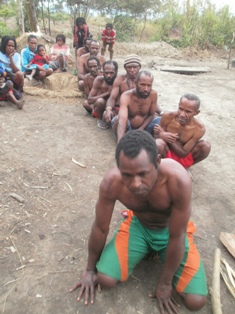 jointly with the National Human Rights Commission (Komnas HAM) should send an independent investigation team to transparently resolve this case, as well as ensuring the adequate punishment of those responsible. The military court law should be reviewed to ensure that members of the military are brought exclusively before a competent, objective and impartial civilian court that is compliant with the internationally-accepted standards of fair trial, including public access to the process, in cases of human rights abuses by members of the military against civilians. (photo: Kurulu victim)
ADDITIONAL INFORMATION:
Torture is used in a widespread way by the police and military against indigenous Papuans, notably on persons suspected of supporting independence movements. Such suspicions are often leveled arbitrarily against members of the indigenous community and result in stigmatisation. This case is a clear example of this pattern.
Furthermore, according to the law on military courts, members of the military that commit crimes against civilians, such as extrajudicial killings or torture, can only be held accountable by military justice systems. Military courts are not open to the public, are notorious for only giving lenient punishments, and show a clear lack of impartiality.
SUGGESTED ACTION:
Please write letters to the authorities listed below asking them to intervene in the case immediately to ensure that all legal process is conducted in accordance with national and international norms.
Please be informed that the AHRC is also sending letters to the Special Rapporteur on the rights of indigenous people, and the Special Rapporteur on torture and other cruel, inhuman or degrading treatment or punishment, calling for their intervention into this matter.
To support this case, please click here: SEND APPEAL LETTER
SAMPLE LETTER
Dear ___________,
INDONESIA: Military officers arbitrarily arrest and torture civilians based on false claims of rebel activity
Name of victims: Melianus Wantik, Edo Doga, Markus Walilo, Pilipus Wantik, Wilem Kosy, Elius Dabi, Lamber Dabi, Othi Logo, Nilik Hiluka, Hukum Logo, Martinus Mabel, and Saulus Logo
Names of alleged perpetrators: Seven commanding officers of the Kurulu military sub-district command (danramil Kurulu)
Date of incident: 2 November 2011
Place of incident: Umpagalo village, Kurulu sub-district, Jayawijaya, Papua
I am writing to voice my deep concern regarding the arbitrary arrest and torture conducted by seven officers of the Kurulu military sub-district command (danramil Kurulu) against 12 civilians at Umpagalo village, between 11pm to 3am.
I have learnt that a Kurulu villager named Alex, who reportedly drank and gambled with members of the pro-Jakarta militia Barisan Merah Putih, provoked Indonesian national military (TNI) officers by claiming there was a meeting between the Free Papua Movement (OPM) and the villagers at Umpagalo on the night of 2 November 2011, at Umpagalo village, Kurulu sub-district, Jayawijaya, Papua without specific evidence. Responding to this vague information, seven armed officers of the Kurulu military sub-district command (danramil Kurulu) prepared to handle the situation without any command letter of authorization (surat izin komando).
I wish to point out that after the armed officers came to Umpagalo at around 11pm, they beat three local activists, Melianus Wantik, Edo Doga and Markus Walilo, as well as nine villagers, Pilipus Wantik, Wilem Kosy, Elius Dabi, Lamber Dabi, Othi Logo, Nilik Hiluka, Hukum Logo, Martinus Mabel and Saulus Logo, then stabbed them with bayonets for two hours, forced them to crawl and doused them with water for one hour. The officers also humiliated, beat with big wood sticks, kicked and stepped on them with their boots, pointed their guns and threatened that they would cut their heads, and shot at them four times. After that, the officers brought all the victims to the 176/ Kurulu military headquarters of Wim Anesili Wamena battalion branch (Pos TNI Batalyon 756 kurulu cabang Batalion Wim Anesili Wamena) and examined them for two hours. The victims were then released without clear reason. Too scared to go to the hospital located around 50 meters from the military post for medical treatment, they made do with traditional remedies.
The victims’ colleagues complained to the Kurulu sector police following the incident, but the police refused to process the complaint since there is no substantial evidence to prove the allegations and the military officers are beyond their jurisdiction based on law no. 31 of 1997 regarding military court.
I also learnt that the head of the military district command (Korem) 172/PWY Ibnu Tri Widodo acknowledged the violence. He stated that the seven soldiers who mistreated the civilians were now held in custody of the Wamena Military Police. They would be brought to the military court. Following the mistreatment, all soldiers on duty in the Kurulu sub-district had been transferred. He further promised that the military would no longer act “arrogantly” towards civilians. However, in many cases, I have noted that military trials, which are not open to the public, only sentence the perpetrators to a light punishment, such as transfer, which is inadequate given the seriousness of the human rights violations committed.
Therefore, I urge TNI jointly with Komnas HAM to send an independent investigation team to transparently resolve this case, including ensuring the adequate punishment of those responsible. The military court law should be reviewed to ensure that members of the military are brought exclusively before a competent, objective and impartial civilian court that is compliant with the internationally-accepted standards of fair trial, including public access to the process, in cases of human rights abuses by members of the military against civilians.
Yours sincerely,
—————-
PLEASE SEND YOUR LETTERS TO:
1. Mr. Susilo Bambang Yudhoyono
The President of Indonesia
Jl. Veteran No. 16
Jakarta Pusat
INDONESIA
Phone : +62 21 3863777, 3503088.
Fax : +62 21 3442223
2. Adm. Agus Suhartono
Headquarter
Tentara Nasional Indonesia (TNI)
Jakarta
INDONESIA
Phone : +62 21 8459-1244, 8459-1243
Fax : +62 21 845-6805
3. Mr. Kemal Azis Stamboel
The Chairman of the First Commission of House of Representative of Indonesia
Gedung DPR RI Nusantara II, Lantai 1
Jl. Jenderal Gatot Subroto
Jakarta 10270
INDONESIA
Phone : +62 21 5715518
Fax : +62 21 5715523
4. Ms. Harkristuti Harkrisnowo
General Director of Human Rights
Department of Law and Human Rights Republic of Indonesia
Jl. HR Rasuna Said Kav.6-7 Kuningan, Jakarta 12940
INDONESIA
Phone : +62 21 525 3006, 525 3889, 526 4280
Fax : +62 21 525 3095
5. Head of National Commission on Human Rights of indonesia
Jalan Latuharhary No.4-B,
Jakarta 10310
INDONESIA
Phone : +62 21 392 5227-30
Fax : +62 21 392 5227
E-mail : info@komnas.go.id
6. Mr. Erfi Triassunu
Commander of Regional Military Command XVII Cendrawasih
(Kemiliteran Daerah Papua / Kodam Papua)
Jl. Polimak atas Jayapura Provinsi Papua
INDONESIA
Fax: +62 967 533763
Thank you.
Urgent Appeals Programme
Asian Human Rights Commission (ua@ahrc.asia)
