
Dear friends,
The Manokwari district court in West Papua has sentenced two peaceful activists to seven and a half months and two years imprisonment respectively. The trial was characterised by a series of violations of the Indonesian criminal procedure and appeared to be politicised and biased. The victims had participated in a peaceful protest in December 2010. The Manokwari Court ignored several basic rights of the accused and the verdict was given despite the lack of sufficient evidence. Five more victims are still undergoing their trial process.
UPDATED INFORMATION:
 On 14 December 2010, seven persons were charged with rebellion after
  they conducted a peaceful protest following a flag raising event. At the correctional facility, they were ill-treated and denied medical care for weeks resulting in serious health conditions. The AHRC issued this urgent appeal regarding their case.
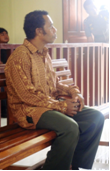
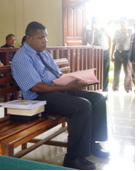
The AHRC has now received information from LP3BH, a local legal aid group in Manokwari that the judges panel led by Cita Savitri, issued the verdict that two of the peaceful protesters, Melki Bleskadit (also known as Melkianus Bleskadit) and Daniel Yenu, were guilty of acts of rebellion, while the other accused are still undergoing the trial process. (photos:Daniel Yenu (left) and Melki Bleskadit (right) in court, source:LP3BH)
On 18 August 2011, the verdict against Mr. Bleskadit was declared and he was sentenced to two years imprisonment. The AHRC also learned that the verdicts were declared based on flawed testimonies. At the trial of both victims, no witnesses to the alleged crime were presented and the judges declared a testimony from a person who had not seen, heard or experienced the incident as sufficient evidence for a criminal conviction.  According to article 1.26 and 1.27 of the Indonesian criminal procedure law (Law 8/1981) such a person is not permitted to be a witness in a trial. Responding to the two year sentence, the public prosecutor, Mudeng Sumaila submitted an appeal, demanding a higher sentence of five years. (photo: public prosecutor at Yenu’s trial source:LP3BH)
On 23 August 2011, Mr. Yenu was convicted to seven months and 16 days imprisonment. At Mr. Yenu’s trial, the judge also convicted the suspect in a trial based on flawed procedure. For example, according to the victim’s lawyer the prosecutor successfully present fabricated evidence such as a megaphone that was not actually used by Mr. Yenu. On 16 August 2011, the judge forced Mr. Yenu to appear before the court trial session without access to his lawyer.
On 19 August 2011, the judges refused the request of Mr. Yenu’s legal counsel to submit the plea to the court, although the Indonesia’s criminal code in article 182.1b entitles the suspect to submit such a plea.
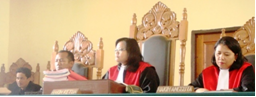 The AHRC is very concerned that local authorities in West Papua frequently apply rebellion charges to peaceful Papuan activists and sentence them in flawed processes that lack proper evidence. The Police, prosecution and judges have thus shown serious disregard for the basic criminal procedure standards and fundamental principles of rule of law. The verdict in this case appears to be quite blatantly fabricated. The AHRC deplores the dysfunction and apparent politicisation of courts in West Papua as this leaves people without access to the law-based and impartial justice mechanisms, they are entitled to. (photo: judges at Yenu’s trial, source:LP3BH)
SUGGESTED ACTION:
Please join us in writing to the authorities listed below, asking them to thoroughly review and examine the trial process against Mr. Bleskadit and. Mr. Yenu and to review the criminal code application against the peaceful expression of opinion.
Please be informed that the AHRC is sending letters on this case to the and protection of the right to freedom of opinion and expression, the Special Rapporteur on the rights of indigenous peoples, and the Special Rapporteur on the independence of judges and lawyers calling for their interventions.
To support this case, please click here: SEND APPEAL LETTER
SAMPLE LETTER
Dear ___________,
INDONESIA: Manokwari court sentences two Papuan activists in flawed trial
Name of victim: Melki Bleskadit, Daniel Yenu
Names of alleged perpetrators: The examining judges, Cita Savitri, I Gusti Ngurah Taruna W and Helmin Somalay
Date of incident: August 2011
Place of incident: Manokwari District Court
I am writing to voice my deep concern regarding the verdict against two Papuan activists, who were sentenced to imprisonment for conducting a peaceful protest in December 2010.
I know that on 14 December 2010, seven persons were charged with rebellion after they conducted a peaceful protest following a flag raising event. At the correctional facility, they were ill-treated and denied medical care for weeks resulting in serious health conditions.
I have receive information that the judges panel led by Cita Savitri, declared the verdict that two of the peaceful protesters, Melki Bleskadit and Daniel Yenu, were guilty for acts of rebellion, while the other five victims are still undergoing their trial process.
On 18 August 2011, the verdict against Mr. Bleskadit was declared and he was sentenced to two years imprisonment. The AHRC also learned that the verdicts were declared based on flawed testimonies. At the trial of both victims, no witnesses of the alleged crime were presented and the judges declared a testimony from a person who had not seen, heard or experienced the incident as sufficient evidence for a criminal conviction. According to article 1.26 and 1.27 of the Indonesian criminal procedure law (Law 8/1981) such a person is not permitted as a witness in trials. Responding to the two year sentence, the public prosecutor, Mudeng Sumaila submitted an appeal, demanding a higher sentence of five years.
On 23 August 2011, Mr. Yenu was convicted to seven months and 16 days imprisonment. At Mr. Yenu’s trial, the judge also convicted the suspect in a trial based on flawed procedure. For example, according to the victim’s lawyer the prosecutor successfully present fabricated evidence such as a megaphone that was not actually used by Mr. Yenu. On 16 August 2011, the judge forced Mr. Yenu to appear before the court trial session without access to his lawyer.
I learned that on 19 August 2011, the judges refused the request of Mr. Yenu’s legal counsel to submit the plea to the court, although the Indonesia’s criminal code in article 182.1b entitles the suspect to submit a plea to the court.
I am very disturbed to hear that local authorities in West Papua frequently apply rebellion charges to peaceful Papuan activists and sentence them in flawed processes that lack proper evidence. The police, prosecution and judges have thus shown serious disregard for the basic criminal procedure standards and fundamental principles of rule of law in this case. The verdict appears to be fabricated and I am very concerned about the impartiality of the local courts and their disregard for Indonesian criminal procedure.
Therefore, I urge you to review and examine the trial process of both victims. The authorities concerned should look into the victim’s allegations of procedural failures in the local institutions and the ongoing lack of intervention – as far as I am aware – following the victims earlier complaints. The principle of fair trial as required by international and national law must be applied in the appeal’s process in the case of Mr. Bleskadit, Mr. Yenu and the ongoing trials of the other five accused.
Yours sincerely,
—————-
PLEASE SEND YOUR LETTERS TO:
1. Mr. Susilo Bambang Yudhoyono
The President of Indonesia
Jl. Veteran No. 16
Jakarta Pusat
Indonesia
Phone : +62 21 3863777, 3503088.
Fax : +62 21 3442223
2. Head of National Commission on Human Rights of Indonesia
Jalan Latuharhary No.4-B,
Jakarta 10310
Indonesia
Phone: +62 21 392 5227-30
Fax: +62 21 392 5227
Email : info@komnas.go.id
3. Office of The Anti Judicial Mafia Task Force (Satgas)
PO Box 9949
Jakarta 10 000
INDONESIA
Contact on website: http://www.satgas-pmh.go.id/?q=node/157
4. Chief Justice of the Republic of Indonesia
Mahkamah Agung
Jalan Medan Merdeka Utara No.9-13, Jakarta 10110
INDONESIA
Phone: +62 21 3843557 -3453348
Fax: +62 21 383541
5. Chairman of Judicial Commission
Komisi Yudisial Republik Indonesia
Jl. Kramat Raya No. 57, Jakarta Pusat
INDONESIA
Phone: +62 21 3905455;
Fax: +62 21 3905455;
Email: kyri@komisiyudisial.go.id
6. Head of Manokwari District Court
Jl. Merdeka No. 69
Nabire, Jayapura 98815
INDONESIA
Phone: +62 984 21007
Fax: +62 984 24087
7. Head of Jayapura High Court
Jl. Tanjung Ria No. 98. Base “G”
Jayapura 99117
INDONESIA
Phone: +62 967 541045, 541443, 541248
Fax: +62 967 541045
Yours sincerely,
Thank you.
Urgent Appeals Programme
Asian Human Rights Commission (ua@ahrc.asia)
