
Dear Friends,
The Asian Human Rights Commission (AHRC) has received updated information regarding the disappearance of a man who had gone missing after a Rapid Action Battalion (RAB) team illegally arrested and detained him along with several others in February 2010 (Please see our previous appeal for details: AHRC-UAC-043-2010). We have learned that the government has failed to produce him despite a High Court Bench order to produce him within three weeks following a Habeas Corpus hearing.
Please strongly urge the government to provide information on the whereabouts of Mr. Salim to his family immediately in compliance to the High Courts order.
UPDATED INFORMATION: (According to information received from lawyers and relatives of the disappeared victim)
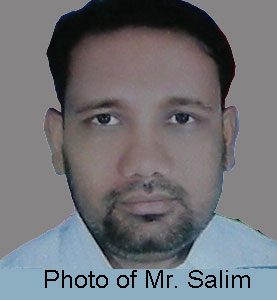 A writ of Habeas Corpus (Petition No. 2851 of 2010) was filed by Mrs. Nazma Begum, the wife of the disappeared person, Mr. Salim, with the High Court Division of the Supreme Court of Bangladesh regarding the disappearance of her husband.
The Habeas Corpus Petition claims that Mr. Salim Miah disappeared after the Rapid Action Battalion (RAB) arrested him on 19 February 2010 from the Kapasia area under the jurisdiction of Kapasia police station of Gagipur district. The petitioner has asked the court that: “A direction upon the respondents to bring the detenu before the Honble High Court Division so that the Honble Court can be satisfied that the detenu is not being held in custody without lawful authority or in an unlawful manner”.
The respondents of the petition were the Secretary of the Ministry of Home Affairs, Inspector General of Police, Director General of Rapid Action Battalion (RAB), Commander of the RAB-4, Deputy Commissioner of Gazipur district, Superintendent of Police of Gazipur district and the Officer-in-Charge (OC) of Kapasia police station of Gazipur district. The petition was supplemented by another petition supported by an affidavit from Mr. Mohammad Ali Hossain, who was also arrested from the same place along with the Mr. Salim.
The two lawyers, representing the petitioner, have informed the Asian Human Rights Commission (AHRC) regarding the updates of the case. According to them, on 15 April 2010, a Division Bench comprising Justice A H M Shamsuddin Chowdhury and Justice Md. Delwar Hossain heard their petition.
The Attorney General’s office claimed the before the Court that “the Rapid Action Battalion (RAB) did not arrest Salim according to their official records”. The High Court’s Division Bench accepted the Habeas Corpus petition after hearing both parties. The Court issued a rule against the seven respondents. It asked as to why a Rule for Habeas Corpus should not be issued upon the respondents. The Court also had directed the Commander of the RAB-4 to explain within three weeks as to whether they rounded up any person named Salim Miah.
Meanwhile, the lawyers have collected the documents regarding the detention of Mr. Mohammad Ali Hossain, a cousin of the disappeared person; and one of the detainees who were arrested and taken under the RAB-4 custody together with the disappeared victim. (For further information, please see: AHRC-043-2010).
According to the documents, Assistant Sub Inspector (ASI) of the Kafrul police station of the Dhaka Metropolitan Police (DMP) had produced Mr. Mohammad Ali Hossain before the Chief Metropolitan Judicial Magistrate’s Court of Dhaka in a case registered with the Kafrul police on 25 February 2010 along with 28 others. It is learned the police have brought charges of suspicious movement at the area of the Bangladesh Road Transport Authorities (BRTA). The police claim that such movement was a crime under Section 84 of the Dhaka Metropolitan Police (DMP) Ordinance-1976 and arrested the 29 persons under Section 100 of the same law. The police requested the Court to conduct a non-FIR (First Information Report) prosecution of the case. The Court released the detained persons, including Mohammad Ali Hossain, upon receiving a penalty of BDT 100.00 (USD 1.30), which is the punishment under Section 84 of the DMP Ordinance-1976.
On 17 May, the lawyers of the Habeas Corpus petition told the AHRC that none of the seven respondents have responded to the Rule of the High Court Division Bench since the Rule was issued on 15 April asking them to respond within three weeks.
SUGGESTED ACTION:
Please write to the authorities below asking that they immediately intervene to ensure that the case is investigated by competent judicial officials, and that Mr. Salim is located and released. Those found to have been involved in the illegal arrest, arbitrary detention and disappearances in this case must be prosecuted without delay. The detainees and their families must be afforded adequate compensation.
Please note that the Asian Human Rights Commission has already written separate letters to the UN Working Groups on Involuntary and Enforced Disappearance and on Arbitrary Detention requesting their interventions in this case.
To support this case, please click here: SEND APPEAL LETTER
SAMPLE LETTER
Dear _______,
BANGLADESH: Government and police officials did not complaint to the High Court order requiring them to explain the disappearance of a man rule in a Habeas Corpus petition
Name of the disappeared victim:
Mr. Salim Miah, aged 35 years, a businessman of fruits and fish, son of Mr. Abdur Rashid, living in Vaoal Chandpur village under the jurisdiction of the Kapasia police station of the Gazipur district
Name of detained victims:
1. Mr. Mohammad Ali Hossain, a farmer and fish businessman, living in Pirojpur village under the Kapasia police station in Gazipur district.
2. Mr. Mohon, 28, son of Ismail Sirker of Mirpur
3. Mr. Abdul Hasanat, 28, son of Shibah Uddin of Vaoal Chandpur village under the Kapasia police station of the Gazipur district
4. Mr. Mainul Islam
5. Mr. Mamun
Name of officers allegedly involved in the case:
1. Mr. Md. Mozaffar Hossain, Deputy Assistant Director (DAD)
2. Mr. Md. Jahangir Alam, Sub Inspector of Police
3. Mr. Quashem, Havildar
4. Mr. Taleb, Lance Nayek
5. Mr. Abul Bashar, Nayek
6. Mr. Mamun, Constable
All are attached to the Rapid Action Battalion (RAB)-4 stationed at Paikpara in Mirpur of the city of Dhaka
Place of original incident: The custody of the RAB-4 in Dhaka
Date of original incident: 19 February 2010
I am writing to express my deep concern over the non-compliance of the government and police officials to explain the disappearance of Mr. Salim, who disappeared after he was illegally arrested by a team of the Rapid Action Battalion (RAB) on 19 February 2010 and arbitrary detained in the RAB-4 camp.
On 15 April, the High Court Bench had already required the respondents to explain the disappearance of the victim. The victim’s wife had earlier sought a petition for the victim to be physically presented the Court. The disappeared man has not yet been brought before the Court even after three weeks have already passed. I strongly demand that the government and police officials must comply with the court order to explain the victims disappearance.
Also Mr. Salims family should also be immediately informed about his whereabouts and that physically he should be produced before the High Court Bench of the Supreme Court. The officers of the RAB-4, who were accused of having responsibility in illegally arresting, detaining and the subsequent disappearance of Mr. Salim, must be brought to justice without further delay.
I am informed that on 15 April 2010 a Division Bench of the High Court Division of the Supreme Court of Bangladesh heard a Habeas Corpus petition (No. 2851 of 2010), filed by Mrs. Nazma Begum, wife of Mr. Salim, who has been disappeared. The Court issued Rule upon the respondents – Secretary of the Ministry of Home Affairs, Inspector General of Police, Director General of Rapid Action Battalion (RAB), Commander of the RAB-4, Deputy Commissioner of Gazipur district, Superintendent of Police of Gazipur district and the Officer-in-Charge (OC) of Kapasia police station of Gazipur district asking as to why the respondents should not be ordered to produce the disappeared person before the Court within three weeks.
I am concerned over the indifference of the public officials and the law-enforcement agencies and the paramilitary forces that have not responded to High Court’s Rule even after one month since the Rule was issued. I question as to whether the government and its law-enforcement agencies pay due respect to the judicial orders for the sake of upholding the rule of law in the country or not?
Bangladesh, as a party to the International Covenant on Civil and Political Rights (ICCPR), has complete obligation under Article 2 of this international human rights law to protect the basic human rights of its citizens. Moreover, the Constitution of Bangladesh obliges the authorities to ensure the right to life, liberty and security as fundamental rights, according to Articles 32 and 33.
I urge the Bangladeshi authorities to investigate into the matters of the disappearance of Mr. Salim and the subsequent indifference shown by the public officials as well as the law-enforcement agencies and paramilitary forces. The officials responsible for the disappearance of Mr. Salim and disregarding the High Court’s Ruling should be held accountable and brought to justice with due punishment for their crimes. I also urge you to inform the whereabouts of the disappeared person to his family immediately.
I am of the opinion that Bangladesh’s law-enforcement and the criminal justice systems are highly dysfunctional and require thorough reforms for the sake of establishing justice in the society. I urge the government to initiate reforms in the criminal justice systems immediately.
I trust that you will take prompt action in this regard.
Yours sincerely,
—————
PLEASE SEND YOUR LETTERS TO:
1. Mrs. Sheikh Hasina
Prime Minister
Government of the People’s Republic of Bangladesh
Office of the Prime Minister
Tejgaon, Dhaka
BANGLADESH
Fax: +880 2 811 3244 / 3243 / 1015 / 1490
Tel: +880 2 882 816 079 / 988 8677
E-mail: pm@pmo.gov.bd or ps1topm@pmo.gov.bd or psecy@pmo.gov.bd
2. Mr. Mohammad Rezaul Karim
Chief Justice
Supreme Court of Bangladesh
Supreme Court Building
Ramna, Dhaka-1000
BANGLADESH
Fax: +880 2 956 5058 /+880 2 7161344
Tel: +880 2 956 2792
E-mail: chief@bdcom.com or supremec@bdcom.com
3. Barrister Shafique Ahmed
Minister
Ministry of Law, Justice & Parliamentary Affairs
Bangladesh Secretariat
Dhaka-1000
BANGLADESH
Tel: +880 2 7160627 (O)
Fax: +880 2 7168557 (O)
Email: info@minlaw.gov.bd
4. Ms. Sahara Khatun MP
Minister
Ministry of Home Affairs
Bangladesh Secretariat
Dhaka-1000
BANGLADESH
Tel: +880 2 7169069 (O)
Fax: +880 2 7160405, 880 2 7164788 (O)
E-mail: minister@mha.gov.bd
5. Mr. Mahbubey Alam
Attorney General of Bangladesh
Office of the Attorney General
Supreme Court Annex Building
Ramna, Dhaka-1000
BANGLADESH
Fax: +880 2 956 1568
Tel: +880 2 956 2868
6. Justice Amirul Kabir Chowdhury
Chairman
National Human Rights Commission
6/3 Lalmatia, Block-D
Dhaka-1207
BANGLADESH
Tel: +880 2 9137740
Fax: +880 2 9137743
E-mail: nhrc.bd@gmail.com
7. Mr. Nur Mohammad
Inspector General of Police (IGP)
Bangladesh Police
Police Headquarters’
Fulbaria, Dhaka-1000
BANGLADESH
Fax: +880 2 956 3362 / 956 3363
Tel: +880 2 956 2054 / 717 6451 / 717 6677
E-mail: ig@police.gov.bd
8. Hassan Mahmood Kahndker
Director General
Rapid Action Battalion
RAB Headquarter
Uttara, Dhaka
BANGLADESH
Tel: + 880 2 8919078/ 880 2 8961101
Mobile: +8801199886600 / 8801713014050/ 8801713374469
Fax: + 880 2 896 2884
Email: dg_rab@rab.gov.bd
Thank you.
Urgent Appeal Programme
Asian Human Rights Commission (ua@ahrc.asia)
