
Dear friends,
The Asian Human Rights Commission (AHRC) has been informed by a local human rights organisation Nervazhy based in Thrissur, Kerala state concerning the case of Mr. Hithin who was abused and tortured by the state police officers. It is reported that Hithin, a Dalit, was taken into custody by the police officers and tortured at the police station in which he suffered serious injuries. It is also reported that Hithin was taken into custody upon a mistaken identity and when the police officers realised their mistake, Hithin was released from custody after being charged with a fabricated charge.
CASE DETAILS:
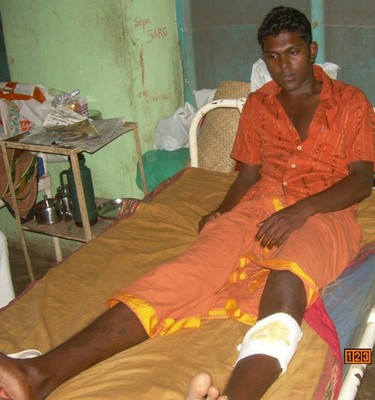 On 14 October 2008, police officers from Varapuzha Police Station took Hithin into custody from a bus stop near Hithin’s house. It is reported that Sub Inspector Mr. Balachandran along with two other police constables from Varapuzha Police Station approached Hithin while he has waiting in a bus stop and asked him to get into the police vehicle in which the officers came. Hithin was waiting at the Thirumuppam bus stop when he was taken into custody.
Nervazhy has recorded a statement from Hithin which is reproduced here:
My name is Hithin. I am a Dalit from the Pulaya community. I work as a cleaner helping the driver of a bulldozer. My parents are poor and earn their livelihood from daily manual labour. On 14 October 2008 while I was waiting at bus stop in Thirumuppam to catch a bus to Ernakulam, a police vehicle came and stopped in front of the bus stop. Sub Inspector Mr. Balachandran and two other police constables stepped out from the vehicle. The Sub Inspector asked me get into the police vehicle.
I asked the officer why should I get into the vehicle for which the officer shouted at me to get in and that he will explain the reason later. I got into the backside of the police vehicle. They took me to Varapuzha Police Station.
At about 1 pm we reached the police station. At the police station, the officers took me to a room. The room had an iron chair, a few police batons and handcuffs. The officers asked me to remain in the room. Within 15 minutes the Sub Inspector came into the room. He then asked “
where did you drive the Scorpio yesterday?” [Scorpio is a four-wheeler]. I replied that I do not know how to drive a vehicle and that such a thing had not happened. Hearing this, the officer punched me on my chest. While punching me the officer shouted at me “you are lying, tayoli mone” [an abusive word in Malayalam & Tamil].
I shivered due to the pain and was thrown to the wall from the force of the punch. The officer then approached me and tore my shirt. He then pulled my pants off. Then he forced my head in between the officer’s legs and started punching me on my spine. I fell down again.
When I was trying to get up the officer kicked me on the left side of my chest and my spine. While he was doing so he asked what was my relationship with Vishnu? Then he punched me again on my chest. The officer shouted at me “
did you think that I will not know you if you drive off when you see me?”. I could not hear anything further as I was feeling so much of pain. The officer continued asking several questions related to the Scorpio and Vishnu, for which whenever I could I kept repeating that I do not know what the officer was asking about, or the Scorpio or the person named Vishnu. By about 3.30pm the officer was exhausted and left the room leaving me on the floor.
As I was struggling to get up once the officer left the room, I saw a person passing by the door, who I knew earlier. I begged him to inform my parents that I am at the police station and did not know why I was brought to the station.
Within an hour my uncle Mr. Pushpakaran came to the station with his friends Mr. Deepu and Mr. Sujith. Soon my father also came to the station with a local politician Mr. Murai. The officer did not allow any of them to talk to me. Later I came to know that when my relatives enquired with the police constables why I was taken into custody, the constables informed them that I was arrested in connection with a theft case. They also informed my relatives that I was being questioned by the Sub Inspector. By this time I was asked to step out from the room where I was assaulted.
At about 5.30 pm the Sub Inspector again approached me and asked me to get into the same room. I was asked to sit on the floor with my legs stretched forward. The officer pulled the iron chair towards me and sat on it. While sitting he started stamping on my shin bones. It pained severely since the officer was wearing a shoe. While doing this the officer repeated the same questions that he was asking me a few hours before. I started crying from pain pleading innocence. Hearing this, the officer said that he know how to make a person confess any crime. Hearing this I cried and said that “
please sir, stop assaulting me, you are asking me about things that I do not know”.
The stopped assaulting me and left the room. Later a police constable came inside the room and asked me to wear my pants and to report at the Sub Inspector’s room. Inside the officer’s room I could see my father, uncle and the local politician.
When I entered the room the officer said to my father “
his friends are not good. He might not be then coming home in time
is it so? Should I straighten him up or will you do that?” Hearing this, my father said “that there is nothing wrong with my son. He is as good as any other person. He is innocent and earns his livelihood from hard labour just like us.” Then my father started crying like a child. At that moment the officer picked up a cane and started caning me in front of all those seated in the room. I started crying out loud. May father also was shocked and cried out loud “please do not abuse and assault my son sir”. My uncle and the politician were also shocked. They pleaded with the officer to stop beating me. The officer stopped beating me.
Then the officer shouted at me “
if I see you anywhere outside or riding a two-wheeler or even squatting in a bus stop, I will charge you with some crime and bring you in.”
Then the officer directed the police constables in the station to register a case against me under Section 290 of the Indian Penal Code, 1860. [Section 290: Whoever commits a public nuisance in any case not otherwise punishable by this Code, shall be punished with fine which may extend to two hundred rupees]. The officer instructed the constables to produce me charged with this offense at the Paravoor Judicial First Class Magistrate Court on 28 October, 2008. The officer also ordered that I must report at the police station every day at 8.30 am.
Hearing this my father pleaded with the officer that I need to go to work every day and that such a condition would not allow me to go to work. After much persuasion, the officer agreed and asked me to report at the police station on every Sunday at 8.30 am. I was also ordered that I must meet the Sub Inspector each time I report at the station.
At about 7 pm I was released on the personal bonds of my father and uncle and allowed to go home. By next day evening my pain increased and I could not take it anymore. By the time my friends and some of my close relatives were aware of what had happened to me. On the same day at about 10.30 pm I was admitted at the Paravoor Government Thaluk Hospital for treatment.
The above incident is a common phenomenon throughout India. It is common practice for the police to take persons into custody on mere suspicion. Investigation of a crime often is torture and the confession extracted by torture. There is no law in India that criminalises torture other than for provisions like Section 330 of the Indian penal Code, 1860 (IPC).
Section 330 mandates “[w]hoever voluntarily causes hurt for the purpose of extorting from the sufferer, or from any person interested in the sufferer, any confession or any information which may lead to the detection of an offence or misconduct
. shall be punished with imprisonment of either description for a term which may extend to seven years and shall also liable to fine.”
This provision of law is a highly diluted expression of criminalisation of torture. Though the concept of torture is far wider than what is mentioned in this section of the IPC, had the justice system in India been geared up to ensure punishment under this section of law, custodial torture in India will be considerably reduced.
There are several impediments that prevent the proper application of this law. Complete lack of an independent investigating and prosecuting agencies, the laxity of Indian authorities, including that of the courts, in dealing with the issue of torture and the general perception of fear against the law enforcing agencies by the average Indians are some of the important reasons why custodial violence goes unpunished in India. Even if a case is registered against the police officer, the chances are that the officer will continue in service.
Lack of disciplinary actions within the police department let police officers charge sheeted with crimes against torture victims in a position to threaten, intimidate and further force the victims to withdraw their complaint. Further the absence of a witness protection law or programme makes it practically impossible for a victim to remain immune to such intimidation and threat from the perpetrators. To make matters further worse the enormous amount of delay, often extending to decades, plaguing the Indian court system renders the entire process a mockery, even if a police officer is charge sheeted, tried and further punished.
The police also employ the tactic of registering fabricated charges, often relating to petty offenses, once they realise that the person have nothing to do with the crime under investigation. This falsification of charges are employed in order to escape the liability of arresting an innocent person and the further possibility of the person complaining about torture, had he been tortured. This pattern has been observed by the AHRC in several past cases the AHRC has reported and Hithin’s case is yet another one in the list.
SUGGESTED ACTION:
Please write to the authorities mentioned below demanding an investigation into the case and further requesting the authorities to keep the accused police officer in suspension pending an enquiry into the case.
The AHRC has written a separate letter to the UN Special Rapporteur on torture and other cruel, inhuman or degrading treatment or punishment calling for intervention in this case.
To support this case, please click here: SEND APPEAL LETTER
SAMPLE LETTER
Dear __________,
INDIA: Custodial torture in Varapuzha Police Station of Kerala must be investigated
Name of victim: Mr. Hithin, aged 20 years, son of Sashi, Mammikandathil House, Alangadu, Varapuzha post, Paravoor, Ernakulam District, Kerala state
Name of alleged perpetrator: Mr. Balachandran, Sub Inspector of Police, Varapuzha Police Station, Varapuzha, Ernakulam District, Kerala state
Date of incident: 14 October 2008
Place of incident: Varapuzha Police Station, Ernakulam district, Kerala state
I am writing to express my concern regarding the case of torture involving the Sub Inspector of Police Mr. Balachandran stationed at Varapuzha Police Station, Ernakulam district, Kerala state. I am informed that Officer Mr. Balachandran, took the victim Mr. Hithin into custody, from a bus stop in a place called Thirumuppam in Ernakulam district on 15 October 2008. The officer along with two constables from Varapuzha Police Station took the victim to Varapuzha Police Station.
I am informed that the victim was tortured at the station, demanding him to confess a crime that he has not committed. The victim has suffered several injuries from the incident, for which he was admitted at the Paravoor Government Thaluk Hospital for treatment on 15 October.
I am informed that the victim has given a statement to Nervazhy, a local human rights organisation about the incident. I am also informed that when the relatives of the victim came to know about the incident they rushed to the police station, where they found the victim in a serious condition, tormented mentally and physically from the torture meted out against him. I am informed that the Sub Inspector of Police Mr. Balachandran even caned the victim in the presence of the victim’s father, uncle and a local politician.
I am further informed that the victim was later released on bail, but after being charged with a fabricated case under Section 290 of the Indian Penal Code, 1860. I am informed that the victim as directed to be present before the Judicial First Class Magistrate Court, Paravoor on 28 October. I am also further informed that the Sub Inspector had directed the victim to report at the police station on every Sunday until further orders.
I am concerned to know about this case and the manner in which the police officer abused, tortured and fabricated a false case against the victim.
I therefore request you to immediately order an impartial investigation in this case, where the Police Sub Inspector Mr. Balachandran is charge sheeted for a crime under Section 330 of the Penal Code, the statements of the victim, his father and uncle and all other witnesses to the case are recorded. I further request you that the officer is kept in temporary suspension pending an enquiry into the case. I also request you that the officer is made liable to pay adequate compensation to the victim for the injuires, mental and physical, he has caused to the victim.
Yours sincerely,
—————-
PLEASE SEND YOUR LETTERS TO:
1. Director General of Police
Government of Kerala
Police Head Quarters
Thiruvanandapuram, Kerala
INDIA
Fax: +91 471 2729434
E-mail: dgn@scrb.org
2. Mr. V. S. Achuthanandan
Chief Minister
Government of Kerala
North Block, Secretariat
Thiruvananthapuram, Kerala
INDIA
Fax: +91 471 2333489
E-mail: chiefminister@kerala.gov.in
3. Mr. Kodiyeri Balakrishnan
Minister of Home Affairs
Government of Kerala
Room No.216, Third Floor
North Sandwich Block
Govt. Secretariat
Thiruvananthapuram 1, Kerala
INDIA
E-mail: minister-home@kerala.gov.in
4. Mr. Oomen Chandy
Opposition Leader
Puthupally House, Jagathy,
Thiruvannathapuram, Kerala
INDIA
Fax: +91 471 2315625
5. District Collector
Collectorate, Kakkanad
Ernakulam – 682 030, Kerala
INDIA
Fax: + 91 484 2422282
E-mail: dcekm@kerala.nic.in
6. Commissioner of Police
Kochi, Ernakulam, Kerala
INDIA
Fax: + 91 484 2394770
Thank you.
Urgent Appeals Programme
Asian Human Rights Commission (ua@ahrchk.org)
