
Dear friends,
The Asian Human Rights Commission (AHRC) has received information that on 1 October 2008 the police allegedly assaulted a man. He tried to prevent a boy at a restaurant from being beaten by the police. As a result he was taken into police custody and again severely beaten by the police.
CASE DETAILS: (Based on the statement from the victim)
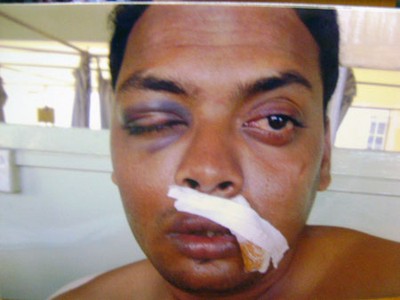 Mr. Erandaka Bulathsinghela attended a celebration for Children’s Day held at S.D.S. Jayasinghe grounds on 1 October 2008. After the celebration, he boarded a bus getting off at Weligampitiya junction where he transferred to another bus to his home in Ganemulla. At the junction, he stopped by a restaurant to buy some food at 2am on October 2.
While he was waiting, he noticed three men in a white car stop near the restaurant. One man got out and asked a boy who was in the restaurant to come out to him. When the boy approached, the man started hitting him without uttering a word.
As the boy was being beaten, Erandaka went to him and told him not to hit the boy. Then, the man asked, “What authority do you have to tell me not to hit the boy? Do you know who I am?” Erandaka replied, “I don’t care who you are but please don’t assault the boy”. Then, the man identified himself as Inspector of Police (IP) Nalin from Kandana Police Station. He asked who Erandaka was. Erandaka said that he was a photo journalist. Then IP Nalin said, “Ohh!, people like you are wanted.” He then released the boy and started assaulting Erandaka. The IP Nalin ordered two other plain clothes policemen to take him to the police station by taxi. Erandaka was brought to the police station and held in a cell.
After some time, IP Nalin came to the police station. He asked an officer for the key to the cell where Erandaka was being detained. When the officer refused to give up the key, the IP scolded him and got the key anyway. The IP opened the cell and started beating Erandaka again. He punched him in the stomach. Erandaka fell to his knees, with the IP striking him about the face for about 30 minutes. Due to this assault, his mouth, eyes and ears sustained multiple injuries and started bleeding. Erandaka was ordered to remove his shirt and mop up his own blood, which he did.
The IP only stopped the physical violence against Erandaka when two other officers, inside the car with him, came and restrained him. Then, he wrote something in a book in the police station. Erandaka was unaware of what he wrote. Erandaka’s mobile phone, watch and sun glasses were confiscated by two other police officers.
Erandaka suffered severe pain. His lips were cracked and one of his eyes was swollen. Due to the unbearable pain, he begged a police officer near his cell to take him to a hospital. But the officer refused saying, “this is an order from higher officers. I can do nothing”.
At 4:30am, a police officer, a friend of Erandaka, working in the same police station came and took him out of the cell. At the same time, the two plain clothes officers changed into uniform and took Erandaka to Ragama Hospital. The police officer, Erandaka’s friend, accompanied them. Erandaka was admitted to the hospital at 5:30am and surgery was performed on his cracked lips. A doctor examined Erandaka post-op and wanted to discharge him. However, a second doctor who further examined him decided to admit him to the 11th ward of the hospital. (Please see his photos 1 and 2) At the hospital, he was able to inform his wife of his situation. He was discharged on October 3 and allowed to go home.
After being discharged, he went to a private medical centre where a doctor diagnosed bulging below his ear and a cracked jaw.
On being informed, Erandaka’s relatives, on October 2, questioned the reason for his arrest and assault to the Officer-in-Charge (OIC) of the Kandana Police Station. The OIC replied that there was no complaint filed against him at the police station, but failed to mention his illegal arrest and assault. Erandaka’s relatives lodged a complaint at the Police Headquarters in Colombo on October 3. Erandaka was informed on October 24 that Headquarters was investigating the complaint. Erandaka continues to suffer pain as a result of the assault.
Erandaka claims that even though he has received an official letter, he has not been informed of any progress made in the investigation.
SUGGESTED ACTION:
Please write letters to the authorities listed below and urge them to ensure a thorough investigation of this case.
Please be informed that the AHRC has also written a separate letter to the UN Special Rapporteur and Human Rights Defenders calling for intervention in this matter.
To support this case, please click here: SEND APPEAL LETTER
SAMPLE LETTER
Dear _________,
SRI LANKA: Police allegedly assault a boy and the man who protests the assault
Name of victim: Mr. Erandaka Bulathsinghela, 29 years old; photo journalist
Name of alleged perpetrators: Inspector of Police Nalin attached to Kandana Police Station, Kelaniya Dist. (North), Kelaniya Division, Western Province (North) Range
Place of incident: a restaurant, Weligampitiya junction, Jaela, Gampaha district, Western province
Date of incident: 2am on 2 October 2008
I am writing to express my deep concern regarding the assault of a boy and a man. The man was arbitrarily arrested and detained on 2 October and severely beaten by police attached to Kandana Police Station.
According to information received, Erandaka was waiting for the food he ordered at a restaurant in Weligampitiya junction, Jaela, Gampaha district. He was on his way home at 2am on October 2 after taking part in a celebration for Children’s Day. Three men in civilian dress came by in a car and one suddenly started assaulting a boy in the restaurant. When Erandaka asked him to stop beating the boy, the man identified himself as Inspector of Police attached to Kandana Police Station. He released the boy but began to severely beat Erandaka.
I have learned that the IP ordered two other officers to take Erandaka to the police station. Here, the IP assaulted him again for about half an hour in his cell. He was hit and kicked in the body and the face which caused eye and ear damage. Not surprisingly, his repeated requests for medical treatment for his injuries were ignored. One officer, known to Erandaka, took him to Ragama Hospital. Surgery was carried out on his cracked lips at 5:30am and he was admitted to the 11th ward for two days.
I am also informed that when Erandaka’s relatives questioned the assault and arrest on October 2, the OIC of the Kandana Police Station avoided replying to the question. He simply said that there was no complaint filed against him but failed to open an investigation. I am aware that Police Headquarters, on October 24, sent a letter to Erandaka, informing him that his case was under investigation.
While welcoming the news that an investigation has been started in this case, I urge you to ensure a thorough and impartial one. Those responsible need to be properly prosecuted and punished according to the law for the assault, arbitrary arrest, detention and failure to provide emergency medical treatment. The negligence of the OIC to investigate, even though Erandaka had been informed, must also be looked into. I also urge you to see that adequate compensation is provided for the violations and injuries that Erandaka suffered at the hands of the police.
This case clearly demonstrates how police misuse their position and abuse the authority given to them under the law. If there are no sanctions for police who misuse power, there will be little room for ordinary people to ask for justice in Sri Lanka and the rule of law will never be normalised.
I trust that you will take proper action in this case.
Yours sincerely,
—-
PLEASE SEND YOUR LETTERS TO:
1. Mr. Jayantha Wickramaratne
Inspector General of Police
New Secretariat
Colombo 1
SRI LANKA
Fax: +94 11 2 440440/327877
E-mail: igp@police.lk
2. Secretary
National Police Commission
3rd Floor, Rotunda Towers, 109 Galle Road
Colombo 03
SRI LANKA
Tel: +94 11 2 395310
Fax: +94 11 2 395867
E-mail: npcgen@sltnet.lk or polcom@sltnet.lk
3. Secretary
Human Rights Commission
No. 36, Kynsey Road
Colombo 8
SRI LANKA
Tel: +94 11 2 694 925 / 673 806
Fax: +94 11 2 694 924 / 696 470
E-mail: sechrc@sltnet.lk
4. Mr. Hemantha Priyasanth Dep
Acting Attorney General
Attorney General’s Department
Colombo 12
SRI LANKA
Fax: +94 11 2 436421
E-mail: ag@attorneygeneral.gov.lk
5. Professor Rajiva Wijesinha
Secretary
Ministry of Disaster Management and Human Rights
2, Wijerama Mawatha
Colombo 7
SRI LANKA
Fax: +94 11 268 1982
Thank you.
Urgent Appeals Programme
Asian Human Rights Commission (ua@ahrchk.org)
