
Dear friends,
The Asian Human Right Commission (AHRC) has been informed that the Indonesian police shot at, arrested and intimidated peasants who were protesting against the alleged illegal occupation of their land by a government-owned plantation company. The land workers have been protesting regularly for years, but rather than address their concerns, the local authorities have cracked down aggressively on their protests. Dozens of peasants been injured by police violence during the last year with at least 11 shot; 13 face criminal trials for their protest actions.
CASE DETAILS:
According to information we have received from the South Sulawesi Legal Aid Institute and the South Sulawesi office of WALHI (Wahana Lingkungan Hidup Indonesia or Indonesian Environment Forum), a demonstration was held on 15 July 2009 by land workers, near a plantation belonging to PT Perkebunan Nusantara (PTPN) section XIV. The clashes between the workers (all from Takalar, North Polongbangkeng) and PTPN employees grew violent, and the Takalar Resort Police filed investigation reports (BAP) against nine peasants. One was arrested and two more were taken into police custody, though no reports were filed against the PTPN employees. During the following days police reportedly conducted aggressive sweeping operations in the local villages and arrested several more land workers for their role in the protests, while intimidating others.
We are told that various such clashes have happened over the last year (as pictured below) with at least 11 persons wounded in police shootings (inlcuding Nasming Nanring, right), and others injured in beatings. In a related incident, a group of ten men were attacked by police on 25 October 2009. They had met with four mobile brigade (Brimob) officers who regularly protect commercial premises at PTPN plantation block K, and were later chased away by an intelligence member of the local military district command (Takalar Kodim). At 6pm as the villagers were returning home they were reportedly chased and shot at by eight Brimob officers, who arrested two of the men: Baddu Dg Sikki from Panaikang village and Basee Dg Gassing from Ma’lolo of Ko’mara village. The officers then continued to follow the other eight civilians for two hours, firing shots and tear gas (photo here) at them until they arrived at their home village.
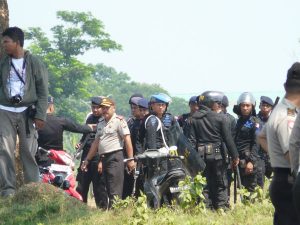 According to our information, 13 of the peasants who took part in the July demonstration have been prosecuted under various charges. However at least two articles, 160 (disobedience against public authorities) and 212 (resistance and rebellion) of the Indonesian Penal Code (KUHP) appear to have been used questionably, in violation of the workers’ rights to free expression and association. The victims are now defendants in criminal trials in Takalar District Court, with eight currently in police custody and five others imprisoned for the duration of the trial.
The National Commission for Human Rights has not responded to the allegations of human rights violations in this case.
BACKGROUND INFORMATION:
According to information presented by local peasants, land that they have owned since 1940 was taken over by the government in 1980 and 1981, without dialogue or enough compensation. More than 2000 peasants from the North Polongbangkeng sub-district lost access to their traditional farming land. PTPN XIV claimed rights to the land between 1994 and 1996 by issuing a certificate that ensured small regular rental payments to the villagers, but this reportedly expired between 2005 and 2006. Since then the villagers’ attempts to access to their land have allegedly been denied, and their protests have become increasingly aggressive. The police and local authorities have offered unstinting support to the plantation company and abused both their power and the constitution of the country, rather than trying to arrange a dialogue between the two parties to legally and democratically address their concerns and interests.
ADDITIONAL COMMENTS:
It is evident that the police in Indonesia continue to use violence to repress protests from civil society, which often arise because a series of rights have been consistently denied. Brimob are notorious for using armed violence against civilians, and the AHRC has documented several other incidents of police brutality this year, among them UAC-155-2009 and AHRC-UAC-135-2009.
The appropriation of civilian-owned farmland for the use for government-owned state plantations, and the use of state security forces to protect them, are also common problems in Indonesia and they warrant top-level attention. Indonesia is a state party to both the International Covenant on Civil and Political Right (ICCPR) and the International Covenant on Economic, Social and Cultural rights, both of which protect citizens’ rights to property, to free expression and association, to a fair trial and to personal security. On a national level the right to protection is cited in the 1945 constitution, and by the recently-enacted regulation of the Chief of Indonesian National Police Number 8 of 2009 which deals with the keeping of human rights standards in the police force.
SUGGESTED ACTION:
Please send your letters to the authorities listed below asking for their intervention, and call on the National Police Commission to investigate the violent conduct of police officers in this incident.
The AHRC has written to the UN Working Group on the arbitrary detention and the Special Rapporteur on the situation of human rights defenders.
To support this case, please click here: SEND APPEAL LETTER
SAMPLE LETTER
Dear _______________,
INDONESIA: Dozens are injured in police attacks during protests against alleged land grabbing
Names of victims of police violence (in 2008 and 2009):
1. Abidin Tika, male, 43 years old; shot in the waist and rib.
2. Tojeng, male, 38 years old; shot in the right arm.
3. Bunga, female, 40 years old, shot in the right calf.
4. Ria, female, 25 years old, shot in the right arm.
5. Jamaluddin Labang, shot in the right calf.
6. Massu, shot in the face.
7. Nasming Nanring, bullet grazing to the head.
8. Nai, shot in the chest.
9. Jumaing Sarro, shot in the thigh.
10. Budianto, victim of violence.
11. Haris Naba, shot in the knee.
12. Jufri Tona, shot in the stomach.
13 other victims are currently charged under the Indonesian penal code (KUHP), articles 170 (2), 351 (1), 55 (1), 160, 212 and under the law of plantation.
Name of Perpetrators:
1. Officers of the Takalar police resort
2. Management of PTPN XIV
3. Members of the Mobile Brigade (Brimob) of the south and west Sulawesi district police.
Dates of the incidents: 10 October 2008, 15 July 2008, 15 July 2009
Place of arrest: Takalar Regency of South Sulawesi province
I am writing to voice my deepest concern regarding a series of police attacks on protesting agricultural workers in the North Polongbangkeng sub-district of Takalar Regency of South Sulawesi Province.
According to information I have received from the South Sulawesi Legal Aid Institute and the South Sulawesi office of WALHI, a demonstration was held on 15 July 2009 by land workers near a plantation belonging to PT Perkebunan Nusantara (PTPN) section XIV. The clashes between the workers and PTPN employees grew violent, and the Takalar Resort Police filed investigation reports (BAP) against nine peasants. One was arrested and two more were taken into police custody, though no reports were filed against the PTPN employees. During the following days police reportedly conducted aggressive sweeping operations in the local villages and arrested several more land workers for their role in the protests, while intimidating others.
I am told that various such clashes have happened over the last year with at least 11 persons wounded in police shootings, and others injured in beatings. In a related incident, a group of ten men were attacked by police on 25 October 2009. They had met with mobile brigade (Brimob) officers at PTPN plantation block K, but as they were returning home they were reportedly chased and shot at by a group of eight Brimob officers, who arrested two of the men: Baddu Dg Sikki and Basee Dg Gassing. I am told that the officers then continued to follow the other eight civilians for two hours, firing shots and tear gas at them until they arrived at their home village.
According to my information 13 of the peasants who took part in the July demonstration have been charged and prosecuted, under various charges, yet I question the use of at least two articles, 160 and 212, of the Indonesian Penal Code (KUHP), since they suggest a violation of the workers’ rights to free expression and association. They are detained at the police resort of Takalar. I am told that the National Commission for Human Rights has not responded to allegations connected to this case.
It is evident that the police in Indonesia continue to use violence to repress protests from civil society, which often arise because a series of rights have been consistently denied. Brimob are notorious for using armed violence against civilians. The appropriation of civilian-owned farmland for the use for government-owned state plantations, and the use of state security forces to protect them, are also common problems in Indonesia, and they warrant top-level attention.
The police and local authorities appear to have offered unstinting support to the plantation company and abused both their power and the constitution of the country, rather than trying to arrange a dialogue between the two parties to legally and democratically address their concerns and interests.
I urge you to ensure that this matter is thoroughly investigated, and that disciplinary and legal action be imposed on the police officers involved, and I call for a proper review of the victims’ convictions. If any irregularities are found in the legality of their charges and conviction, their case must be withdrawn promptly. I also call for the effective implementation of the Regulation of the Chief of Indonesian National Police Number 8 of 2009, which was enacted to deal with the Implementation of Human Rights Principles and Standards in the Discharge of Duties of The Indonesian National Police.
I look forward to your action in this matter.
Yours sincerely,
—————-
PLEASE SEND YOUR LETTERS TO:
AKBP. Andi Asdi
Chief of the Takalar Police Regency
Kepala Kepolisian Resor Takalar (Kapolres Takalar)
JL. H. M. Manjarungi No. 1 Takalar 92212 SulSel
Tel: +62 – 418 – 324101
Fax: +62 – 411 – 21135
Inspector General (Irjen) Pol. Adang Rochjana
Head of the South and West Sulawesi police district
Kepala Kepolisian Daerah Sulawesi Barat dan Selatan (Kapolda SULSEL / BAR)
JL. Perintis Kemerdekaan Km. 16 Makassar SulSel
Telp : +62 – 411 – 515201 , +62 – 411 – 514663
Fax : +62 – 411 – 515136 , +62 – 411 – 515144
Mr. Susilo Bambang Yudhoyono
President of Republic of Indonesia
Presidential Palace,
Jl. Medan Merdeka Utara Jakarta Pusat 10010
INDONESIA
Tel: +62 21 384 5627, ext. 1003
Fax: +62 21 231 4138, 345 2685, 345 7782
Email: mallarangeng@yahoo.com
General Bambang Hendarso Danuri
Chief of Indonesian National Police
Jl. Trunojoyo No. 3
Jakarta Selatan
INDONESIA
Tel: +62 21 721 8012
Fax: +62 21 720 7277
Email: polri@polri.go.id
Mr. Adnan Pandu Praja
Chairman of the national police commission (Kompolnas)
Jl. Tirtayasa VII No. 20 Komplek PTIK Jakarta Selatan
INDONESIA
Tel. +62 21 739 2352
Fax. +62 21 739 2317
Mr. Patrialis Akbar
Minister of Justice and Human Rights
JI. H.R. Rosuna Said Kav. 6-7
Kuningan, Jakarta Selatan
INDONESIA
Fax: +62 21 525 3095
Mr. Beny K Harman
Chairman of Commission one of The House of Representative
(Komisi III DPR RI)
Jl. Gatot Subroto No. 6 Jakarta
INDONESIA
Tel : +62 21 5715569
Fax: +62 21 5715566
Mr. Ifdhal Kasim
Chief of Indonesian Commission on Human Rights (KOMNAS HAM)
Jln. Latuharhary No. 4B, Menteng,
Jakarta Pusat 10310
INDONESIA
Tel: +62 21 3925230 ext. 225/221
Fax: +62 21 3925227
Email: info@komnasham.go.id
————————
Thank you.
Urgent Appeals Programme (ua@ahrc.asia)
Indonesia Desk (indonesia@ahrc.asia)
Asian Human Rights Commission
