
Dear friends,
The Asian Human Rights Commission (AHRC) has learned that Paikgachha police have created a fake case against six men; all of whom were trying to take a case against a local con man. Two were demanding the refund of police bribe money. The events suggest that officers are supporting a man who has allegedly swindled clients through a fake Non Governmental Organisation (NGO). He has yet to be held to account legally and is instead filing cases of his own, which are being quickly dealt with despite their shaky legal grounding. One of the men he swindled has reportedly been tortured in police remand twice, and six have now been charged with abducting the con man’s daughter who we have been told was never abducted.
CASE DETAILS:
A warrant of arrest and a number of cases were registered with various police stations and courts this year against Mr. Afaz Uddin Sardar and some of his associates, after an NGO that he founded (Jayoti Manob Kallyan Shangstha) was exposed as a fake.
According to our reports, a group of former clients who had been swindled managed to track down one of the NGO’s former workers, Afaz’s brother-in-law Mr. Hasanul Islam, on 10 May, and they handed him to the Patkelghata police in a kind of citizen’s arrest.
Sub Inspector Ziaur Rahman Zia reportedly suggested that they sign a deal which would see Hasanul lodged at the house of an elected Member of the Nagarghata Union Council until 15 May, while he repaid the money owed. This agreement of responsibility is known as ‘Jimmanama’ and is outside the legal process, but Zia apparently signed and stamped it as an Affidavit on 13 May (No. 34/09 from a Notary Public in Satkhira district, seen hereand here).
However we are told that on 13 May, Afaz with Hasanul’s mother as complainant declared that Hasanul was abducted from his home by the swindled clients, and he allegedly then bribed officers in Paikgachha to lodge a complaint. Eleven persons (persons 1 to 11 in the letter below) were accused in the First Information Report (FIR No. 19/09), leading Paikgachha police to then raid the Council Member’s home on 17 May, ‘rescue’ Hasanul, and arrest the member’s younger brother Mr. Seyed Ali Sardar, with the knowledge of SI Zia, who made no move to intervene. Sardar complains that he was beaten by police. He has since been bailed out.
Various attempts were then made to arrest the 11 swindled men by Sub Inspector Delwar Hossain of Paikgachha. Police raided all of their houses repeatedly, including that of Mr. Khairul Islam, a physically disabled man (pictured), and Mr. Anarul Islam, neither of whom were home; both their relatives had copies of the original Affadavit, signed by Zia.
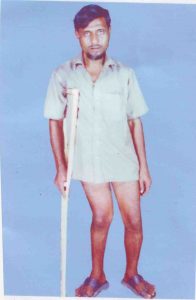 One victim, Mr. Monirul Islam Morol was granted ad interim anticipatory bail by the High Court Division of the Supreme Court of Bangladesh on 3 July, after he sought its intervention in the raids. Police were ordered not to arrest or harass him further. However all eleven also agreed to bribe SI Delwar in return for peace, and his submission of a Final Report that would discharge them from the complaint. Khairul’s relatives allegedly paid 7,000.00 takas and Anarul’s relatives 10,000.00 takas.
But within a few weeks SI Delwar had submitted his investigation report to the Court and brought the fake abduction charge against all of the accused. Khairul’s and Monirul’s relatives demanded a refund, and their houses in particular were targeted in raids, led by Delwar. Monirul was caught, and on 23 July he was illegally arrested and detained for two days without a court warrant, and despite the High Court orders. He reports receiving severe beatings in custody.
On 25 July the police then lodged a reportedly fake case against him and five others (Mr. Khairul Islam, Ms. Rawshanara, Mr. Enayet Gazi, Mr. Kabir Mollik and Mr. Kutub Ali: case no. 28, dated 25 July 2009) for the attempted abduction of the daughter of the former NGO head, Afaz though investigations by human rights defenders have suggested that no such attempt took place. Monirul was in police remand for three more days and claims that he was badly beaten again. His relatives reportedly paid 20,000.00 takas to SI Delwar for police to stop the torture.
On 29 July we are told that Monirul was sent to the Khulna District Jail through the Senior Judicial Magistrate’s Court of Paikgachha, where he remains. The others are currently in hiding.
BACKGROUND INFORMATION:
The NGO in question – Jayoti Manob Kallyan Shangstha was registered with the Department of Social Welfare of Satkhira district few years back. Members paid a subscription hoping to receive loans, and work abroad. However after collecting money for about three years Afaz closed the office and left the Satkhira area. A number of the warrants from the Satkhira district courts went to the Paikgachha police station, but no arrests were made. Local rights organizations report that the accused moved around freely, and that police were bribed not to arrest them. A list of the complaints lodged can be found here.
ADDITIONAL COMMENT:
Corruption and con artistry by disreputable NGOs is common in Bangladesh and it will continue to be so while those who engineer it enjoy such impunity. Some have cheated subscribers by keeping their fees, while siphon money from local groups ethnic minorities, the underprivileged or victims of custodial torture and the foreign funding agencies that support them. This is allowed by corrupt pracices at the NGO Affairs Bureau and the district administrators responsible for authorizing the organisations, dispersing foreign funds and checking audit reports, and among the police. The trade of justice is something on which the AHRC has reported many times in the past, through appeals such as UAC-049-2009 and UAU-067-2008 (cases of torture by police to elicit bribes), or in reports, like Disconnected policing and the justice trade in Bangladesh.
As a result, projects for development or social empowerment in Bangladesh are being stunted and are losing credibility. It is high time for the process for NGO registration and management to be reformed, and more closely monitored by the Anti Corruption Commission, which itself must be given greater authority and independence
SUGGESTED ACTION:
Please write to the officials listed below calling for them to investigate the violations committed by police in Paikgachha and asking that they arrange adequate compensation for the victims.
The AHRC has written a separate letter to the UN Special Rapporteurs on the Question of Torture and on the Independence of Judges and Lawyers urging their intervention into this case.
To support this case, please click here: SEND APPEAL LETTER
SAMPLE LETTER
Dear __________,
BANGLADESH: Police torture a man and file fake charges against him and others in support of an alleged con man
Names of victims:
1. Mr. Monirul Islam Morol, age 35, son of Mr. Md. Lutfur Morol, living in Dhamrail village under the Paikgachha police station in Khulna distirct
Name of the Victim (In Fabricated Case):
1. Mr. Khairul Islam, age 36, son of late Mr. Jasmatullah Fakir, living in Chak Kawali village under the Paikgachha police station in Khulna district
2. Mr. Anarul Sana, age 38, son of late Mr. Jaha Box Sana, living in Kawali village under the Paikgachha police station in Khulna district
3. Mr. Seyed Ali Sardar, age 37, son of Mr. Jasim Sardar, living in Nagarghata village under the Patkelghata police station of Satkhira district
4. Ms. Rawshanara, age 40, elected Member of Nagarghat Union Council in the reserved seats for the female persons, daughter of Mr. Jasim Sardar, living in Nagarghata village under the Patkelghata police station of Satkhira district
5. Mr. Enayet Gazi, age 36, son of Mr. Ibrahim Gazi, living in Patkelghata village under the Patkelghata police station of Satkhira district
6. Mr. Kabir Mollik, age 22, son of Mr. Kawsar Mallik, living in Dhulihar village under the Satkhira Sadar police station in Satkhira district
7. Mr. Shafikul Mallik, age 40, son of Mr. Kawsar Mallik, living in Dhulihar village under the Satkhira Sadar police station in Satkhira district
8. Mr. Nazrul Islam Sana, age 35, son of Mr. Mohiuddin Sana, living in Dhulihar village under the Satkhira Sadar police station in Satkhira district
9. Mr. Razzak Morol, age 39, son of Mr. Asmatullah Morol, living in Alomdanga under the Patkelghata police station of Satkhira district
10. Mr. Ismaile Hossain, age 30, son of Mr. Nur Mohammad, living in Jhikargachha under the Kolaroa police station in Satkhira district
11. Mr. Abdul Hannan Boddi, age 38, son of Mr. Abdul Kader Boddi, living in Komlapur under the Satkhira Sadar police station in Satkhira district
12. Mr. Kutub Ali, age 28, son of Mr. Sayed Ali, living in Hadipur village under the Devhata police station in Satkhira district
Names of alleged perpetrators:
1. Mr. Delware Hossain, Sub Inspector of Police, attached to the Paikgachha police station in Khulna district at the time of the incident
2. Mr. Badrul Alam, Inspector of Police and Officer-in-Charge (OC) of the Paikgachha police station in Khulna district at the time of the incident
3. Ms. Monzila Begum, age 36, wife of Mr. Afaz Uddin, living in Dhamrail under the Paikgachha police station in Khulna district
4. Ms. Fatema Begum, age 55, wife of Mr. Wahed Ali Gayen, living in Moukhali under the Paikgachha police station in Khulna district
5. Sub Inspector Ziaur Rahman Zia, Sub Inspector of Police, attached to the Patkelghata police station in Satkhira district at the time of the incident
Date of incident: 13 May and 23 – 29 July 2009
Place of incident: Home of Monirul Islam Morol and the Paikgachha police station
I am writing to express my serious concern over the alleged torture and corruption taking place in areas under the jurisdiction of the Paikgachha and Patkelghata police. I have learned that, among other crimes, Paikgachha police have created a fake abduction case against six men who were trying to have a powerful local con man arrested. One of the men is now in jail illegally, contravening a high court order, and has been badly beaten.
I am told that earlier this year a warrant of arrest and a number of cases were registered against Mr. Afaz Uddin Sardar and associates, after an NGO that he founded (Jayoti Manob Kallyan Shangstha) was exposed as a fake. His brother-in-law (and former employee) Mr. Hasanul Islam was taken to the Patkelghata police by a group of swindled clients on 10 May.
A Sub Inspector Ziaur Rahman Zia reportedly engineered a deal between the clients and Hasanul, and signed an affidavit (13 May, No. 34/09 from a Notary Public in Satkhira district) that lodged Hasanul at the house of an elected Member of the Nagarghata Union Council while he repaid the money owed.
However I understand that Paikgachha police then raided the Council Member’s home on 17 May to ‘rescue’ Hasanul, and that they arrested and allegedly beat the member’s younger brother Mr. Seyed Ali Sardar, with the knowledge of SI Zia. I am reliably informed that this is due to bribes paid by Afaz, who arranged for a fabricated complaint lodged on 13 May, claiming that Hasanul was abducted.
Since then continuing raids have been made on the houses of the 11 swindled clients ignoring ad interim anticipatory bail given to one, Mr. Monirul Islam Morol, by the High Court Division of the Supreme Court of Bangladesh on 3 July. The raids were led by Sub Inspector Delwar Hossain of the Paikgachha police, who also allegedly demanded and received bribes for protection from the relatives of those men.
On 23 July one of the men, Mr Morol, was illegally arrested and detained for two days without a court warrant, despite the High Court orders, and he reports being severely beaten in custody. On 25 July Paikgachha police lodged a reportedly fake case against him and five others (Mr. Khairul Islam, Ms. Rawshanara, Mr. Enayet Gazi, Mr. Kabir Mollik and Mr. Kutub Ali: case no. 28, 25 July 2009). They were accused with the attempted abduction of Afaz Uddin Sardar’s daughter, which I am reliably informed never took place. These men are now in hiding, while Mr. Morol was beaten again in custody and is now in Khulna District Jail. His relatives reportedly paid 20,000.00 takas to SI Delwar for police to stop the torture.
It appears that con artistry by disreputable NGOs is common in Bangladesh, and it will continue to be so while those who engineer it enjoy such impunity. Corruption is a severe issue in the Bangladeshi police force but it is also entrenched in public entities, from the NGO Affairs Bureau to district administrators. The application process is currently opaque and vulnerable to abuse. It needs to be transparent, logical and rigorously monitored by the Anti Corruption Commission, which itself must be given much greater authority and independence.
The twelve persons above are innocent victims of this systemic corruption and I urge your intervention to ensure their safety. Mr. Monirul Islam Morol must be swiftly released, and he and the other victims provided with redress and compensation. Those alleged to have been involved in Mr. Morol’s torture and illegal arrest, and the intimidation of his companions, must be fully investigated and if found guilty, brought before the law.
I look forward to your action in this case
Sincerely
—————
PLEASE SEND YOUR LETTER TO:
1. Mrs. Sheikh Hasina
Prime Minister
Government of the People’s Republic of Bangladesh
Office of the Prime Minister
Tejgaon, Dhaka
BANGLADESH
Fax: +880 2 811 3244 / 3243 / 1015 / 1490
Tel: +880 2 882 816 079 / 988 8677
E-mail: pm@pmo.gov.bd or ps1topm@pmo.gov.bd or psecy@pmo.gov.bd
2. Mr. M. M. Ruhul Amin
Chief Justice
Supreme Court of Bangladesh
Supreme Court Building
Ramna, Dhaka-1000
BANGLADESH
Fax: +880 2 956 5058
Tel: +880 2 956 2792
3. Barrister Shafique Ahmed
Minister
Ministry of Law, Justice & Parliamentary Affairs
Bangladesh Secretariat
Dhaka-1000
BANGLADESH
Tel: +880 2 7160627
Fax: +880 2 7168557
4. Ms. Sahara Khatun MP
Minister
Ministry of Home Affairs
Bangladesh Secretariat
Dhaka-1000
BANGLADESH
Tel: +880 2 7169069
Fax: +880 2 7160405, 880 2 7164788
5. Mr. Mahbubey Alam
Attorney General of Bangladesh
Office of the Attorney General
Supreme Court Annex Building
Ramna, Dhaka-1000
BANGLADESH
Fax: +880 2 956 1568
Tel: +880 2 956 2868
6. Justice Amirul Kabir Chowdhury
Chairman
National Human Rights Commission
6/3 Lalmatia, Block-D
Dhaka-1207
BANGLADESH
Telefax: +880 2 9137743
7. Mr. Nur Mohammad
Inspector General of Police (IGP)
Bangladesh Police
Police Headquarters’
Fulbaria, Dhaka-1000
BANGLADESH
Fax: +880 2 956 3362 / 956 3363
Tel: +880 2 956 2054 / 717 6451 / 717 6677
E-mail: ig@police.gov.bd
8. Deputy Inspector General of Police (DIG)
Khulna Range
Office of the DIG of Khulna Range
Khulna
BANGLADESH
Fax: +880 41 761300
Tel: +880 41 761823
E-mail: digkhulna@police.gov.bd
Thank you.
Urgent Appeal Programme
Asian Human Rights Commission (ua@ahrc.asia)
