
Dear friends,
The Asian Human Rights Commission (AHRC) wishes to share its concern regarding the killing of two women and a 12-year-old child by army personnel under unclear circumstances in Bardyia National Park in Nepal. Although the army claims that the victims were killed during an encounter, there is evidence to suggest otherwise, leading to strong suspicions of a cover-up operation. The wide reaching impunity of army personnel who commit human rights violations in Nepal remains of grave concern.
CASE DETAILS:
According to the information we have received from the Advocacy Forum, a Nepali NGO, and survivors of the incident, two women, Devisara Sunar, 29, and Amrita Sunar, 28, and a child Chandrakala Sunar, 12, were shot dead by army personnel under unclear circumstances in Bardyia National Park on 10 March.
On March 7, 2010 a group of four manual labourers from Hirapur Village Development Council settled in Baspaani near Bardiya National Park in order to collect tree bark or Kaulo, used for medicinal purposes, to sell it to a contractor. The group consisted of Ratna Bahadur Sunar, Krishna Bahadur Sunar, Bal Dev Giri and Bhaktaraj Giri. On March 10, 2010 a few more members joined them Devisara Sunar, Amrita Sunar, Chandrakala Sunar and Bhmisara Guri. All planned to go back to the village the next day.
However according to the survivors, on the night of March 10 at around 9pm, they woke to find themselves surrounded by seventeen army personnel and four forest guards. The soldiers opened fire.
Four labourers managed to flee the scene but Devisara Sunar, Amrita Sunar and Chandrakala Sunar were allegedly captured by army personnel. Krishna Badhur Sunar, who was able to run and hide, says that he heard his daughter Chandrakala calling out in distress. He returned to try and save his daughter.
According to official army release, the labourers were heavily armed poachers and were first to open fire on army personnel. The army claims that the three victims were killed in the cross-fire.
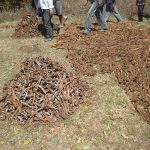 However a fact-finding mission conducted by two national human rights NGOs, the Advocacy Forum (AF) and the Informal Sector Service Center (INSEC), gathered details contradicting the official version of the incident. For example they found that vast amounts of Kaulo had really been collected in that area of the park (see picture), suggesting that it was this, rather than animal hunting, that brought the group to the area.
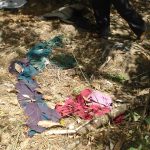
Moreover when the AF visited the site on March 12 no blood stains could be found there. Instead female clothes, without any blood traces, were spread out there (as pictured). Eyewitnesses have reported seeing army personnel carrying the dead bodies of the three persons at around 11pm on March 11, with fresh blood dripping from the bodies into the road. Yet if the army’s declaration was the case, blood would have been found in the place of the encounter and on the victims’ clothes; fresh blood would not have been dripping from the corpses more than 24 hours after the killings.
The evidence indicates a case of extrajudicial execution.
Suspicions have also arisen regarding the clothing, as evidence; since the clothing discarded at the site resembles that belonging to the dead women, yet their bodies were found, according to the autopsy, dressed in trousers. The villagers accuse the army of having raped the women however the medical examination has not reported signs of rape.
Krishna Bahdur Sunar was arrested along with the three women and detained in police custody from March 10 to March 15. He was released on March 15 due to lack of evidence. The police prepared and filed the First Information Report, and claim that they visited the site on March 11 and found gunpowder and guns there. Krishna Bahadur Sunar reported that he was not allowed to clearly see the contents of the FIR when the police made him sign it in detention.
The case must be investigated thoroughly and transparently by the local police, with the investigation monitored by an independent body such as the National Human Rights Commission. The witnesses must be questioned and their statements recorded and they must be provided with protection until the case is prosecuted. Steps must be taken so that this case is not brushed aside with an opaque military inquiry, as has often happened in Nepal. The question of where the case is tried in a military court martial or a civilian court must be decided by the Supreme Court of Nepal rather than army officers or politicians.
BACKGROUND INFORMATION:
The fact-finding report points out various contradictions in the official version from the army, and from past experience the AHRC considers it likely that collusion has taken place between the army and the police in its production. For an example of this, please refer to the case of 15-year-old Maina Sunuwar, who was tortured to death by army officers six years ago. The case has become emblematic of the frenetic attempts of the army to cover up allegations, including the tampering of evidence. As one way of supporting the claim that the victim had been killed while trying to escape, the perpetrators later shot a bullet into the back of the victim’s body (UP-173-2006)
In its December 2008 report on conflict-related disappearances in Bardyia District the OHCHR office in Nepal remarked that the destruction of evidence in enforced disappearances ‘should be treated as a criminal offence amounting to obstructing the course of justice’. It is important that this be applied to other kinds of human rights violations.
The ‘esprit de corps’ or the fraternity of the Nepal Army continues to be an obstacle to its accountability, leading to the highest levels of the hierarchy attempting to cover up allegations of human rights violations committed by its personnel. This was acknowledged in the February 2010 report of the OHCHR on its activities in Nepal which states that ‘Both the Nepalese Army and UCPN-M continue to resist attempts to hold their personnel accountable for human rights violations and abuses and to withhold cooperation from civilian authorities responsible for investigating these cases’. In Maina Sunuwar’s case the army still refuses to hand over one of the perpetrators to the police in spite of an arrest warrant pending against him, (please see UAU-004-2010 for detailed information).
The OHCHR report mentioned above also documents hundreds of cases of enforced disappearances conducted by the army during the conflict. In December 2008, two years after the end of the conflict the army was still denying that those persons had been disappeared and was hiding behind fabricated and sometimes contradictory statements; that they had been released or killed during an encounter or simply denied the arrest in spite of evidences pointing to the opposite.
Collusion between the police and the army further adds to the difficulties faced while trying to hold army personnel accountable for human rights violations. The police often refuses to file cases which involve army personnel: in 2007, the police refused the right to file a FIR for the widow of a man abducted and murdered by the Nepal Army and it took five months after the Supreme Court ordered that the file should be immediately filed before it was effectively registered. (See UAU-055-2008 for more detailed information). The police also showed neglect in the investigation into the rape of a 15-year-old girl by a member of the Nepal Army and a civilian (see UA-250-2007) and the shooting and killing of a 12-year-old by army personnel. (see UA-225-2007). Strong actions must be taken to eradicate this culture of impunity which damages the peace-process in the country.
SUGGESTED ACTION:
Please write to the listed authorities to express your concern about the killings of those three women and to denounce the attempts to cover up this case by the army.
The AHRC is writing separate letters to the OHCHR field office in Nepal and to the United Nations Special Rapporteur on Extrajudicial Executions asking for their immediate intervention.
To support this case, please click here: SEND APPEAL LETTER
SAMPLE LETTER
Dear __________,
NEPAL: The killing of three Dalit women must be investigated
Names of victims:
1.Devisara Sunar, 29 , resident of Hirapur Village District Committee (VDC) ward no.2
2. Amrita Sunar, 28, resident of Hirapur Village District Committee (VDC) ward no.2
3. Chandrakala Sunar, 12, resident of Hirapur Village District Committee (VDC) ward no.2
Names of alleged perpetrators:
1. Captain Subodh Kunwar along with 17 army soldiers and 4 armed forest guards
2. Chief of the battalion Prakash Deuja of Jwala battalion, Thakurdwara, Bardia
Place of Incident: Bardyia National Park
Date of Incident: March 10, 2010
I am writing to express my serious concern regarding the killing of three women, including a 12 year old child by army personnel in Bardyia National Park.
According to the information I have received, the victims were part of a group of seven manual labourers from Hirapur VDC who had come to Bardiya National in order to collect Kaulo, a bark of tree used for medicinal purposes, to sell it to a contractor.
On the night of March 10, at around 9pm, they were reportedly awoken as seventeen army personnel and four forest guards gathered around them. According to survivors the army personnel then opened fire. Four labourers managed to flee the scene but Devisara Sunar, Amrita Sunar and Chandrakala Sunar could not escape and were captured by army personnel. Krishna Badhur Sunar, the father of the youngest victim, was later arrested by the army, though he and was released from police custody on March 15 due to lack of evidence.
I know that the circumstances of the three women’s deaths remain unclear. According to the official army statements the labourers were heavily armed poachers and opened fire first. The army hence claims that the three victims were killed in self-defense in the cross-fire which followed.
Nevertheless I am aware that a fact-finding mission conducted by national human rights NGOs gathered details that contradict and raise questions regarding the official version. It found, for example, that vast amounts of Kaulo had recently been collected in Bardyia National Park which contradicts the assertion that they came to the national park to hunt for animals.
I am surprised to hear that when the AF visited the site on March 12 no blood stains could be found there. Instead female clothes, without any blood traces, were spread out there (as pictured). Eyewitnesses have reported seeing army personnel carrying the dead bodies of the three persons at around 11pm on March 11, with fresh blood dripping from the bodies into the road. Yet if the army’s declaration was the case, blood would have been found in the place of the encounter and on the victims’ clothes; fresh blood would not have been dripping from the corpses more than 24 hours after the killings.
Suspicions have also arisen regarding the clothing, as evidence; since the clothing discarded at the site resembles that belonging to the dead women, yet their bodies were found, according to the autopsy, dressed in trousers. Please note that though villagers accuse the army of having raped the women however the medical examination has not reported signs of rape.
However I seriously question the army’s official position: that the victims were armed poachers, killed during an encounter. I am concerned to hear that the police prepared and filed a First Information Report that appears to abide by the armys official position. They claim that they visited the site of the incident on March 11 and that they found gunpowder and guns there.
One detainee Krishna Bahadur Sunar reported that he was not allowed to see the contents of the FIR clearly when he was asked to sign it in detention.
I know that impunity of army personnel who have allegedly committed human rights violations remains a serious issue in Nepal and that the OHCHR has expressed several times its concerns regarding this problem. I consider that the general attitude of the army which tries to cover up allegations of human rights violations by giving misleading statements or tampering with evidences should be strongly condemned.
I am therefore calling for the immediate launching of an independent investigation to determine the exact circumstances of the deaths of those three women. The post-mortem reports should all be made public; the FIR relating to Krishna Bahadur Sunar must be discarded and those found guilty of murdering those three women should be criminally prosecuted, along with those who have tried to cover up the case. If proven that police officers have collaborated with the army to cover up the case they should face sanctions as well.
The case must be investigated thoroughly and transparently by the local police, with the investigation monitored by an independent body such as the National Human Rights Commission. The witnesses must be questioned and their statements recorded and they must be provided with protection until the case is prosecuted. Steps must be taken so that this case is not brushed aside with an opaque military inquiry, as has often happened in Nepal. The question of where the case is tried in a military court martial or a civilian court must be decided by the Supreme Court of Nepal rather than army officers or politicians.
Yours sincerely,
———————–
PLEASE SEND YOUR LETTERS TO:
1. Mr. Madhav Kumar Nepal
Prime Minister’s office
Singha Durbar
Kathmandu
NEPAL
Fax: + 977 1 42 27286
2. Dr. Bharat Bahadur Karki
Attorney General
Office of Attorney General
Ramshahpath
Kathmandu
NEPAL
Fax: +977 1 4262582
Tel: +977 1 4262506
Email: attorney@mos.com.np
3. Mr. Kedar Nath Upadhaya
Chairperson
National Human Rights Commission
Pulchowk, Lalitpur
NEPAL
Fax: +977 1 55 47973
Tel: +977 1 5010015
Email: complaints@nhrcnepal.org or nhrc@nhrcnepal.org
4. Bidhya Bhandari
Ministry of Defense
Singh Durbar, Kathmandu
NEPAL
Fax: + 977-1-4211294
Email: mod@mos.com.np
5. Chief of Army Staff
General Chhatraman Singh Gurung
Army Headquarters
Kathmandu
NEPAL
Fax: 977-1-4245020
+ 977 1 4242168
Email: na_humanrights@yahoo.com
6. Honble Rakam Chemjong
Ministry of Peace and Reconstruction
Singh Durbar, Kathmandu, Nepal.
Tel: +977 1 4211189
Fax: +977 1 4211186 and 4211173
Email: info@peace.gov.np
7. Bhim Bahadur Rawal
Ministry of Home Affairs
Singha Darbar
Kathmandu
Nepal
Tel : 00977-1-4211204 / 4211252
Fax: 00977-1-4211246
Email : info@moha.gov.np
——————————–
Please be aware that although we regularly update our contact databases, emails to local authorities do sometimes bounce back due to domestic technical issues. If this happens consistently please do inform us at the email address below.
Thank you.
Urgent Appeals Programme
Asian Human Rights Commission (ua@ahrc.asia)
