
Dear friends,
The Asian Human Rights Commission (AHRC) would like to report a case of police brutality against members of the United National Party who were in possession of lawful posters for a rally supporting the presidential opposition candidate in December. One man from the party has been arrested and charged with carrying illegal political posters.
CASE DETAILS:
According to the information we have received, retired school teacher Mr. Kankonana Arachchige Hemasiri is the manager of the United National Party in Hakmana constituency. On the 19 December 2009 at around 10:30pm he was waiting opposite the Singer Showroom in Hakmana town with two other party members, Mr. Somadasa Jayasuriya and Mr. Jayatissa Palagasinghe when four police officers in a jeep stopped to look at the posters they were carrying.
The Officer-in-charge (OIC) of Hakmana Police Station Mr. Kamal Amarasinghe, supported by three constables, questioned Hemasiri roughly about the posters and cursed the men. The victims informed him that they were waiting for Pradeeshiya Saba council member Mr. Alahaengoda, who the police then derided before telling Palagasinghe to get into the jeep because, the OIC said, such posters were not allowed after the 17th.(According to Sri Lankan law posters that carry symbols of political parties or photos of their candidates cannot be shown publicly between the time of nomination and voting).
Palagasinghe was then reportedly pulled towards the jeep by OIC Amarasinghe and beaten. When Hemasiri tried to intervene he was also beaten and started to bleed from the mouth (pictured below). The OIC reportedly drove off with Palagasinghe in the jeep.
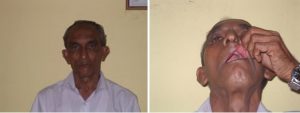 Hemasiri admitted himself to the Allewalla Rural Hospital for treatment and then went to Matara Hospital the next day, where three of his teeth had to be extracted as a result of the beating. Hospital police took down a statement before he was discharged on the 23 December. He has since filed charges against OCI Amarsinghe in a fundamental rights case (FR 12/2010), which was granted by Chief Justice Shiran Thialakwardena on 20 January 2010 for violations of article 11 and article 14. The case will be taken up on 3 May 2010.
Palagasinghe was released on 20 December on police bail after being charged with crimes relating to his possession of illegal political posters; he claims that the content of the posters, publicizing a rally, was legal. He was produced at the magistrate court in Matara on 6 January on Rs10,000 personal bail and the case has been postponed until 30 September 2010.
There has been no criminal investigation into the maltreatment of these men, which amounts to torture under international standards. It is the obligation of the state to launch one immediately under act 22 of the 1994 penal code. The tenuous and politically- motivated charges against Mr. Palagasinghe must be dropped, and compensation arranged.
SUGGESTED ACTION:
Please write to the authorities listed below to demand a criminal investigation into the actions of the police officers involved in this case and for disciplinary and legal action, should they be proven to have acted against the law and guilty of torture.
The AHRC has written to the UN Special Rapporteur on Torture, informing him of this case.
To support this case, please click here: SEND APPEAL LETTER
SAMPLE LETTER
Dear __________,
SRI LANKA: Two men are abused by police for carrying opposition posters during the presidential election; one is arbitrarily arrested
Name of victim: Mr. Kankonana Arachchige Hemasiri, resident of Mahakandarawa Wathta, Western Weipathara, Hakmana
Name of alleged perpetrators: Three constables and Officer-in-charge (OIC) Mr. Kamal Amarasinghe of Hakmana Police Station, Southern Range, Matara Division
Date of incident: 19 December 2009
Place of incident: Hakmana
I am writing to voice my deep concern regarding a case of politically motivated police brutality and arbitrary arrest that took place in the lead up to the presidential elections.
According to the information I have received, retired school teacher Mr. Kankonana Arachchige Hemasiri is the manager of the United National Party in Hakmana constituency. On the 19 December 2009 at around 10:30pm he was waiting opposite the Singer Showroom in Hakmana town with two other party members, Mr. Somadasa Jayasuriya and Mr. Jayatissa Palagasinghe, when four police officers in a jeep stopped to look at the posters he was carrying. The men were questioned roughly by the Officer-in-charge (OIC) of Hakmana Police Station Mr. Kamal Amarasinghe, supported by three constables, regarding the posters that they were carrying. The victims informed him that they were waiting for Pradeeshiya Saba council member Mr. Alahaengoda, who the police then derided.
OIC Amarasinghe allegedly then ordered Mr. Palagasinghe to get into the jeep since posters were ‘not allowed after the 17th.’ Palagasinghe was then reportedly pulled towards the jeep by the OIC and beaten. When Mr. Hemasiri tried to intervene he was also beaten and started to bleed from the mouth, and the police drove off with Mr. Palagasinghe in the jeep.
Hemasiri admitted himself to the Allewalla Rural Hospital firstly for treatment and then went to Matara Hospital the next day, where three of his teeth had to be extracted as a result of the beating. I understand that hospital police took down a statement before he was discharged on the 23 December.
He has since filed charges against OCI Amarasinghe in a fundamental rights case (FR 12/2010), which was granted by Chief Justice Shiran Thialakwardena on 20 January 2010 for violations of article 11 and article 14. The case will be taken up on 3 May 2010. However there has been no criminal investigation into the maltreatment of these men, which in Mr. Hemasiri’s case amounts to torture under international standards. It is the obligation of the state to launch one immediately under act 22 of the 1994 penal code.
Mr. Palagasinghe was released on 20 December on police bail after charges were filed against him relating to his possession of the political posters; he claims that the content of the posters, publicizing a rally, was legal. He was produced at the magistrate court in Matara on 6 January 2010 on personal bail RS 10,000 and the case has been postponed until 30th September 2010. I am deeply skeptical of the grounds for these charges and urge that a criminal investigation be conducted into the actions of the police officers involved. Disciplinary and legal action must follow, should they be proven to have acted against the law and perpetrated torture. I understand that the UN Special Rapporteur on Torture has been informed of this case.
Yours sincerely,
—————-
PLEASE SEND YOUR LETTERS TO:
Mr. Mahinda Balasuriya
Inspector General of Police (IGP),
New Secretariat,
Colombo 1,
SRI LANKA
Fax: +94 11 2 440440
Email: igp@police.lk
Mr. Mohan Peiris
Attorney General
Attorney General’s Department,
Colombo 12,
SRI LANKA
Fax: +94 11 2 436421
Secretary,
National Police Commission,
3rd Floor Rotunda Towers,
109 Galle Road,
Colombo 03,
SRI LANKA
Tel/Fax: +94 11 2 395960
Email: polcom@sltnet.lk
Secretary,
Human Rights Commission of Sri Lanka,
No 108 Barnes Place,
Colombo 07
SRI LANKA
Tel: +94 11 2 694 925 / 673 806
Fax: +94 11 2 694 924 / 696 470
Email: sechrc@sltnet.lk
Senior Superintendent of Police (SSP)
Office of the Senior Superintendant of Police
Matara
SRI LANKA
Fax: +94 41 2222113
—————————-
Thank you.
Urgent Appeals Programme
Asian Human Rights Commission (ua@ahrchk.org)
