
Dear friends,
The Asian Human Rights Commission (AHRC) has received information that two young Pakistanis who chose to marry out of their tribal boundaries are currently in hiding, after the leaders of both tribes sentenced them to death in a jirga, or tribal court. The pair has a baby, and the husband’s family members have since been beaten and robbed by the rival tribe, with two relatives abducted. The couple narrowly escaped with their lives, and now either need significant protection from the government, or help to leave the country.
CASE DETAILS:
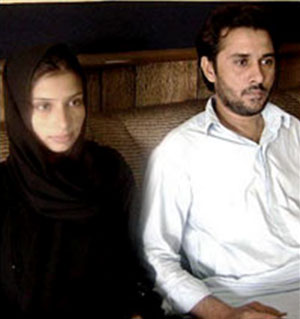 Ms. Saira Jatoi, 22, and Mr Mohammad Ismail Soomro, 30, met and married in May 2007. However their union was almost immediately ruled a breach of Islamic-tribal law by the leader of the woman’s Jatoi tribe, originally from Balochistan. The feudal lords demanded that they both, as Karo-Kari (‘black marked’), be handed back by the husband’s tribe for an honour killing.
According to the wife, Saira, she had earlier rejected a potential husband proposed by her parents, an elderly, wealthy man of her own tribe, and had been severely beaten and tortured at home as a result. Ismail Soomro agreed to marry her and the ceremony took place in Sukkur on the 15 June, 2007. Realising the danger, the two moved away from their tribal areas and kept a low profile, however in July of that year a Jatoi jirga was held, lead by Sardar Abid Hussain Jatoi, and the couple were condemned to death in absentia.
On 3 June, 2008 Jatoi members stormed the house of Ismail’s uncle, during which they robbed and beat family members, and abducted Ismail’s cousin and his cousin’s wife (Dr. Javaid Soomro and Samia Soomro; FIR 85/2008). Meanwhile the husband’s Soomro tribe had located the couple and proposed to swap them for the kidnapped couple. Ismail and Saira were convinced to return home by Sardar Junaid Soomro, who falsely promised to protect them. Ismail was asked by family members to divorce Saira, and he refused.
After the switch, the couple were detained and moved to a house in Shiakrpur in the run up to their executions, however friends of Ismail’s had called the police. The couple escaped the same day with the help of Sukkur Deputy Inspector General (DIG) Bashir Ahmed Memon, and have now gone into hiding. A second FIR was registered by DIG Memon (FIR 97/2008) against both Sadars, for kidnap. However staff dealing with their case at the Human Safety Foundation say that the couple are still in very real danger of abduction and death by any Jatoi at any time.
In August 2008 the foundation lodged a constitutional petition on their behalf (D1571), accusing several of the Jatoi tribe and Soomro tribe members and demanding compensation, and the case has been validated in the court by police officers involved in the case. Of the Jatois, the accused are: Sardar (chief) Abid Hussain Jatoi, Mir Khan, Allahdino Jatoi, Abdul Khaliq, Deedar and Abid (sons of Habibullah Jatoi) and Sijjad (son of Allahdino Jatoi), resident of Shalimar Phattak, Old Sukkur. Of the Soomro tribe are Ali Sher and Khadm, of Micro Colony Sukkur. Those accused have refused to withdraw the jirga death sentence.
The government has since failed to secure an assurance of the couple’s safety, should they return to the area. The pair has no means of supporting themselves in hiding, are in a place ill equipped for living in, and have reported hunger–receiving just one meal a day–and mental anguish. The lives of the husband’s family members are also in danger. Under the circumstances, the couple has expressed a wish to find asylum overseas, considering the failure of their own country to protect or provide for them.
ADDITIONAL INFORMATION:
Tensions between tribes are not uncommon in Pakistan, and Balochi tribes such as the Jatoi consider it a particular dishonour if their women marry into another group. The groups are strictly feudal and religiously conservative, with justice meted out by tribal courts or jirgas: illegitimate gatherings of elders, in which women have no voice and hearsay more often than not, replaces evidence. In cases of female dishonour these cases often result in a woman being marked as Kari. A Kari or ‘black marked’ woman can be killed by any member of the tribe with impunity, for the sake of honour.
Recent statistics have reported that about 300 women are killed every year in Pakistan sbecause of Kari, often in land distribution disputes, and often by male relatives. This kind of rural vigilante justice is generally tolerated by local police, due to the influence of powerful tribal leaders, and few cases reach the courts. A man who is accused of having an illicit relationship with a woman is generally fined to the tune of a young female member of his family, who is give to the complainant, or killed.
The Supreme Court and the Sindh High Court have declared the Jirga courts as illegal and unconstitutional, however the custom prevails.
SUGGESTED ACTION:
Please write to the authorities, urging them to provide security to the couple and their infant, who are currently under threat from warring tribes, and appealing for an end to illegitimate jirga trials.
Please be informed that the AHRC has also written separate letter to the UN Special Rapporteur on the violence against women and extrajudicial, summary or arbitrary executions calling for their intervention in this case.
To support this case, please click here: SEND APPEAL LETTER
SAMPLE LETTER
Dear _________________
PAKISTAN: A young couple is in hiding after a tribal court sentenced them to death for their inter-tribal marriage
Name of victims: Ms. Saira Jatoi and Mr. Mohammad Ismail Soomro, Address in Karachi, known to DIG Police Sukkur, Sindh, not to be disclosed for couples protection
Name of alleged perpetrators:
1. Sardar (chief) Abid Hussain Jatoi; Mir Khan; Allahdino Jatoi–All resident of Shikarpur, Sindh
2. Abdul Khaliq; Deedar and Abid (sons of Habibullah Jatoi); Sijjad (son of Allahdino Jatoi)–All resident of Shalimar Phattak, Old Sukkur, Sindh
3. Sardar Junaid Soomro; Ali Sher; Khadm–All resident of Micro Colony, Sukkur, Sindh
Date of Incident: May 2007
Place of Incident: Shikarpur, Sindh
I am writing to express my concern about the safety and welfare of a young Pakistani couple, currently hiding from a jirga-ruled death sentence in Shikarpur, Sindh province.
Ms Saira Jatoi, 22, and Mr Mohammad Ismail Soomro, 30, met and married in May 2007. However their union was almost immediately ruled a breach of Islamic-tribal law by the leader of the woman’s Jatoi tribe, originally from Balochistan, due to her marriage into another tribe.
According to the wife, Saira, she had rejected a potential husband proposed by her parents, an elderly, wealthy man of her own tribe, and had been severely beaten and tortured at home as a result. Ismail Soomro agreed to marry her and the ceremony took place in Sukkur on the 15 June, 2007. Realising the danger, the two moved away from their tribal areas and tried to keep a low profile, however in July of that year a Jatoi jirga was held, lead by Sardar Abid Hussain Jatoi, and the couple were condemned to death in absentia.
On 3 June, 2008 Jatoi members stormed the house of Ismail’s uncle, during which they robbed and beat family members, and abducted Ismail’s cousin and his cousin’s wife (Dr Javaid Soomro and Samia Soomro; FIR 85/2008). Meanwhile the husband’s Soomro tribe had located the couple and proposed to swap them for the kidnapped couple. Ismail and Saira were convinced to return home by Sardar Junaid Soomro, who falsely promised to protect them. Ismail was asked by family members to divorce Saira, and refused.
After the switch, the couple were detained and moved to a house in Shikarpur in the run up to their executions, however friends of Ismail had called the police. With the help of Sukkur Deputy Inspector General (DIG) Bashir Ahmed Memon the couple escaped the same day, and have now gone into hiding. A second FIR was registered by DIG Memon (FIR 97/2008) against both Sardars, for kidnap. However staff dealing with their case at the Human Safety Foundation say that the couple are still in very real danger of abduction and death by any Jatoi at any time.
In August 2008 the foundation lodged a constitutional petition on their behalf (D1571), accusing several of the Jatoi tribe and Soomro tribe members and demanding compensation, and the case has been validated in the court by police officers involved in the case. Of the Jatois, the accused are: Sardar (chief) Abid Hussain Jatoi, Mir Khan, Allahdino Jatoi, Abdul Khaliq, Deedar and Abid (sons of Habibullah Jatoi) and Sijjad (son of Allahdino Jatoi), resident of Shalimar Phattak, Old Sukkur. Of the Soomro tribe are Ali Sher and Khadm, of Micro Colony Sukkur. Those accused have refused to withdraw the jirga death sentence.
The government has since failed to secure an assurance of the couple’s safety, should they return to the area. The pair has no means of supporting themselves in hiding, are in a place ill equipped for living in, and have reported hunger–receiving just one meal a day–and mental anguish. The lives of the husband’s family members are also in danger. Under the circumstances, the couple has expressed a wish to be find asylum overseas, considering the failure of their own country to protect or provide for them.
I wish to express my concern that those involve in the illegal jirga courts have not yet been remanded, and their illegitimate death sentence on the couple taken back and defused within the community. The government has a duty to protect its citizens from arbitrary murder, and to provide for them adequately when their protection has failed. This case shows a pressing need for illegal jirga courts to be thoroughly tackled and effectively banned, both in legislation and the cultural fabric of the rural provinces. It also shows a need for the government to ramp up its efforts to socially and economically empower women, to prevent them being bartered in marriage or killed in the name of misguided religious honour.
I hope your intervention in this case will save the lives of the couple involved, and their infant child.
Yours sincerely,
————
PLEASE SEND YOUR LETTERS TO:
1. Mr. Asif Ali Zardari
President
President’s Secretariat
Islamabad
PAKISTAN
Fax: +92 51 922 1422, 4768 / 920 1893 or 1835
2. Mr. Syed Yousaf Raza Gillani
Prime minister
Prime Minister House
Islamabad
PAKISTAN
Fax: +92 51 9221596
Tel: +92 51 9206111
E-mail: webmaster@infopak.gov.pk
3. Mr. Rehman Malik
Advisor for Ministry of Interior
Room No. 404, 4th Floor, R Block,
Pak Secretariat
Islamabad
PAKISTAN
Fax: +92 51 920 2624
Tel: +92 51 921 2026
E-mail: ministry.interior@gmail.com
4. Dr. Ishrat-ul-Ebad Khan
Governor of Sindh province
Karachi, Sindh Province
PAKISTAN
Fax: +92 21 920 5043
Tel: +92 21 920 1201
E-mail: governor@governorsindh.gov.pk
5. Syed Qaim Ali Shah
Chief Minister House
Karachi, Sindh Province
PAKISTAN
Fax: +92 21 920 2000
E-mail: pppsindh@yahoo.com
6. Chief Justice of Sindh High Court
High Court Building
Saddar, Karachi
Sindh Province
PAKISTAN
Fax: +92 21 9213220
E-mail: info@sindhhighcourt.gov.pk
7. Ms. Nadia Gabol
Minister for Human Rights
Government of Sindh,
Pakistan secretariat, Barrack 92,
Karachi, Sindh Province
PAKISTAN
Tel: +92 21 9207043
Fax: +92 21 9207044
E-mail: secy.law@sindh.gov.pk
8. Dr. Zulfiqar Ali Mirza
Minister for Home
Government of Sindh
Barrack 79, Pakistan Secretariate
Near MPA hostel
Karachi, Sindh Province
PAKISTAN
Fax: +92 21 9204456
Tel: +92 21 9201920-1
E-mail: secy.home@sindh.gov.pk
9. Ms. Toqeer Fatima Bhutto
Minister women development
Government of Sindh,
New Secretariat, Karachi,
Sindh- Pakistan
E-mail: secy.wd@sindh.gov.pk
Thank you.
Urgent Appeals Programme
Asian Human Rights Commission (ua@ahrc.asia)
