
Dear friends,
The Asian Human Rights Commission is seriously concerned by the apparent delay of a trial of Ma Suu, a Burmese migrant worker who died after being beaten and set on fire by her employers, Suchart and Yuwadee Akkavibul in July 2002. The accused Thai airforce officer and his wife had escaped justice for two years, because of the officer’s influence and position of authority. (See further: UA-91-2004)
According to the information we have received, hearings were held to take evidence two times on July 26 and August 4 2004. After hearing a number of witnesses and obtaining strong evidence, the public prosecutor charged the accused, Suchart and Yuwadee, with murder, confinement and harbouring an illegal alien, and the case went to the full court on November 1, 2004 (Black No. 1089/2547 at Uthaithanee Provincial Court).
However, the court delayed the trial by setting the next hearing in January 2006 saying that the court needed to handle pending cases before new ones, under a new procedure. Local human rights groups say that some new cases will be delayed for about three or four years under these circumstances. Ma Suu’s lawyer worries that the case will be weakened by this delay as it is not certain that witnesses will be available at the convenience of the court over a year from now.
The AHRC calls for your urgent intervention into this matter. Please send a letter to Mr Kampree Kaocharern, the Attorney General of Thailand, and urge him to take prompt steps to speed up the case, considering the brutality and urgency and the fact that the case has already been considerably delayed before the accused is an airforce officer. Please also urge him to take evidence from witnesses prior to the next hearing in 2006 in order to prevent damage to the prosecution case.
Urgent Appeals Desk
Asian Human Rights Commission (AHRC)
————————————————————
UPDATED INFORMATION:
An 18-year-old Burmese migrant worker, Ma Suu, was brutally murdered by her employees, Suchart Akkavibul and his wife Yuwadee, who set her on fire alleging theft in Lop Buri Province, Thailand, in early July 2002. Two years after the incident on June 25, 2004, Suchart and his wife finally appeared before the Uthaithanee Provincial Court. However, they were given bail on the grounds that Suchart is a state officer, although the prosecutor opposed bail. Suchart Akkavibul is a special group commander in the Royal Thai Airforce.
The public prosecutor then applied to the court in order to take testimony from the witnesses before the entry of the charge in the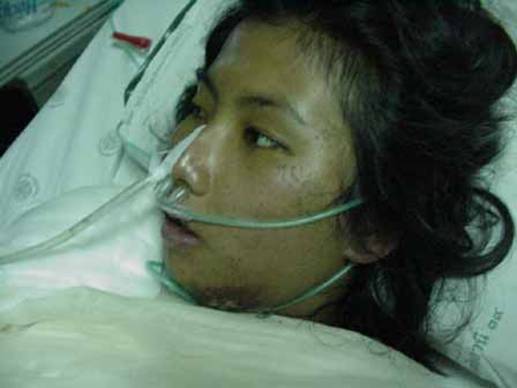 court under Section 237 of the Criminal Procedure Code B.E.2477 [1928]. According to Section 237, when there are reasonable grounds to believe that it is difficult for the witness to give testimony in the future, the public prosecutor can apply motion to the court to take his testimony promptly before the entry of the charge in the court.
The court received this application and hearings were held two times on July 26 and August 4, 2004. Five Burmese workers who were employed by Suchart gave their testimony at the hearings. Their names were recorded as Mr Janai, Mr Chid, Mr Chai, Mr Nai and Mr Sang. At the hearings, they testified that they saw that Ma Suu was severely beaten by the employers. Some of them also testified that they saw her burn injuries after the incident. Another Thai employer named Samrueng Ponnikorn, who had been involved in the incident, also testified against the two accused with the agreement that he would be escape from prosecution. His elder brother, Kamron Ponnikorn has also already agreed to testify in next hearing on the same condition.
The victim, Ma Suu
Finally, the Public Prosecutor charged Suchart and his wife with murder, confinement and harbouring an illegal alien under Sections 289 and 310 of the Penal Code of Thailand and Section 64 of the Immigration Act B.E.2522 [1979]. The first hearing of the case was held at Uthaithanee Provincial Court on November 1. Although the initial progress looked good, the court set the next hearing for January 2006. As a new hearing system was enforced a year ago, the court needs time to handle pending cases filed in the old hearing system prior to hearing new cases. However, local human rights groups argue that enforcing the new hearing system is being used as an excuse to drag on trial in some cases, and this case must be heard without further delay due to its brutality and urgency. The accused Thai airforce officer and his wife had already escaped justice for two years, apparently because of the officer’s influence and position of authority.
A journalist working for the Voice of America is also scheduled to give a statement in the next hearing. He is the person who recorded Ma Suu’s statement about the incident and took her photos when he visited her at the hospital in July 2004.
Ma Suu’s lawyer worries that the delay will weaken the case and the accused will enjoy impunity in the end, as most of these 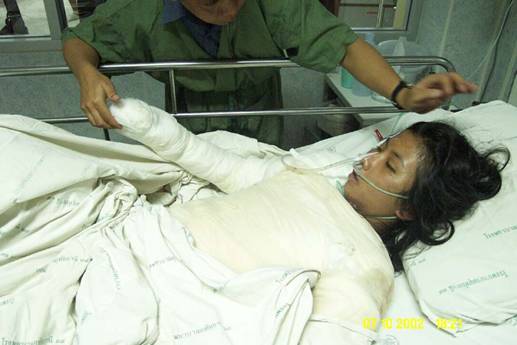 witnesses may not be expected to be available at the convenience of the court over a year from now. The lawyer is also concerned that even though some witnesses may appear in the court in 2006, the evidence of the case will be destroyed because the accused is an influential state officer.
BREIF REMINDER OF THE CASE:
Ma Suu was brutally murdered by her employers, Suchart and Yuwadee Akkavibul, who set her on fire alleging theft in Lop Buri Province, Thailand, in early July 2002. Although Ma Suu sustained fatal burn injuries, her employers abandoned her in a room without treatment or food for three days and then dumped her by a roadside. On the early morning of July 7, 2002, a man found Ma Suu on the road and sent her to a hospital in town. However, she died nine days later, after implicating the accused three persons;, Suchart his wife and Kamron Ponnikorn.
Ma Suu in the hospital
SUGGESTED ACTION:
Please send a letter to the Attorney General of Thailand and urge him to take prompt steps to speed up the case. Please also urge the Attorney General to file the motion to the Court under Section 237 of the Criminal Procedure Code B.E.2477 [1928], and take evidences from the witnesses concerned prior to the next hearing in 2006 in order to prevent loss of evidence.
To support this case, please click here: SEND APPEAL LETTER
SAMPLE LETTER
Dear Mr Kampree,
THAILAND: Case of the killing of a migrant worker dragged on by apparent delay of trial; Public prosecutor must speed up the case; (Black No. 1089/2547 at Uthaithanee Provincial Court)
Name of Victim: Ma Suu, 18, a Burmese migrant worker
The Accused:
1) Suchart Akkavibul, a special group commander in the Royal Thai Airforce
2) Yuwadee Akkavibul, wife of Suchart Akkavibul
Case Number: Black Number 1089/2547 at Uthaithanee Province Court
It is with grave concern that I write to you regarding the apparent delay of a trial of Ma Suu, a Burmese migrant worker brutally murdered by her employers, Suchart and Yuwadee Akkavibul in July 2002.
According to the information I have received, at the first case hearing on 1 November 2004, the Uthaithanee Provincial Court delayed the trial by setting the next hearing for January 2006 despite the presence of a number of witnesses and strong evidence ensured through preliminary hearings.
This delay will weaken the case, as the witnesses concerned may not be expected to be available at the convenience of the court over a year from now. I am also concerned that the case evidence may be harmed due to the delay by giving enough time and chance to the accused to manipulate it. I would like to remind you that one of the accused, Suchart Akkavibul, is an influential officer in the Royal Thai Airforce, and he and his wife have so far escaped justice for two years because of this.
I therefore urge you to take prompt action to speed up the case in court. I also urge you to take appropriate steps to take evidence from the witnesses concerned, with the permission of the court, prior to the next hearing in 2006, in order to prevent loss of evidence.
Yours truly,
————————-
SEND A LETTER TO:
Mr Kampree Kaocharern
Attorney General
Office of the Attorney General
Lukmuang Building
Nahuppei Road
Prabraromrachawang, Pranakorn
THAILAND
Fax: +66 2 224 1448 / 221 0858
SEND A COPY OF THE LETTER TO:
1. Mr Pongthep Thepkanjana
Minister of Justice
Office of the Ministry of Justice
Ministry of Justice Building
22nd Floor
Chaeng Wattana Road
Pakkred, Nonthaburi
Bangkok 11120
THAILAND
Tel: +66 2 502 6776/ 8223
Fax: +66 2 502 6699/ 6734/ 6884
2. Ms Yakin Erturk
Special Rapporteur on Violence against Women
OHCHR-UNOG
Palais Wilson, 8-14 Avenue de la Paix
1211 Geneva 10
SWITZERLAND
Fax: +41 22 917 9022
3. Ms Gabriela Rodr?uez Pizarro
Special Rapporteur on the human rights of migrants
Att: Ms. Veronica Birga
Room: 3-040
8-14 Avenue de la Paix
1211 Geneva 10
Switzerland
Tel: +41 22 917 9336
Fax: +41 22 917 9006
E-mail: urgent-action@ohchr.org (please include in the subject box: Special Rapporteur HR Migrants)
Thank you.
Urgent Appeals Programme
Asian Human Rights Commission (AHRC)
