
Dear friends,
The Asian Human Rights Commission (AHRC) has been closely monitoring the case of U Than Lwin, who was assaulted after leading a prayer meeting in Burma for the release of political prisoners. His assailant ran into the office of a government-backed organisation; however, the police were refused access to investigate. Since Than Lwin lodged a complaint, there are now moves to lodge a counter complaint against persons who chased his assailant, which follows a pattern in other similar cases in Burma during recent times.
CASE DETAILS:
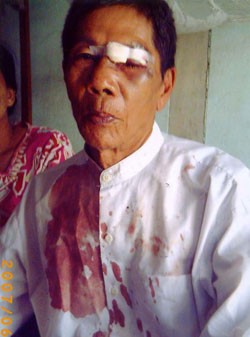 According to information received from a number of sources, on 15 June 2007 U Than Lwin and some colleagues led a group of persons to pray for the release of all political prisoners in Burma at pagodas in his town of Mettaya, in upper Burma, as part of a nationwide campaign in recent months. They informed the pagoda trustees in advance.
Around 9am the group of around 35 persons started out, but at each place it had planned to visit it found local council officials and members of a government-organised mass body, the Union Solidarity and Development Association (USDA) and thugs standing around and waiting. Thus, the group decided that it was not safe to pray at the pagodas and instead changed the plan and went to the prayer hall of a nearby monastery. At around 10am while approaching the monastery the people were stopped by a local government official who warned them that they would face trouble if they continued with their plan. Than Lwin and another leader of the group explained that as they were going to pray peacefully they did not see why there would be any trouble.
The group proceeded to the monastery and at 10:45am finished their prayer meeting quietly. Then they saw that the gates of the monastery had been blocked by the persons who had been waiting at the pagodas. As the group filed out, the crowd of around 400 persons started to walk behind and alongside. As they walked along the road, one man emerged from the crowd and hit 70-year-old Than Lwin in the face with a knuckle-duster, before running off. Some members of the prayer group immediately ran after him and chased him for about a mile, until he went into a local USDA office.
Members of the prayer group immediately went to report the incident at the local police station, and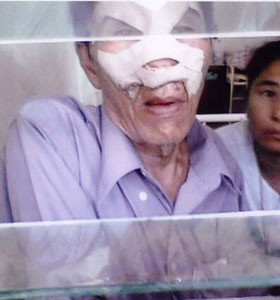 rushed Than Lwin to hospital. At 2pm a report was taken at the police station, and thereafter three police officers came to the USDA office to investigate. There three eyewitnesses verified that they had seen the alleged assailant run into the office; however, the USDA staff refused to allow the police inside.
The township hospital found that Than Lwin had a broken nose and left cheek, and serious facial injuries, and sent him to the Mandalay General Hospital for an operation the next day, June 16. On June 19 the investigating officer in the case came to see him in hospital; however, according to Than Lwin there has been no further investigation of the case. Meanwhile, he had to remain hospitalised, due to dizziness and poor eyesight.
Furthermore, on June 26 a USDA township committee member, U San Min, reportedly lodged a criminal complaint in the local court against the persons who had chased the assailant to the office, including a number of Than Lwin’s children. The AHRC will make the details of the complaint available as they come to hand.
BACKGROUND INFORMATION:
This case follows a resurgence in attacks on human rights defenders and others in Burma during recent months (see AHRC statement, AS-125-2007), including an orchestrated attack on a group of rights defenders in the delta region: the victims in that case are now also themselves being sued and are under detention (UP-082-2007). In that case too the USDA was implicated as the main organiser of the attack. Likewise, it was accused of being behind the notorious 2003 Depayin massacre, in which a convoy carrying democracy party leader Daw Aung San Suu Kyi was violently attacked, leading to many deaths and serious injuries. The Asian Legal Resource Centre released a report in December 2003 on the massacre, which can be downloaded here: http://www.article2.org/pdf/v02n06.pdf. The report of the ad hoc commission on the massacre, organised by the Burma Lawyers Council, can be read here: http://www.ibiblio.org/obl/docs/Depayin_Massacre.pdf.
The USDA has a great deal of power and is also known to have been involved in covering up killings and abuses by local officials, such as the recent beating to death of Ko Naing Oo in a Rangoon suburb this March (UA-096-2007). The patron of the association is the head of the military junta, Senior General Than Shwe.
The AHRC has also previously reported on other cases where the victims of human rights abuses in Burma have themselves been made into the targets of legal action after they had attempted to complain. For instance:
Daw Khin Win was freed from jail on appeal after being sentenced for complaining about corruption among local authorities (UP-050-2007; UA-054-2007)
U Tin Kyi was jailed for supposedly insulting authorities about an agricultural project adjacent to his own property (UA-292-2006);
U Tin Nyein was jailed for complaining about the destruction of his crops due to incompetent government officials (UA-155-2006); he was released after eight months’ imprisonment, at the start of February 2007 (UP-018-2007);
U Aye Myint was jailed for helping farmers to make a complaint about land usage by the government, and was released only after intense pressure from the International Labour Organisation (ILO) (UP-139-2006; UA-119-2006);
U Aye Min & U Win Nyunt were jailed for complaining about local corruption (UP-054-2006; UA-071-2006).
See also the 2006 AHRC Human Rights Report chapter on Burma, and visit the AHRC Burma homepage: http://burma.ahrchk.net.
______________________________
SUGGESTED ACTION:
Please write to the Minister of Home Affairs and other concerned persons below calling for an immediate investigation into this attack. Please note that for the purpose of the letter, the country should be referred to by its official title of Myanmar, rather than Burma.
To support this case, please click here: SEND APPEAL LETTER
SAMPLE LETTER
Dear ___________,
MYANMAR: Failure to apprehend assailant of U Than Lwin and counter-complaint by Mettaya authorities
Name of victim: U Than Lwin, 70, elected member of parliament (National League for Democracy), resident of Mettaya Township, Mandalay Division
Alleged perpetrators:
1. Unidentified assailant affiliated with Union Solidarity and Development Association (USDA) of Mettaya Township
2. Ko Tin Ko, Chairman, Ward Peace and Development Council, No. 2 Zone, Northeastern Quarter, Central Market, Mettaya
3. Other persons believed associated with the Ward Peace and Development Councils, USDA and Swan-arshin group
Date of incident: 15 June 2007
Place of incident: Road in Mattaya
Case: Mattaya Township Police, First Information Report (FIR) No. PaRa/401, Penal Code sn. 325 (grievous hurt); Investigating Officer (IO) Zaw Min Min Htwe (Deputy Security Officer)
I am writing to express my serious concern at the attack on a human rights defender in Mettaya Township, Myanmar and especially reports that the township Union Solidarity and Development Association (USDA) appears to have orchestrated the attack, protected the assailant and is now itself launching counter-legal action against the victim’s family.
According to the information that I have received so far, around 9am on 15 June 2007 U Than Lwin and some colleagues together with some 30 persons went to pray for the release of political prisoners in Myanmar at the Myohtaung Shwekou Pagoda, Sutaungpyi Pagoda and Hnithseleihsu Pagoda in Mettaya town, as part of a nationwide campaign. They informed the pagoda trustees in advance; however, at each place they found local council officials and members of the government-organised Union Solidarity and Development Association (USDA) and “Swan-arshin”–thugs that appear to be organised through the USDA and local councils–standing around and waiting. Thus, the group instead went to the prayer hall of the East Shwetheindaw Monastery. At around 10am its members were walking together to the monastery when they were stopped by Ko Tin Ko, chairperson of the council for the number 2 zone, northeastern quarter of the Mettaya main market, who warned them that they would face trouble if they continued with their plan. Than Lwin and another leader of the group explained that as they were going to pray peacefully they did not see why there would be any trouble.
The group proceeded to the monastery and at 10:45am finished their prayer meeting. Then they saw that the gates of the monastery had been blocked by the persons who had been waiting at the pagodas. As the group filed out, the crowd of around 400 persons started to walk behind and alongside. As they walked along the road, one man emerged from the crowd and hit Than Lwin in the face with a knuckle-duster, before running off. Some members of the prayer group immediately ran after him and chased him for about a mile, until Zaw Min Lwin–Than Lwin’s son–and two local residents saw him go into the Mettaya Township USDA office.
At 2pm an FIR was recorded at the Mettaya Township Police Station, and Station Chief U Khin Maung Thein ordered IO Zaw Min Min Htwe to go with two constables to the USDA office to investigate. There the eyewitnesses verified that they had seen the alleged assailant run into the office; however, the USDA staff refused to allow the police inside.
Than Lwin had a broken nose and left cheek, and serious facial injuries, and was sent to the Mandalay General Hospital for an operation on June 16. On June 19 the investigating officer in the case came to see him in hospital; however, according to Than Lwin there has been no further investigation of the case. Meanwhile, he had to remain hospitalised, due to dizziness and poor eyesight.
Furthermore, on June 26 a USDA township committee member, U San Min, reportedly lodged a criminal complaint in the Mettaya Township Court and requested that it investigate under section 202 of the Criminal Procedure Code. The eight respondents include four of Than Lwin’s children–Ko Zaw Min Lwin (son), Ma Khin Mar Kyi and Ma Khin Mar Lay (daughters), Ko Nyan Sein (son in law)–and four others named as U Nyo Kyi, Ko Kyaw Swe, Ko Nyo Lay and Ko Nyi Nyi.
I am appalled that in this case the police were obstructed from performing their duties by the USDA personnel, and that those same officials are now apparently launching some kind of legal action against the family and supporters of the victim. This speaks not to a society based on law and order of the sort described by the government of Myanmar, but one where lawlessness is the only order of the day. It is also part of a pattern of non-investigation and persecution of victims and others close to them in Myanmar that is barbaric and unacceptable.
I thus call for a proper criminal investigation of the attack on U Than Lwin, with non-obstruction of police, followed by prosecution and punishment for the person or persons involved. I also call for compensation and protection from further attacks, be they physical or legal, for the victim and his family.
Finally, I note with concern that the USDA has in the past been accused of organising attacks on human rights defenders and others in Myanmar, in particular, the assault on a convoy at Depayin in 2003. I am not aware of any investigations or prosecutions ever following from that incident and would hope that effective action in this case may lead to the possibility for justice for other victims of abuse of power by its executives.
Yours sincerely
—
PLEASE SEND YOUR LETTERS TO:
Maj-Gen. Maung Oo
Minister for Home Affairs
Ministry of Home Affairs
Office No. 10
Naypyitaw
MYANMAR
Tel: +951 250 315 / 374 789
Fax: +951 549 663 / 549 208
PLEASE SEND COPIES TO:
1. Lt-Gen. Soe Win
Prime Minister
c/o Ministry of Defence
Naypyitaw
MYANMAR
Tel: + 95 1 372 681
Fax: + 95 1 652 624
2. U Aye Maung
Attorney General
Office of the Attorney General
Office No. 25
Naypyitaw
MYANMAR
Tel: +95 67 404 088/ 090/ 092/ 094/ 097
Fax: +95 67 404 146/ 106
3. Brig-Gen. Khin Yi
Director General
Myanmar Police Force
Naypyitaw
MYANMAR
Tel: + 95 1 549 196/ 228/ 209
4. Mr. Shariq Bin Raza
Representative
UN Office on Drugs and Crime
11A Malikha Road
Ward 7, Mayangone Township
Yangon
MYANMAR
Tel: +951 666 903/ 660 556/ 660 538/ 660 398/ 664 539
Fax: +951 651 334
E-mail: fo.myanmar@unodc.org, shariq.raza@unodc.org, camila.vega@unodc.org
5. Mr. Homayoun Alizadeh
Regional Representative for Asia-Pacific of OHCHR
UNESCAP
UN Secretariat Building, 6th Fl., Room A-601
Rajdamnern Nok Ave.
Bangkok 10200,
THAILAND
Tel: +662 288 1496
Fax: +662 288 3009
6. Professor Paulo Sergio Pinheiro
Special Rapporteur on Myanmar
Attn: Mr. Laurent Meillan
c/o OHCHR-UNOG
1211 Geneva 10
SWITZERLAND
Tel: + 41 22 9179 281
Fax: + 41 22 9179 018 (ATTN: SPECIAL RAPPORTEUR MYANMAR)
E-mail: lmeillan@ohchr.org
7. Ms. Hina Jilani
Special Representative of the Secretary General for human rights defenders
Att: Melinda Ching Simon
Room 1-040
C/o OHCHR-UNOG
1211 Geneva 10
SWITZERLAND
Tel: +41 22 917 93 88
Fax: +41 22 917 9006 (ATTN: SPECIAL REPRESENTATIVE HUMAN RIGHTS DEFENDERS)
Thank you.
Urgent Appeals Programme
Asian Human Rights Commission (AHRC) (ua@ahrchk.org)
