Home / News / Urgent Appeals / UPDATE (Sri Lanka): Progress is made in a case of judicial and police corruption

UPDATE (Sri Lanka): Progress is made in a case of judicial and police corruption

June 17, 2010

ASIAN HUMAN RIGHTS COMMISSION - URGENT APPEALS PROGRAMME

Urgent Appeal Update: AHRC-UAU-025-2010

17 June 2010

[RE: AHRC-UAC-010-2010: Balagolla police mislead a magistrate and prepare charges against the wrong person.]
---------------------------------------------------------------------
SRI LANKA: Progress is made in a case of judicial and police corruption

ISSUES: Administration of justice; corruption; right to a fair trial
---------------------------------------------------------------------

Dear friends,

The Asian Human Rights Commission is pleased to report strong progress in the complaint of a road accident victim, whose case was wilfully mishandled by police and a judge. The judge allowed himself to be misled by police officers and when the victim complained, he closed the case. This is now being thoroughly investigated, with support offered to the victim by the Kandy Criminal Investigation Division (CID) and the involvement of officers from CID headquarters. However some obstacles are being encountered and those involved in the case are concerned that the magistrate will not be held to account.

CASE NARRATIVE:
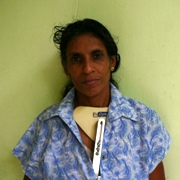
Shortly after an urgent appeal was issued in February this year, an investigation was launched into the closing of Malani Serasinghe’s case after she refused to take settlement pay from the wrong person. Malani was seriously injured when she was run over by a motorbike, as detailed in AHRC-UAC-010-2010. An unknown person was substituted as the accused by police, with the knowledge of the judge.

In February the Inspector General of Police informed the AHRC that the Deputy Inspector General of the Central Ranges would inquire into the case. Malani reports that she was then contacted by Kandy police in March, and that her complaint was taken. She told us that a statement had also been taken from the real perpetrator and that several witnesses had been contacted, including the three-wheeler driver who had taken her to the hospital. On 12 June Malani was invited back to Kandy Police Station to discuss the case, and she has been asked to give her statement to the Assistant Superintendent of Police later in the month. On 15 June she was visited by officers from the Kandy CID who promised their support and protection, should she go ahead with the case against the police.

This progress is heartening and the AHRC looks forward to Malini’s case being correctly tried, and for the then-acting magistrate, Umesh Chanaka Kalansooriya, and police officers to be prosecuted in a display of zero tolerance against corruption. It also expects the Judicial Commission service to inquire into the case and take disciplinary action against Mr. Kalansooriya.

We are concerned that a local rights organisation has been continually prevented from getting a copy of the B Report (No. 22482). After first being sent the wrong file, the group has been blocked from accessing the report with various excuses from the registrar’s office among them: that the report is locked in the record room, that has gone missing, and that it is ‘unavailable’. We urge the registrar to rectify this immediately.

ADDITIONAL INFORMATION:

It is a criminal act for a judge to tolerate the abuse of the legal system by police. The law continues to be used as a tool of harassment by those who work with it in Sri Lanka, and this not only leaves civilians vulnerable but significantly reduces public confidence in the court

It also paves the way for fabricated charges. The AHRC has documented numerous cases in which the names of persons have been pasted into charge sheets for cases they had no connection to. See recent UAs: Panadura North Police mislead the judiciary and detain a man for forty days or Police torture and fabricate charges against a young man for revenge. It is the duty of a judge to act as a check on police corruption, not as an aid to it.

The victim was originally upset at the prospect of charging the accused, who is the same age as her son, although her injuries were severe and the young man allegedly had no driver’s licence. Malani reports that her resolve was hardened by the response from the driver’s family, and the police. She says: "They gave us no consideration. They said, ‘we have money and the police and judge are in our hands, so we can do whatever we want. So now I want to fight for justice."

Malani still needs to wear a body brace, which she takes off at night, and cannot lift her right arm completely. She has X-rays and medical reports from a neurological consultant at the Teaching Hospital of Kandy. Since the accident she hasn’t been able to work in their paddy field or tend to the family’s livestock, and they have had to rent out the land. The hearing in her right ear is still impaired. Her next step will be to file for compensation.

--------------------------------

Thank you.

Urgent Appeals Programme
Asian Human Rights Commission (ua@ahrc.asia)

Document Type :
Urgent Appeal Update
Document ID :
AHRC-UAU-025-2010
Countries :
Document Actions
Share |
Subscribe to our Mailing List
Follow AHRC
Extended Introduction: Urgent Appeals, theory and practice

A need for dialogue

Many people across Asia are frustrated by the widespread lack of respect for human rights in their countries.  Some may be unhappy about the limitations on the freedom of expression or restrictions on privacy, while some are affected by police brutality and military killings.  Many others are frustrated with the absence of rights on labour issues, the environment, gender and the like. 

Yet the expression of this frustration tends to stay firmly in the private sphere.  People complain among friends and family and within their social circles, but often on a low profile basis. This kind of public discourse is not usually an effective measure of the situation in a country because it is so hard to monitor. 

Though the media may cover the issues in a broad manner they rarely broadcast the private fears and anxieties of the average person.  And along with censorship – a common blight in Asia – there is also often a conscious attempt in the media to reflect a positive or at least sober mood at home, where expressions of domestic malcontent are discouraged as unfashionably unpatriotic. Talking about issues like torture is rarely encouraged in the public realm.

There may also be unwritten, possibly unconscious social taboos that stop the public reflection of private grievances.  Where authoritarian control is tight, sophisticated strategies are put into play by equally sophisticated media practices to keep complaints out of the public space, sometimes very subtly.  In other places an inner consensus is influenced by the privileged section of a society, which can control social expression of those less fortunate.  Moral and ethical qualms can also be an obstacle.

In this way, causes for complaint go unaddressed, un-discussed and unresolved and oppression in its many forms, self perpetuates.  For any action to arise out of private frustration, people need ways to get these issues into the public sphere.

Changing society

In the past bridging this gap was a formidable task; it relied on channels of public expression that required money and were therefore controlled by investors.  Printing presses were expensive, which blocked the gate to expression to anyone without money.  Except in times of revolution the media in Asia has tended to serve the well-off and sideline or misrepresent the poor.

Still, thanks to the IT revolution it is now possible to communicate with large audiences at little cost.  In this situation there is a real avenue for taking issues from private to public, regardless of the class or caste of the individual.

Practical action

The AHRC Urgent Appeals system was created to give a voice to those affected by human rights violations, and by doing so, to create a network of support and open avenues for action.  If X’s freedom of expression is denied, if Y is tortured by someone in power or if Z finds his or her labour rights abused, the incident can be swiftly and effectively broadcast and dealt with. The resulting solidarity can lead to action, resolution and change. And as more people understand their rights and follow suit, as the human rights consciousness grows, change happens faster. The Internet has become one of the human rights community’s most powerful tools.   

At the core of the Urgent Appeals Program is the recording of human rights violations at a grass roots level with objectivity, sympathy and competence. Our information is firstly gathered on the ground, close to the victim of the violation, and is then broadcast by a team of advocates, who can apply decades of experience in the field and a working knowledge of the international human rights arena. The flow of information – due to domestic restrictions – often goes from the source and out to the international community via our program, which then builds a pressure for action that steadily makes its way back to the source through his or her own government.   However these cases in bulk create a narrative – and this is most important aspect of our program. As noted by Sri Lankan human rights lawyer and director of the Asian Human Rights Commission, Basil Fernando:

"The urgent appeal introduces narrative as the driving force for social change. This idea was well expressed in the film Amistad, regarding the issue of slavery. The old man in the film, former president and lawyer, states that to resolve this historical problem it is very essential to know the narrative of the people. It was on this basis that a court case is conducted later. The AHRC establishes the narrative of human rights violations through the urgent appeals. If the narrative is right, the organisation will be doing all right."

Patterns start to emerge as violations are documented across the continent, allowing us to take a more authoritative, systemic response, and to pinpoint the systems within each country that are breaking down. This way we are able to discover and explain why and how violations take place, and how they can most effectively be addressed. On this path, larger audiences have opened up to us and become involved: international NGOs and think tanks, national human rights commissions and United Nations bodies.  The program and its coordinators have become a well-used tool for the international media and for human rights education programs. All this helps pave the way for radical reforms to improve, protect and to promote human rights in the region.