
Dear friends,
The Asian Human Rights Commission (AHRC) has received information regarding the death of hundreds of people in the Dogiyai District in Papua, Indonesia, due to a cholera epidemic. Despite requests to local and national authorities, the epidemic has not yet been prevented from spreading into neighbouring provinces. Local organisations report that 239 people had lost their lives from Cholera as of mid September. The AHRC is deeply concerned about the ongoing deaths due to the outbreak and the lack of sufficient response from state authorities.
CASE DETAILS:
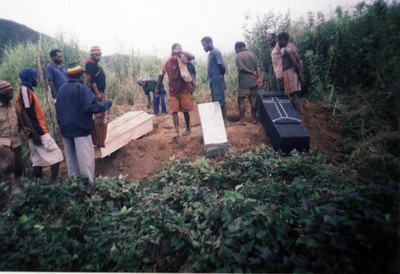 The first cases of diarrhea in the Dogiyai District in Papua, Indonesia, were registered in April 2008, mainly in Ekemanida and Idakotu, as well as in surrounding villages. It has been confirmed that the Cholera Bacterium was the causing agent. So far, the provincial health office has officially confirmed 81 fatal cases in the districts of Dogiyai, out of 552 officially known cases of infection. Additionally the provincial health office has reported 23 cases of infections, resulting in 6 deaths in Obano, the neighboring sub-district.
Local organisations however (Médecins du Monde Papua; PRIMARI), have reported much higher figures of deaths than the official numbers indicate. The fatality number in mid July was 173 (Geraja KINGMI – Christian Evangelical KEmah Church, Please see the list), whilst a report from mid September stated that 239 people had lost their lives by then. There is a large discrepancy between the official numbers of fatalities provided by the provincial health office and those provided by the local NGO’s and churches
Although the ministry of health has stated that the outbreak is under control, suspected cholera cases in the areas around lake Tigi and Painai have surfaced in mid-August. The number of cases of diarrhea and the deaths resulting from the epidemic in Paniai has been increasing.
It is reported that the government has not taken appropriate action despite repeated requests from local groups asking for an intervention from health authorities.
To stop the further spread of the epidemic, proper disposal of faecal waste and disinfection is essential. A weekly surveillance system in the infected areas (suspected and confirmed) should be established. Appropriate medical tools and village-level training of community health workers should also be made available. This training should naturally be funded by the Government, and it is regrettable that such training has not already been initiated, given that cholera outbreaks in the recent past have shed many lives in the region (for example as recently as 2006 more than 200 people died in the Jayawijaya regency of Papua).
Unfortunately, the required materials; personnel for the treatment of infected persons; and the prevention of the epidemic from further spreading into the neighbouring District of Paniai, have neither been provided nor initiated at this point in time.
BACKGROUND INFORMATION:
The health infrastructure in Papua is very poor. Papua is Indonesia’s most naturally abundant region, with resources such as timber and other minerals prevailing in the area. The revenue created by non-Papuan mining companies and the migration flows of Muslim traders from other regions of the country have not resulted in a visible upsurge in the living conditions of the predominantly Christian communities. Native Papuans blame past transmigration policies imposed by the government, as well as the exploitation of the natural resources, for undermining their livelihood, traditional culture, and way of life.
Under Indonesia’s domestic law 23/1992, the government is required to provide sufficient health facilities throughout the nation and take action to combat both infectious and non-infectious diseases in order to decrease mortality rates. Given that the Indonesian Government has ratified the International Covenant on Economic, Social and Cultural Rights (ICESCR) and has also incorporated it into domestic law with the implementation of Law number 11/2005, the government must recognize the right of everyone to enjoy the highest attainable standard of physical and mental health, and must maximize available resources to achieve full realization of this right.
ADDITIONAL COMMENTS:
Frustration among members of the indigenous community about the lack of government response has sparked riots in Moanemani. A history of harassment, torture and other forms of human rights violations directed against the indigenous population in Papua means that communities have a high level of distrust towards authorities of the central government. Some have even expressed suspicion that the delay in providing aid is a deliberate failure on the part of the government, intending to harm the indigenous people.
SUGGESTED ACTION:
Please write to the authorities listed below expressing your grave concern regarding the lack of facilities and the negligence of health institutions regarding this case. The authorities must employ all means necessary to ensure that the cholera epidemic is brought under control and that further unnecessary deaths are prevented.
Please be informed that the AHRC has also written to the UN Special Rapporteur on the right to health, the right of indigenous people, and on racism, calling for an intervention in this matter.
To support this case, please click here: SEND APPEAL LETTER
SAMPLE LETTER
Dear __________,
INDONESIA: Hundreds die due to government’s failure to control Cholera outbreak
Details: 239 people have died of Cholera Bacterium, Dogiyai District in Papua, Indonesia
Date of incident: since April 2008
I am writing to express my deep concern about the cholera epidemic currently taking place in a number of districts in Papua, Indonesia. At this time, hundreds of people have died from the disease and the Indonesian government has failed to respond despite requests for action to both local and national authorities. Medical assistance has not been dispatched to affected areas and preventative measures have not been implemented in neighboring provinces.
According to the Ministry of Health, there have thus far been 81 fatal cases from the epidemic out of the total 552 cases of known infections in the districts of Dogiyai. Local organizations however, have reported much higher numbers; at least 239 people are reported to have lost their lives by mid September. There is thus a large discrepancy in these figures, and the reliability of official records is made questionable.
Cholera is an easily treatable disease. According to the World Health Organization (WHO), “the prompt administration of oral rehydration salts to replace lost fluids nearly always results in cure”. What is deeply disturbing then, is the fact that the Indonesian government has failed to take sufficient action since the first reported cases of diarrhea in the Dogiyai District, dating back all the way to April 2008.
Law number 23/1992 of Indonesian domestic law requires that the government provides sufficient health facilities throughout the nation and that it takes action to combat both infectious and non-infectious diseases. Additionally, as a signatory of the International Covenant on Economic, Social and Cultural Rights (ICESCR), which it has incorporated into its domestic law (Law number 11/2005), Indonesia also recognizes the right of everyone to enjoy the highest attainable standard of physical and mental health, and should accordingly maximize available resources to achieve full realization of this right. As such, the government’s current inaction with regards to the cholera epidemic in Papua constitutes a severe breach of these domestic and international human rights laws and standards.
The government has a duty to ensure all citizens’ right to health, which would include both treatment and prevention of illnesses and disease. Its current lack of effort to combat cholera and the disease’s ongoing spread (suspected cases in Puweta and Kaamu barat districts have surfaced as recently as in mid-August) seems to demonstrate an apathetic attitude toward its own citizens.
Inasmuch as inaction leaves authorities accountable, I urge you to immediately take proper actions to address the cholera epidemic. Dispatching personnel for treatment plus the implementation of a weekly surveillance system in affected, as well as potentially affected, areas is recommended for effective action.
Further, preventative measures such as disinfections; the proper disposal of faecal waste and village-level training of community health workers, should also be taken to stop the spread of the disease.
I look forward to your prompt and effective response.
Yours sincerely,
————————————
PLEASE SEND YOUR LETTERS TO:
1. Mr. Susilo Bambang Yudoyono
President
Republic of Indonesia
Presidential Palace
Jl. Medan Merdeka Utara
Jakarta Pusat 10010
INDONESIA
Fax: + 62 21 231 41 38, 345 2685, 345 7782
Tel: + 62 21 3845627 ext 1003
E-mail: president@ri.go.id
2. Ms. Siti Fadilah Supari
Ministry of Health
Jl. H.R. Rasuna Said
Blok X 5 Kav. 4-9 Blok A
Jakarta 12950
INDONESIA
Tel: +62 21 5201590
3. Mr. Aburizal Bakrie
Ministry of Social Welfare
Jl. Merdeka Barat
No. 3, Jakarta Pusat
INDONESIA
Fax: +62 21 3453289
Tell: +62 21 34832544
E-mail: biro_informasi@menkokesra.go.id
4. Mr. Tigor Silaban
Head of Service Office of Health
Jl. Raya Sentani Kota Rajo
Jayapura 99225
INDONESIA
Fax: +62 967 581 065
5. Mr. Ifdhal Kasim
Chairperson
KOMNAS HAM (National Human Rights Commission)
Jl. Latuharhary No. 4B Menteng
Jakarta Pusat 10310
INDONESIA
Fax: +62 21 3151042/3925227
Tel: +62 21 3925230
E-mail: info@komnasham.or.id
Thank you.
Urgent Appeals Programme
Asian Human Rights Commission (ua@ahrchk.org)
