
Dear friends,
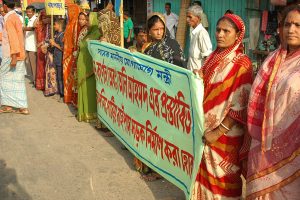 The Asian Human Rights Commission (AHRC) is concerned about the eviction risk faced by around 300 people of a lower caste Hindu community in Chittagong, without adequate compensation or rehabilitation being arranged. The land will be seized for the government-led Patiya Bypass project, yet the community is very poor and residents have not been given the education or training necessary to know how to move or make a living elsewhere. Compensation has been offered, but it is inadequate and has not been offered in writing. To avoid creating a larger group of internally displaced people in Bangladesh the government must make a clear framework for such relocations, taking the rehabilitation of the tenants into account. This community is in need of particularly urgent protection.
CASE DETAILS:
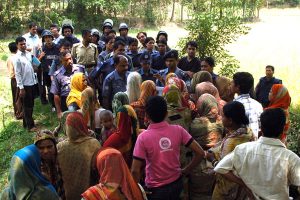
On 15 September 2009 the District Administration of Chittagong served a notice (PDF) to the residents of Nathpara, Karol village, asking that they claim official ownership before 14 October 2009. The residents did not respond and several evictions attempts have followed, by the Patiya police and assisted by the Chittagong and Patiya Upazilla representatives. All were met with protests (see the video below and here).
The 300 residents claim a strong ancestral and craft history. Its members have been making a living by weaving domestic house-mats from nearby aquatic plants for generations, and say that if they move they will also lose their livelihoods (see video footage of the village here). They allege that an adequate rehabilitation policy has not been offered, but rather a lump sum of 50,000 takas, which will not cover the costs of purchasing land in the area. The authorities have reportedly not offered documents promising this compensation, which they must do by law.
The Nathpara inhabitants believe that they are being targeted and exploited because they are a low caste minority group. Like many such groups in Bangladesh, this one has been marginalised; the majority of its members survive on less than US$.0.5 per day, receive no social security benefits from the government and have very limited access to education, health and sanitation facilities. The new development will improve infrastructure in the area, but will only disadvantage this group. There is a strong chance that they will become internally displaced, unable to support themselves or to find affordable plots of land. Many residents are also unable to produce the necessary ownership papers, though the land has been inhabited by their families for more than a century.
Two community leaders, Mr. Srimat Subashananda Abdhuth and Mr. Dilip De, have alleged that the community is being targeted. The original bypass plan (1991-1996) passed straight from Patiya Indra Pol Bridge to Kocuayi Girish Chowdhury Market over agricultural land, and a revised plan curves to travel across their homestead, depriving them of their right to housing and security. They claim that they have not received any response to the formal letters they have sent to the country director of the Asian Development Bank, which is funding the project, or from the team leader of Roughton International, which is an implementing partner.
In recent weeks a group of community representatives have met and received verbal assurances from the incumbent minister and secretary of the Communications Ministry. However the local administration, with police, continues to visit the village regularly to urge residents to leave.
ADDITIONAL INFORMATION:
 Plans for the Patiya Bypass have been underway since the nineties, managed by the Roads and Highways department under the Ministry of Communications; it will connect Chittagong with Coxs Bazar, which is another costal town at the southeast corner of the country. The project is officially called RNIMP-2 and the plan has been revised under the new government.
There is a large gap between the published market price and the actual price of land plots in the area as in the rest of the country. Property developers are consistently accused of under-pricing land to reduce tax payments. Therefore calculated compensation amounts, while enough on paper, are rarely enough to secure a family a new plot, or materials to build their home. According to the governmental records the official price of an acre of land in this area is around 100,000 Takas, yet they are allegedly being sold for around 10 million Takas.
SUGGESTED ACTION:
Please write letters to the concerned authorities requesting their review of the Patiya Bypass construction plan, and should it go ahead, requesting their arrangement of a rehabilitation and compensation package for the current residents. Please also demand that the government creates a clear framework for such future procedures.
The AHRC has also written letters to the Special Rapporteur on Adequate Housing and Independent Expert on Minority Issues urging their intervention into this case.
To support this case, please click here: SEND APPEAL LETTER
SAMPLE LETTER
Dear _________,
BANGLADESH: Around 30 lower caste families in the Hindu community face eviction in Chittagong
The community at risk: Low caste; Hindu; Nathpara community in Karal village, under the Patiya police station in Chittagong district.
The authorities involved: The Ministry of Communication, the Patiya police and representatives from Chittagong and Patiya Upazilla.
I am writing to express my grave concern over the prevailing risk of eviction faced by around 300 members of a lower caste Hindu community in Nathpara, Karal village in Chittagong. The government is constructing a six kilometer bypass road via Patiya town across the area, however the authorities allegedly have not laid out a comprehensive scheme for the community’s rehabilitation and compensation, prior to serving the eviction notice, should residents relocate.
According to the information I have received, the Roads and Highways Department (under the Ministry of Communications) have been planning the Chittagong to Coxs Bazar highway since the1990s officially known as RNIMP-2 and in a recent change, have included land occupied by the Nathpara area of Karal village. A lump sum of 50,000 Takas has been offered to the current residents, which will not cover the costs of purchasing land in the area. There is usually a large gap between the published market price and the actual price of land plots in the country. In this area according to the governmental records, the official price of an acre of land is around 100,000 Takas, yet they are allegedly being sold for around 10 million Takas.
The 300 residents claim a strong ancestral and craft history; their families have been making a living by weaving domestic house-mats from nearby aquatic plants for generations, and say that if they move they will lose their livelihoods. As a low caste minority group, the residents also believe that they are being exploited, and possibly targeted in collusion with prominent social groups. Most of the members survive on less than US$.0.5 per day, receive no social security benefits from the government and have very limited access to education, health and sanitation facilities.
The new development will improve infrastructure in the area, but will not only disadvantage this group. There is a strong chance that they will become internally displaced; unable to support themselves or to find plots of land cheap enough to buy. Many residents are also unable to produce the necessary ownership papers, though the land has been inhabited by their families for more than a century.
Two community leaders, Mr. Srimat Subashananda Abdhuth and Mr. Dilip De, claim to not have received any response from formal letters sent to the country director of the Asian Development Bank, which is funding the project, or from the team leader of Roughton International, which is an implementing partner.
In recent weeks a group of their representatives have met and received verbal assurances from the incumbent minister and secretary of the Communications Ministry. However the local administration, with police, continues to visit the village regularly to urge residents to leave.
While I am fully aware that the government has constitutionally empowered to acquire lands for development of the countrys infrastructure, I want to voice my concern about the protection of the right to adequate housing, particularly for underprivileged communities, which is enshrined in the Constitution of Bangladesh. I urge you to investigate the concerns of the area’s inhabitants and review the construction plan. Each family should be afforded the greatest possible level of rehabilitation and resources, to allow their relocation to similar homes and neighbourhoods in the district.
Yours sincerely,
——————–
PLEASE SEND YOUR LETTER TO:
1. Mrs. Sheikh Hasina
Prime Minister
Government of the People’s Republic of Bangladesh
Office of the Prime Minister
Tejgaon, Dhaka
BANGLADESH
Fax: +880 2 811 3244 / 3243 / 1015 / 1490
Tel: +880 2 882 816 079 / 988 8677
E-mail: pm@pmo.gov.bd or ps1topm@pmo.gov.bd or psecy@pmo.gov.bd
2. Mr. Syed Abul Hossain MP
Minister
Ministry of Communications
Bangladesh Secretariat
Dhaka-1000
BANGLADESH
Tel: +880 2 7164977
Fax: +880 2 7166636
E-mail: minister@moc.gov.bd
3. Mr. Md. Mozammel Haque Khan
Secretary
Ministry of Communications
Bangladesh Secretariat
Dhaka-1000
BANGLADESH
Tel: +880 2 7152866
Fax: +880 2 9553900
E-mail: secretary@moc.gov.bd
4. Justice Amirul Kabir Chowdhury
Chairman
National Human Rights Commission
6/3 Lalmatia, Block-D
Dhaka-1207
BANGLADESH
Telefax: +880 2 9137743
———————
Thank you.
Urgent Appeals Programme
Asian Human Rights Commission (ua@ahrc.asia)
