
Dear friends,
The Asian Human Rights Commission (AHRC) has received information that Kegalle jailors illegally detained a man. They asked for money to release him even though there was an order of release on bail from the court on 22 October 2008. When he told another jailor about his illegal detention, he was assaulted and further detained. He was finally released on October 24 requiring hospitalization for over a week.
CASE DETAILS: (Based on the victims statement)
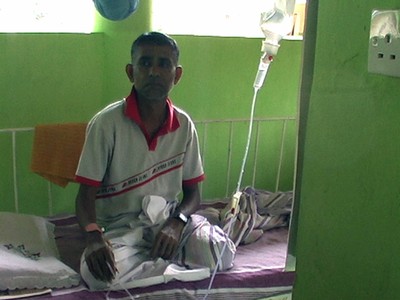 Mr. Udayarathne was accused of theft and detained in Kegalle prison on 20 October 2008. He was produced before the Kurunegale court which ordered him released on bail on October 22. He was then taken to the fiscal department at the court accompanied by his wife Seetha. Here the jailors asked him to sign a statement before returning home.
A jailor, with a document of bail, asked for Rs. 1,000.00 (USD 9) for his release. When Udayarathne said that he did not have the entire amount, the jailor asked him to pay half and Udayarathne paid half. Then the jailor took Udayarathne to see Rathnayake, Full-in-Charge (FIC) of the department and asked him whether it was all right to release him. The FIC then asked Udayarathne, “Did you promise something to the jailor?” When Udayarathne replied negatively, the FIC ordered the jailor to return Udayarathne to the cell in the fiscal department. Meanwhile, the money that Udayarathne paid was given back to his wife.
Udayarathne was kept in the cell until 7:30pm when he was again taken to Kegalle prison. When his wife questioned the jailors about this, they said that he would be brought back to Kurunegala on the following morning. Udayarathne spent the night of 22 of October in the Kegalle prison.
At 5:30am on October 23, jailors started getting ready to transfer those remanded to Kurunegala prison but they did not include Udayarathne. Udayarathne appealed to the FIC Mr. Jayathilaka Banda to take him too. However, Jayathilaka asked, “Do you have money?” When receiving a negative response, he said, “If you don’t have money, tell your family to bring Rs. 10,000.00 (USD 90). He asked “How much did you pay your lawyers?” Udayarathne replied “about Rs. 200,000.00 (USD 1,839).” He scolded Udayarathne saying, “You have money to give to the lawyers but you don’t like to give money to us.” Then, Jayathilaka refused his transfer to Kurunegala prison.
After that, Udayarathne began crying because of the injustice and violence done to him. While he was crying, others remanded with him advised that he go to the welfare office at the prison. He went and told all about the incident to a welfare officer. The welfare officer dispatched a prisoner as messenger to the jailors asking the reason why they would not allow Udayarathne to go home. A little while later, the messenger returned and said that the jailors asked Udayarathne to come to the office. He went to the prison office where the jailors scolded him saying, “Why did you go to see the welfare officers and tell them about the incident?” The jailors again put Udayarathne back into a cell.
At 6am when cells were opened for breakfast, Udayarathne did not go to eat but appealed to a jailor to let him go. He said, “We will let you go only when we want to let you go. If you are going to argue with us, I will slap you.”
At 1:30pm while in a cell, Udayarathne was told to come to the office where he was told him to get ready to go to Negombo prison. He told them that he was released on bail and did not need to go to Negombo prison. He also reiterated that there was no case against him. However, the jailors ignored him and sent him to Negombo with two prison guards reaching the prison at 5pm. The jailors at Negombo prison refused to admit Urayarathne, saying that there was no reason to admit him.
At 8:30pm Udayarathne was again brought back to Kegalle prison. He saw the FIC Jayathilaka Banda at the entrance of the prison. As Udayarathne entered the prison, three jailors began scolding and ridiculing him using foul language. He begged, “Please don’t scold me. I am so tired. Please ask what happened from the other two who went with me to the Negombo prison.” Suddenly Jayathilaka came up to Udayarathne and slapped him. Another jailor joined in the slapping. Yet another ordered him to remove his slippers. When Udayarathne bent down to remove his slippers, the jailor kicked him and he fell to the floor. Then, Jayathilaka kicked him in the stomach, saying, “We will kill you.” In like manner, all four jailors beat Udayarathne using both hands and feet. He was then dragged and put him back into the cell. They did not provide any food for his dinner.
As a result of this assault, Udayarathne started vomiting blood and bleeding from his mouth. His left ear was damaged. Stomach pain caused him to loose control of his bowels.
On October 24, he was so sick that he did not wake up and continued sleeping. At 10:30am, a jailor came and said, “Now we are going to release you. But, keep in mind that we are the people who decide to release you or not. You can do nothing until we decide.” Even though he was released, he was unable to go home alone and was sitting in a visitor’s room of the prison building. He borrowed a mobile phone from a visitor and called home. When his son and a relative came to Kegalle prison to bring him home, he decided to inform the chief jailor of the prison of the incident. He was allowed to meet the chief jailor telling him the whole story. Then, the chief jailor said, “Oh! They had no right to assault you. Please be seated outside and I will take action on this.”
A while later, a jailor came and took Udayarathne to a room where he had earlier been assaulted. The jailor started to take down a statement from him. He related the story in full but the jailor did not write it down. Udayarathne said that the jailors who assaulted him were under the influence of liquor at the time. The jailor told him, “you cannot say that without seeing them drinking.” He also said he vomited blood as a result of the assault. But the jailor refused to write it down saying, “We did not see you vomiting blood, so we cannot write it down.” Due to his repeated appeals, the jailor finally wrote it down.
While the statement was being taken, another jailor came into the room. Udayarathne identified him as one of jailors who assaulted him. He said, “Sir, that jailor also assaulted me.” The jailor taking his statement said, “I can write his name down only if you can tell me his name.” Udayarathne replied “I do not know his name but you know it sir.” However, the jailor did not write down the name. After completing the statement, the jailor asked Udayarathne to write ‘I read the statement and I agree with this’ and sign it. Even though he declined to write down and sign the statement, because it was incorrectly written, he was forced to sign it.
After his release from prison, he went to Dambulla hospital where he was hospitalized for 6 days. He was later transferred to Matale hospital and stayed for 3 days. He was then transferred to Kandy hospital for a test on his damaged ear and came back to Matale hospital where he was discharged on November 1. He could not hear out of his left ear due to the assault and is now facing financial problems because of his hospital bills.
ADDITIONAL INFORMATION:
This is yet another case showing the normal practice of torture by the police. Jailors simply ignore a court order when they fail to get a bribe from a remanded person. The AHRC has also earlier reported several other cases taking place in prisons.
The case of Nandani is indicative. She was involved in a private argument with another woman whose husband is a high ranking government officer. She was arrested and remanded in prison where she was repeatedly ill-treated by jailors (AHRC-UAC-196-2008). Miswar, the prime witness in the case was attacked by jail guards warning him not to appear in court as a witness (AHRC-UAC-214-2008). A minor was tortured by jail guards to confess to a case of robbery (AHRC-UAC-030-2008). No investigation has been conducted even though an inmate complained to the authorities (AHRC-UAC-065-2008).
SUGGESTED ACTION:
Please write a letter to the government authorities listed below asking them to investigate the assault and arbitrary detention of Udayarathne and the corruption of the officials at the prisons.
Please be informed that the AHRC has also written a separate letter to the UN Special Rapporteur on the Question of Torture and Working Group on Arbitrary Detention calling for intervention in this case.
To support this case, please click here: SEND APPEAL LETTER
SAMPLE LETTER
Dear _________,
SRI LANKA: Jailors assault and arbitrarily detain a man who failed to pay a bribe
Name of victim: Mr. Herath Mudiyanselage Udayarathne, 42 years old; businessman; married with three children
Jailors involved:
1. Mr. Jayathilaka Banda, Full-in-Charge of Kegalle prison
2. Mr. Rathnayake, Full-in-Charge of Kurunegala prison fiscal department
3. Chief jailor and another jailor from Kurunegala prison fiscal department
Place of incident: Kegalle prison and Kurunegala prison fiscal departments.
Date of incident: from 22 to 24 of October 2008
I am writing this letter to express my deep concern regarding the assault, the arbitrary detention and the corruption of jailors in both Kegalle and Kurunegala prisons taking place in late October 2008.
According to information received, Udayarathne, who had been remanded in Kurunegala prison was released on bail on October 22, preparing to return home with his wife. A jailor of the prison asked him for Rs. 1,000.00 (USD 9) if he wanted to be released. When Udayarathne failed to pay, he was not released and detained again in a cell and transferred to Kegalle prison at 7:30pm on October 22.
I am informed that at 5:30am on October 23 while at the Kegalle prison he begged Jayathilaka Banda in charge to let him go. Jayathilaka ignored him saying that he would be free if he paid the money. At 6am, Udayarathne again begged jailor Rathnayake for a release but he denied him saying that he would be freed whenever the jailors wanted. Then, he appealed to the welfare office. He was then put back into a cell for informing the welfare office.
He was transferred to Negombo prison at 5pm but denied entry by the Negombo prison officer. He was taken back to Kegalle prison by 8:30pm. At the Kegalle prison, four jailors indiscriminately assaulted him, which caused him to vomit blood, to bleed from the mouth, and to suffer damage to his left ear. He also lost control of his bowels due to the stomach pains caused by the assault.
I was informed that he was released on October 24. But before going home, he met with the chief jailor of the prison to lodge a complaint. His statement was not taken down correctly yet he was forced to sign it. Udayarathne was hospitalized for over a week and lost the hearing in his left ear due to the assault.
Therefore, I urge you to investigate this case so that those responsible for assault and arbitrary detention are properly prosecuted and punished in accordance with the law. I also urge that the bribery commission look into this matter. It appears that allegations of bribe-taking at the prisons are normal practice by jailors. Even though Udayarathne was released on bail on October 22 he was kept in detention for two more days by the jailors.
I further urge that a complaint-receiving system be established inside the prisons and properly monitored. The welfare officers can then take the necessary steps to prevent complainants in prison from being victimized by jailors. I also urge that Udayarathen be provided compensation for financial loss incurred during his hospitalization due to the assault. I finally urge that proper medical treatment for the injury to his left ear be provided so that his injury is properly assessed and treated.
I trust that you will take the proper action required in this case.
Yours sincerely,
—-
PLEASE SEND YOUR LETTERS TO:
1. Commissioner General of Prisons
Department of Prisons
150, Baseline Road
Colombo 09
SRI LANKA
Tel: +94 11 2695204
Fax +94 11 2695205
E-mail: prisons@sltnet.lk
2. Bribery Commissioner
Commission to Investigate Allegation of Bribery or Corruption (CIABOC)
No 36 Malalasekera Mawatha
Colombo 07
SRI LANKA
Tel: +94 11 2559923 or 2596360
Fax: +94 11 2596014
E-mail: ciaboc@eureka.lk or sccy@sltnet.lk
3. Secretary
Human Rights Commission
No. 36, Kynsey Road
Colombo 8
SRI LANKA
Tel: +94 11 2 694 925 / 673 806
Fax: +94 11 2 694 924 / 696 470
E-mail: sechrc@sltnet.lk
4. Mr. Jayantha Wickramaratne
Inspector General of Police
New Secretariat
Colombo 1
SRI LANKA
Fax: +94 11 2 440440/327877
E-mail: npcgen@sltnet.lk or polcom@sltnet.lk
5. Mr. Hemantha Priyasanth Dep
Acting Attorney General
Attorney General’s Department
Colombo 12
SRI LANKA
Fax: +94 11 2 436421
E-mail: ag@attorneygeneral.gov.lk
Thank you.
Urgent Appeals Programme
Asian Human Rights Commission (ua@ahrchk.org)
