
Dear friends,
The Asian Human Rights Commission (AHRC) writes with deep concern regarding the continued detention of a labour lawyer after having been arbitrarily arrested from his house on murder charges. He first briefly disappeared on October 23 but was later found to be in police custody. Apart from the murder, he was also falsely charged with arson and conspiracy to commit rebellion together with 18 other activists in separate incidents.
CASE DETAILS: (According to information from the Center for Trade Union and Human Rights (CTUHR) and Alliance for the Advancement of Peoples Rights (KARAPATAN))
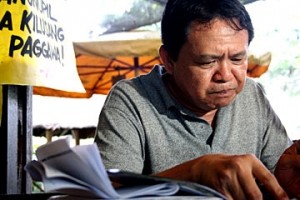 At around 1pm on 23 October 2008, Attorney-at-law, Remigio Saladero Jr. was working in his house when an unidentified man, in plainclothes entered and asked him if he was attorney. Saladero. Saladero replied that he was. Thereafter, the man left and when he returned he was in police uniform together and accompanied by several other police officers from the Antipolo City Police Office (ACPO) of the Philippine National Police (PNP).
The police showed him a warrant of arrest dated 6 October 2008 issued by Regional Trial Court (RTC), Branch 40 in Calapan City in Mindoro Oriental. However, the name and address of the person mentioned in the arrest warrant were different from his. The warrant was for charges of multiple murders and multiple frustrated murders that took place in Mindoro.
Saladero was handcuffed and forcibly taken into custody. The police also took his mobile phone, computer CPU (central processing unit) and a laptop. Later that day his wife, Maricel, who was supposed to meet him at 4pm found that he was not there. The gates to the property and doors of their house were open; the floor was covered in mud and filth.
Saladero was first taken to the Rizal Provincial Police Headquarters in Antipolo City where the arresting officers photographed him. While in police custody, the police refused Saladero’s assertion that he should be allowed to contact his family and inform them of his whereabouts.
Later, he was transferred to Camp Vicente Lim in Laguna. It was only after 8pm that he was able to contact his wife. Maricel arrived at the camp at around 11:30pm accompanied by Atty. Noel Neri, a colleague of Saladero from the Pro-Labor Legal Assistance Center (PLACE), and other groups and persons comprising of the Quick Reaction Team (QRT)–KARAPATAN-National office, AnakPawis Partylist and Kilusang Mayo Uno (KMU) members.
At first, the police refused to allow Maricel and Neri to speak to the victim. It was only after they had a heated argument that the police allowed Maricel and Neri to do so for a short time.
The team stayed in the area until October 24 to ensure that Saladero would be treated accordingly while in police custody. At around 6:30am on October 24, Saladero was made to board a red Toyota Corrolla with no license plates. He was then transported to a pier in Batangas where he was taken on a ferry to Calapan City.
By 10am, another group of QRT was also waiting for Saladero at the court where he would be taken in Calapan City. However, it took the team five hours, instead of the usual travel on a ferry of an hour and 45 minutes, for the police to arrive and to present Saladero in court. It was only around 4pm on October 24, that Saladero and his custodians arrived at the court. He was then taken to the Calapan City Provincial Jail where he is presently detained.
While waiting for Saladero, the paralegal of the team tried asking a clerk of the court for documents on the charges that had been filed against him but they were refused citing various reasons.
ADDITIONAL INFORMATION:
Apart from the murder charges, Saladero was also falsely charged with arson and conspiracy to commit rebellion together with 18 other activists for allegedly having been involved in burning a cell site of a telecommunication company in Lemery, Batangas last August 2, 2008. Responsibility for the said incident has already been publicly claimed by a rebel group, the New People’s Army (NPA).
Those falsely charged together with him were Nestor Samarita, Noriel Ricafort, Agaton Bautista, Amelito Sto. Tomas, Bayani Cambronero, Antonio Cule, Reynaldo Malaborbor, Alex Arias, Rolando Mingo, Nestor San Jose, Mario Caraig, Yolanda Yaun, Jacquilin Entienza, Romeo Lorca Aguilar, Dina Capetillo, Edmar Fernandez, Isabelo Alicaya, and Rafael Magadia.
A certain Arvin Martinez Leviste, a self-proclaimed deep penetrating agent (DPA) of the Philippine Air Force, stood as witness of the case. Leviste claimed that he has been involved with Saladero in NPA activities for a year now.
It was only early this month when Saladero found out that his name and photo was among the list in a memorandum order subject to preliminary investigation by the prosecutor’s office in Batangas City although the order was dated August 12.
Saladero spent most of his time in dealing cases he handles in court at his law office in E. Rodriguez Quezon City. He also regularly met his clients for consultation; thus, the charges filed against him for having been involved in rebel’s activities is highly questionable. It is also physically not possible for him to get involved in stressful activities as he has been suffering from a heart ailment and diabetes.
The PLACE, labor center which Saladero is also one of the lawyers, handles around 700 pending cases involving labor, human rights, criminal, civil and administrative cases on a pro-bono basis. These include the high profile cases of farmers in Hacienda Luisita in Tarlac and workers in Nestle Philippines in Calamba, Laguna.
Saladero is the chief legal counsel of Kilusang Mayo Uno (KMU). Saladero and his law firm is also a long time partner of the CTUHR in training and workshops on legal and court system in various parts of the country.
Before the police took custody of Saladero, there have been incidents of overt surveillance conducted at the office of their labour center, PLACE.
On October 2007, a soldier was arrested for spying on the PLACE’s office in Quezon City. When taken to the police station, the soldier admitted that he and another companion who had escaped from arrest was carrying out surveillance at the PLACE and that they were on official duty. For details please read: UA-309-2007
Saladero was a professor at the Lyceum of the Philippines University and Dominican College, all in Metro Manila. He is also a columnist of the Pinoy Weekly, an online newspaper where he writes about various labor cases in the Philippines.
Saladero, a San Beda law graduate, was one of the top 20 board passers when he took the bar examination in 1984.
SUGGESTED ACTION:
Please write letters to the concerned authorities requesting them investigate the allegations that the continued detention and arrest of the victim was arbitrary; and the charges filed against him had no substantial basis. The murder charges against him, if they are proven to be fabricated, must be withdrawn, and he must be released unconditionally.
Also, the charges for arson and conspiracy to commit rebellion against him and 18 other activists must also be thoroughly reviewed. They must also be dropped if found that no substantial evidence to hold them for trial.
Please also be informed that the AHRC is writing letters to the Special Rapporteur on human rights defenders and Working Group on arbitrary detention calling for intervention in this case.
To support this case, please click here: SEND APPEAL LETTER
SAMPLE LETTER
Dear _________,
PHILIPPINES: Arbitrary arrest and detention of a labour lawyer; 18 other activists falsely charged
CASE 1:
Name of victim: Atty. Remigio Saladero Jr.; 49 years old; member of the Pro-Labor Legal Assistance Center (PLACE); chief legal counsel for Kilusang Mayo Uno (KMU), an alliance of Trade Unions
Place of incident: at his house in Antipolo City, Rizal province
Date of incident: 23 October 2008 at 1pm
Alleged perpetrators: Policemen attached to the Antipolo City Police Office (ACPO)
Status of the case: He was charged with multiple murders and multiple frustrated murders before the Regional Trial Court (RTC), Branch 40 in Calapan City in Mindoro Oriental. He is presently detained at the Provincial Jail in Calapan City
CASE 2:
Name of victims:
1. Atty. Remigio Saladero Jr.
2. Nestor Samarita
3. Noriel Ricafort
4. Agaton Bautista
5. Amelito Sto. Tomas
6. Bayani Cambronero
7. Antonio Cule
8. Reynaldo Malaborbor
9. Alex Arias
10. Rolando Mingo
11. Nestor San Jose
12. Mario Caraig
13. Yolanda Yaun
14. Jacquilin Entienza
15. Romeo Lorca Aguilar
16. Dina Capetillo
17. Edmar Fernandez
18. Isabelo Alicaya
19. Rafael Magadia
Status of the case: All were charged for arson and conspiracy to commit rebellion for allegedly having been involved in burning a cell site of a telecommunications company in Lemery, Batangas on 2 August 2008
I am to writing to voice my deep concern to the continued arbitrary detention of Atty. Remigio Saladero Jr. after the police unit mentioned above have forcibly took him from his house on 23 October 2008.
Though the police were carrying arrest orders for Saladero’s alleged involvement in murder charges, I am deeply concerned over the irregularities in the issuance of the order which raised concerns that he had been arrested over fabricated charges. The name written in the order and the address of a person subject of arrest was different from his.
When the policemen took him from his house, the policeman who first came to serve the order did not properly introduce himself. Instead of introducing himself and his companions to him and their purpose, the first one who approached the victim deliberately wears plainclothes asking the victim who he was; and only after they got confirmation from the victim himself that he was their supposed target did the police came to serve the arrest order.
In this scenario, the policeman have misrepresented themselves and misled the victim into believing they are not members of the security forces, which have taken advantage of the victim’s weakness being a lawyer who is often visited and approached by ordinary persons regarding the cases that he handles.
Apart from that, the searches the police have conducted which resulted to the disarray of the Saladero’s place and seizure of documents without properly explaining to him the purpose and of presenting orders allowing them to do so, is completely unacceptable and are contradictory on matters on policing regarding gathering of evidence. The police’ refusal to allow him, while he was in their custody, to contact and inform his relatives that he was in police custody and of his whereabouts was also condemnable.
He was first taken to the Rizal Provincial Police Headquarters in Antipolo before he was transferred to Camp Vicente Lim in Laguna. On October 24, he was taken to the Regional Trial Court (RTC), Branch 40 in Calapan City in Mindoro Oriental before he was transferred to the provincial jail there where he is presently detained.
It is disappointing that when the paralegals who are helping Saladero’s case tried to obtain the court documents regarding the charges filed against him, the court clerk have refused to provide them the copies invoking various reasons. Therefore, it prevented Saladero’s family and the group helping his case from immediately learning about the charges filed again him; and of how to effectively help his case.
Apart from the murder charges, I have also learned that Saladero has been charged with arson and conspiracy to commit rebellion together with 18 other activists mentioned above for allegedly burning a cell site of a telecommunications company in 2 August 2008.
I have learned that it was only early this month that Saladero came to know that he was amongst those subjects for investigation even though the preliminary investigation has already order to commence on August 12. I am gravely concerned over the irregularities in inquiry at the prosecutor’s office in Batangas province. In doing so, it has prevented once again the victim and his co-accused from making their defense and from being properly informed of the charges filed against them.
I am deeply concerned that the charges filed against Saladero that resulted to his continued arbitrary detention and arrest; and filing of charges to 18 other activists, could have been done to frighten and to prevent them from doing their activities in helping victims of abuses without fear.
For Saladero’s part, prior to his arbitrary arrest, the office where he is attached, PLACE, has since been the object of soldier’s obvious surveillance. Their office has also represented over 700 pro-bono cases involving labour disputes, complaints involving violation of rights, amongst others. Thus, his arbitrary arrest and detention has effectively prevented him from performing as lawyer and to represent his clients in court cases–which is unacceptable.
Also, to accuse Saladero as having been involved in rebel activities is physically not possible for him given him his poor health condition and of his law practice. He had heart ailment and is also a diabetic. He also had a public life. He also reports to his office regularly, appears in court cases and conduct legal consultations to his clients–this put the claims of him having involved in a rebel group highly questionable.
It is shocking that the lawyers who are representing the poor sectors of the society are themselves targets and are themselves victimized. I therefore urge you to conduct a thorough investigation into the allegations against the policemen and the charges filed against him. If proven that there are no substantial evidence to hold him and his co-accused for trial, their case must be withdrawn.
Yours sincerely,
————-
PLEASE SEND YOUR LETTERS TO:
1. Mrs. Gloria Macapagal-Arroyo
President
Republic of the Philippines
Malacanang Palace
JP Laurel Street, San Miguel
Manila 1005
PHILIPPINES
Fax: +63 2 736 1010
Tel: +63 2 735 6201 / 564 1451 to 80
E-mail: corres@op.gov.ph
2. Ms. Leila De Lima
Commissioner
Commission on Human Rights
SAAC Bldg., Commonwealth Avenue
U.P. Complex, Diliman
Quezon City
PHILIPPINES
Fax: +63 2 929 0102
Tel: +63 2 928 5655 / 926 6188
E-mail: chr.delima@yahoo.com or mtm_rodulfo@yahoo.com
3. Deputy Director General Jesus A. Verzosa
Chief, Philippine National Police (PNP)
Camp General Rafael Crame
Quezon City
PHILIPPINES
Fax: +63 2724 8763
Tel: +63 2 726 4361/4366/8763
E-mail: bluetree73@gmail.com
4. Mr. Raul Gonzalez
Secretary
Department of Justice (DoJ)
DOJ Bldg., Padre Faura
1004 Manila
PHILIPPINES
Fax: +63 2 521 1614
E-mail: raulgonzalez_doj@yahoo.com
5. Mr. Ronaldo V. Puno
Secretary
Department of Interior and Local Government (DILG)
A. Francisco Gold Condominium II
EDSA cor. Mapagmahal St., Diliman
Quezon City
PHILIPPINES
Fax: +63 2 925 0332
Tel: +63 2 925 0330 / 31
E-mail: rvpuno@dilg.gov.ph
6. Mr. Christopher Lock
Court Administrator
Office of the Court Administrator
Supreme Court of the Philippines
New Supreme Court Building Annex
Padre Faura St.,Ermita,
1000 Manila
PHILIPPINES
Tel: +63 2 525 5741 / 521 5133
Thank you.
Urgent Appeals Programme
Asian Human Rights Commission (ua@ahrchk.org)
