
Dear friends,
The Asian Human Rights Commission (AHRC) regrets to inform you that at least three more persons have been arrested in recent days apparently because of their work in relief efforts for the victims of Cyclone Nargis. The three are the chairman and members of the Human Rights Defenders and Promoters group. Meanwhile, a famous comedian and a magazine editor also taken away in June have now had serious charges laid against them.
CASE DETAILS:
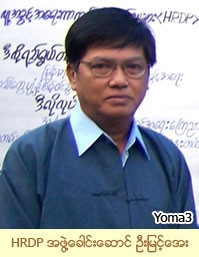 According to information that the AHRC has received from the Yoma 3 news group (Thailand) and a number of other sources, a team of police and administration officers came to the house of U Myint Aye, the chairman of the Human Rights Defenders and Promoters (HRDP) group at around 4pm on 8 August 2008 and after searching the house for over two hours and taking some documents and other items they told Myint Aye to go with them for a short while. However, Myint Aye did come back that night.
The next afternoon, another team came to the house and asked for some sets of clothes for Myint Aye, indicating that he will be detained for some time. They told his family not to worry and to ask for any help if they need it; however, as in other cases like this they did not give any details about where they had taken Myint Aye or why. His family and colleagues believe that his arrest is somehow connected to the cyclone relief work that he and his group were doing after Nargis hit the country in May, and documents relating to that work were among those taken from the house during the search.
Myint Aye’s arrest followed that of another two members of the HRDP group. Myo Min, who lives nearby, was taken on August 6 and Ko Thant Zaw Myint was taken on August 7. At this stage the AHRC does not have full details on the circumstances of their arrests or whereabouts.
The arrests coincided with the visit to the country of the new United Nations special expert on human rights in Burma.
UPDATE OF PREVIOUS APPEAL
The AHRC had previously reported on the arrest of prominent comedian Zarganar for his Cyclone Nargis relief work and outspokenness on the need for a greater recovery effort (AHRC-UAC-126-2008; see also related article at UPI Asia Online). Zarganar and another person who was similarly detained around the same time, Ko Zaw Thet Htwe, the former editor of a sports magazine, have both now reportedly been charged with serious criminal offences. According to their lawyer, so far he has learned that his clients are being charged with upsetting the public tranquility, outraging religious feelings, having contact with illegal associations, having illegal videos and some electronic communications offences. A further two persons are also reportedly included on the charge sheets.
The AHRC is following this and other cases arising from Cyclone Nargis closely and will provide further details as they come to hand.
ADDITIONAL INFORMATION:
The AHRC has on numerous previous occasions reported on harassment of the members of HRDP, including the arrest of at least 19 of its members during last September’s protests (AHRC-OL-035-2007); an assault on U Myint Aye in March (AHRC-UAC-062-2008); the life imprisonment of Ko Thiha also in March (AHRC-UAC-052-2008); the assault, arrest and imprisonment of “The Henzada 6“, and the imprisonment of Ko Min Min (UP-108-2007). A number of these cases are discussed in detail, together with further explanatory content, in the December 2007 edition of the Asian Legal Resource Centre’s periodical, article 2.
Zarganar too was detained last September for his role in the monk-led protests but was later released. See UP-126-2007 and UP-125-2007.
For more information on human rights issues after Cyclone Nargis please visit: http://campaigns.ahrchk.net/cyclonenargis/
SUGGESTED ACTION:
Please write to the persons listed below to call for U Myint Aye and other persons arrested over their relief efforts of Cyclone Nargis victims to be released immediately. Please note that for the purpose of the letter, the country should be referred to by its official title of Myanmar, rather than Burma.
Please be informed that the AHRC is writing a separate letter to the UN Special Rapporteur on Myanmar, the UN Special Representative on human rights defenders, the UN Working Group on arbitrary detention and the regional human rights office for Southeast Asia, calling for interventions into this case.
To support this case, please click here: SEND APPEAL LETTER
SAMPLE LETTER
Dear ___________,
MYANMAR: Chairman and members of human rights group arrested and detained without charge
Details of victim: U Myint Aye, 57, resident of Makyidaung, East Ward, Kyimyindaing Township, Yangon, chairman of the Human Rights Defenders and Promoters group
Some officials involved:
1. Police Captain Kyaw Sein, Yangon Division Police (intelligence)
2. Myat Linn, Police Chief, Kyimyindaing Township Police, Yangon
3. Unidentified Special Branch personnel
4. Chairman, Makyidaung Ward Peace and Development Council, Kyimyindaing
5. Member, Ohboe Ward Peace and Development Council, Kyimyindaing
Date and place of incident: Residence of U Myint Aye, 8 August 2008, around 4-6:30pm
I am writing to express my concern over the detaining of a human rights defender, U Myint Aye, and at least another person in his group, apparently in connection with their relief efforts for victims of the recent Cyclone Nargis.
According to information that I have received, a team of about 12 police and civilian officials led by Police Captain U Kyaw Soe and the township police chief entered the house U Myint Aye at around 4pm on 8 August 2008 and after searching the premises for around two and a half hours and taking some documents and other items they told Myint Aye to go with them for a short while.
However, Myint Aye did come back and instead the next afternoon, another team of around six persons led by the township station police chief came to the house again at around 4pm and asked for some sets of clothes for Myint Aye. They told his family not to worry and to ask for any help if they need it; however, as in other cases like this they did not give any details about where they had taken Myint Aye or why.
Myint Aye’s family and colleagues have expressed their fears that his arrest is somehow connected to the cyclone relief work that he and his group were doing after Nargis hit the country in May, as documents relating to that work were among those taken from the house during the search. They fear that some serious charges will be framed against him and two other members of his group, Ko Myo Min and Ko Thant Zaw Myint, who were reportedly arrested on August 6 and 7.
Their fears are justified. I note with special concern that at least four other persons who were involved in cyclone relief work, namely prominent comedian Zarganar (a.k.a. Ko Thura), former editor Ko Zaw Thet Htwe, Ko Thant Zin Aung and another young man, are being charged with a range of very serious offences including upsetting the public tranquility and outraging religious feelings (Penal Code sections 505[b] and 295A), having contact with illegal associations (Unlawful Associations Act, section 17(1)), having illegal videos and some electronic communications offences.
I am extremely disturbed to hear of the continued arrest and charge-sheeting of persons whose “crime” was to work for the betterment of their fellow citizens at a time of great need, not to mention the fact that these people have not at the time of arrest been told where they are being taken or why, nor given access to their families and lawyers until interrogations have been completed with a view to lodging these fabricated cases.
I am particularly shocked to note that these particular arrests coincided with the visit of the new United Nations Special Rapporteur on the situation of human rights in Myanmar, speaking to the government’s very deep lack of integrity and commitment to fundamental human rights and the good of its citizens.
I therefore call for the immediate release of U Myint Aye and all other persons detained in connection with Cyclone Nargis, for the dropping of charges against any against whom cases have already been commenced, and for the return of their possessions. I also take this opportunity to call for the release of imprisonment of all members of the Human Rights Defenders and Promoters group, including Ko Thiha, 34, convicted of sedition (Penal Code section 124A) and upsetting public tranquility, sn. 505(b), sentenced to 22 years in prison; Ko Myint Naing, 40, Ko Kyaw Lwin, 40, U Hla Shein, 62, U Mya Sein, 50, U Win, 50, and U Myint, 59, all residents of Henzada Township sentenced to four to eight years for upsetting public tranquility (Penal Code section 505(b)(c)) and Ko Min Min, 30, residing in Pyi Township, sentenced to three years’ imprisonment for illegal tuition.
Finally, I take this opportunity to remind the Government of Myanmar of the need to allow the International Committee of the Red Cross access to places of detention and not least of all, access to those persons and forcibly disrobed monks and nuns who have been held in violation of criminal procedure and without charge or trial since the events of last September.
Yours sincerely,
—————-
PLEASE SEND YOUR LETTERS TO:
1. Maj-Gen. Maung Oo
Minister for Home Affairs
Ministry of Home Affairs
Office No. 10
Naypyitaw
MYANMAR
Tel: +95 67 412 079/ 549 393/ 549 663
Fax: +95 67 412 439
2. Lt-Gen. Thein Sein
Prime Minister
c/o Ministry of Defence
Naypyitaw
MYANMAR
Tel: + 95 1 372 681
Fax: + 95 1 652 624
3. U Aung Toe
Chief Justice
Office of the Supreme Court
Office No. 24
Naypyitaw
MYANMAR
Tel: + 95 67 404 080/ 071/ 078/ 067 or + 95 1 372 145
Fax: + 95 67 404 059
4. U Aye Maung
Attorney General
Office of the Attorney General
Office No. 25
Naypyitaw
MYANMAR
Tel: +95 67 404 088/ 090/ 092/ 094/ 097
Fax: +95 67 404 146/ 106
5. Brig-Gen. Khin Yi
Director General
Myanmar Police Force
Ministry of Home Affairs
Office No. 10
Naypyitaw
MYANMAR
Tel: +95 67 412 079/ 549 393/ 549 663
Fax: +951 549 663 / 549 208
Thank you.
Urgent Appeals Programme
Asian Human Rights Commission (ua@ahrchk.org)
