
Dear friends,
The Asian Human Rights Commission (AHRC) has received information that a conscripted young man who objected to military service based on his conscience on 27 July 2008, received an order four times to join in order to disperse protestors, which he has refused. Based on this fact, the prosecutor who pleaded for an arrest warrant with detention, which was earlier dismissed, has again pleaded for it and the detention of the young man has been decided.
CASE DETAILS:
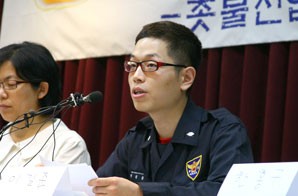 Mr. Lee Gil-jun, 24 years old, held a press conference at 7pm on 27 July 2008 and declared that he objected serving as an auxiliary police – a type of duty of national defense. He received a special holiday for three days due to his duty to suppress people taking part in the candlelit rallies.
He claims in his statement that he received orders from his commander to hit protestors with the shield and batons, in order to disperse them during recent ongoing protest. He had to return to Jung Lang Police Station, Seoul at 8pm on July 25 but instead he held a sit-in protest. On July 31, he voluntarily returned to the police station with thoughts that even though he violated the current law he had made this decision from his conscience.
When the prosecutor’s office pleaded for an arrest warrant with detention, charging him with not returning to the police on time and for defamation, a court decided not to issue an arrest warrant without detention based on the fact that there is no worry of him running away or destruction of evidence. After the court decision, he was forced to return to the police station on August 2.
Then at the police station, knowing Mr. Lee objected military service based on his conscious, his commander ordered him to join with his colleagues to disperse people holding assemblies. The commander asked him to follow the order in a serious tone four times but Mr. Lee repeatedly refused the order. Based on this fact the prosecutor once again pleaded for an arrest warrant with detention from a court on August 5, after adding one more charge of his disobeying order.
On August 8, the court issued an arrest warrant with detention saying that Mr. Lee has refused to follow the order from his commander and there is a concern of repetition of the offence. It also added that there is also concern on his running away in the light of his repetition of disobeying an order.
Unofficial translated version
[Declaration of Conscience] I Resist!
July 27th 2008 / Lee Gil-jun
I, a conscripted policeman on active service, declare a conscientious objection to the military, and refuse to rejoin my unit. It was definitely not an easy decision. It was difficult for me to imagine all the pain and suffering it would bring, especially what my parents would have to go through. But here I am, still screaming resistance. It all sounds quite serious. But I’m not doing this to serve a greater cause. I’m just going through a process of finding myself, and trying to have a voice in my own life.
Yes. Resistance, to me, is a way to lead my life with my own subjectivity. Listening to your inner voice, having the values you believe to be right, adding colors to enrich your life and co-existing with others in harmony are all things that would be meaningful to just about anyone. And in the process, if something should suppress your life, you face it and resist it. That, I believe, is the way to live your life with passion. So now, I shed my old self, the one who has adapted to the ways of suppression, and move on to find myself through resistance.
This past February, I enrolled in the army as a conscripted policeman. I understand the many criticisms about this decision, especially regarding the actions I’m taking now. Although I oppose the idea of compulsory military service, if I had to serve my own society, I wanted to do something that is truly meaningful to society and myself. After giving it much thought, the path I chose was to join the conscripted police. But it turned out to be far different from what I had expected. Some people might criticize me and say I’m not being responsible for my own decision, but I don’t think that takes away my right to object to unjust orders.
During my service as a riot police officer, I realized that we can be put into unwanted situations by the authorities at any time. Over the last few months, I saw the candlelight protests in the eyes of a policeman, and these thoughts ran through my head. The things people were saying with candles in their hands–“Renegotiate the terms of US beef import!s”, “No privatization of state-owned corporations and public health insurance”, “No more education system that drives fierce competition in schools.” — all sounded to me like one voice. As if they were saying that the authorities can threaten our lives at any given moment, and they want to stand up to it.
At the candlelight protests, various voices came together for a common goal. There were many different sights, but the overall atmosphere was not one of grave strife but more like a festival of people. It was a festival for themselves and for the good of society. But the life-threatening authorities showed no efforts to communicate. Instead they forced young men in police uniforms into a situation where they would have to fight against fellow citizens. Should we have quelled the citizens as if they were our enemy because we’re such evil people? All of us just wanted to serve our society and our families for 2 years. None of us came into this to attack ordinary people demonstrating in the streets. The authorities would tell us to keep in mind that the protesters are not our enemies, but it was in complete hypocrisy. In reality, they wanted us to treat them as our enemies and always be ready for a violent crackdown at any moment.
When faced with an unseen force, such as orders given by the system, an individual becomes completely powerless. As I confronted the citizens with my shield, as I committed acts of violence or helped continue the violence, I couldn’t dare think to go against the orders. All I could do was to take in all the pain I was faced with. This goes for all the riot policemen out there. We take out our anger on the protesters, our so-called “enemies”, and we justify our actions and hide our hurt while those in power that got us here in the first place is nowhere to be seen.
As days went by, I felt my sense of humanity burning to ashes. As I was brought into repression operations, as I guarded the streets indefinitely, and even when I heard people’s complaints and ridicules, it was awful accepting the fact that I had to follow orders without being able to say anything. I could bear the straining working hours and the physical pain, but it got worse when I thought about what I was doing, questioning what exactly it was that I was trying to protect. No one actually speaks of such matters, but is it okay for barely 20 year old young men to act as tools of violent repression if it’s for the sake of social “order” and “safety”? Who is to guarantee its legitimacy?
During this difficult time, I tried to escape from reality in any possible way, but at some point it hit me that running away was no longer the answer. As long as I stayed on that side of the protests, I would always be contributing to suppression, and that would just be an act of abandoning all the things I had seen. It was especially important for me to listen to my inner voice and to express a definite resistance to what was oppressing me in order to live out what’s left of my life with my own subjectivity. I was also apprehensive that I would become a shallow hypocrite if I continue to conform to orders that I felt were unjust and neglect all my hurt feelings.
The only way to heal my wounds, as an offender and a victim, and to get my life back on track, was resistance. Looking back, I feel that I have lived a life of compromise, never resisting the things that suppressed my life. I saw this opportunity as a turning point in my life. This path might be painful and difficult, but it’s also somewhat fun discovering the person I want to be.
I don’t consider myself to be a scapegoat or a martyr in this troubled political situation, as many around me have feared. Nor do I want to be the hero of my time. I don’t want any part in political games or take advantage of this situation in any way. I’m just staying true to my desires to lead an ordinary life of peace and harmony with others, and I want to be able to live with myself.
I don’t want to declare my struggle to be one of so much seriousness. I believe the process of resistance should be fun. With suppression come many harsh conditions, but confronting them and finding your own voice in the process shouldn’t necessarily be taken so seriously. I will continue with my efforts, but I have a small wish that more people will begin to resist any form of suppression that may be in their lives.
Through my actions, I feel that I am beginning to take control of my life and I hope that the current system of forced, repeated violence can come to an end. Isn’t it time to put an end to thousands of young men having to stay up another tormenting night, who could be getting hurt just as I’ve been?
Finally, I want to thank all those who have listened to my story, who supported me and are still with me now. I especially want to thank my parents who made a difficult choice in supporting me and withstanding pain for this unworthy son, who understand me and are always on my side. I just want to say that I love you.
ADDITIONAL INFORMATION:
In South Korea, every man has a duty to fulfil national defense according to the Constitution and they are conscripted to finish the duty for about 26 months. It is estimated that about 3,761 young men from 2002 to 2006 have objected to military service and all are criminalized due to the lack of recognition of conscientious objection to military service and alternative military system. Due to their criminal record, they have had difficulties in getting a job and been discriminated against in society.
The Korean government has been recommended to adopt alternative military service from different UN human rights monitoring mechanisms and the UN Human Rights Committee expressed in its jurisprudence saying that the Republic of Korea has violated articles of the International Covenant on Civil and Political Rights (ICCPR), to which the Republic of Korea is a state party.
After being criticised, the Ministry of National Defense established a Research Committee on Alternative Service under the Ministry and finished its research in 2006. In addition, the government made its voluntary pledges and commitment to be re-elected as a member of UN Human Rights Council regarding this issue.
However, it is reported on July 4 that the Ministry is reviewing from the beginning the plan of adoption of alternative military service starting early 2009.
SUGGESTED ACTION:
Please write to the authorities listed below urging them to release Mr. Lee so that he is no longer detained before he receives a final decision from the court.
Please be informed that the AHRC has written separate letters to the UN Special Rapporteur on the Question of Torture, freedom of opinion and expression and Working Group on Arbitrary Detention calling for intervention in this matter.
To support this case, please click here: SEND APPEAL LETTER
SAMPLE LETTER
Dear _______,
SOUTH KOREA: Arbitrary detention of a conscientious objector for disobedience
Name of victim: Mr. Lee Gil-gun, 24 years old; currently detain at Joong Rang Police Station and will be transferred to Seong-dong Detention Center
Date of incident: 7 August 2008
Place of incident: Joong Rang Police Station, Seoul
I am writing to express my deep concern regarding the arbitrary detention of a conscripted young man who objected to military service based on his conscience on 7 August 2008.
According to the information that I have received, regretting his duty to suppress protestors after being conscripted, he objected to military service on July 27 and returned to his unit three days after the fixed time. Based on his delay to return to his unit, a prosecutor asked for an arrest warrant with detention from the court but the court dismissed the prosecutor’s request.
From the information that I have learned, since the first denial of detention from the court, his commander ordered Mr. Lee to join his colleagues to disperse protestors four times, which Mr. Lee refused. Based on this reason, the prosecutor added one more charge of disobey an order and again asked for his detention from the court. On August 7 his detention order was issued.
Based on the fact that Mr. Lee was conscripted into the battle police and auxiliary police, for him to complete his constitutional duty of national defence, he objected to military service based on his conscience. His commander already aware of his objection repeatedly asked him to follow his order. Due to his disobedience he is detained.
Mr. Lee has to be released from his unit and should be brought before the court where his objection to military service will be judged before the court. However, Mr. Lee was forced to remain in his unit, which caused him to disobey. Finally detained, the court must give its final decision on his case.
Accordingly, I urge you to release Mr. Lee so that his case will be dealt with by the court. I also urge the government of the Republic of Korea to recognise the conscientious objection to military service and adopt the alternative military service: as promised in its voluntary pledges and commitment at the re-election at the UN Human Rights Council, so that those objectors including Mr. Lee will be no longer criminalised on the basis of their conscience.
Yours sincerely,
———–
PLEASE SEND YOUR LETTERS TO:
1. Mr. Park Jong-su
Senior Superintendent of Police
Jung Lang Police Station
249-2, Jungnang-gu, Seoul
REPUBLIC OF KOREA
Fax: +82 2 971 9306
Tel: +82 2 977 0112
E-mail: jr270@npa.go.kr
2. Mr. Eo Cheong-soo
Commissioner General
Korean National Police Agnecy
209 Migeun-dong
Seodaemun-gu, Seoul
REPUBLIC OF KOREA
Fax: +82 2 365 5797
Tel: +82 2 363 0112
E-mail: cnpa100@police.go.kr
3. Mr. Won Sei-hoon
Minister
Ministry of Public Administration and Security
Central Government Complex
55 Sejong-no (77-6 Sejong-no 1ga)
Jongno-gu
Seoul, 110-760
REPUBLIC OF KOREA
Fax: +82 2 2100 4001
Tel: +82 2 2100 3000
E-mail: webmaster@mopas.go.kr
4. Mr. Lee Sang-hee
Minister
Ministry of National Defense
Youngsan-dong 3 Ga, Youngsan-gu
Seoul, (140-701)
REPUBLIC OF KOREA
Fax: +82 2 748 6895
Tel: +82 2 748 1111
E-mail: cyber@mnd.go.kr
5. Mr. Kim Kyung-Han
Minister
Ministry of Justice
88 Gwanmon-ro, Gwachon-si
Gyonggi Province 427-760
REPUBLIC OF KOREA
Fax: +82 2 2110 3079 / 503 7046
E-mail: webmaster@moj.go.kr
6. Mr. Lee Myeng-Bak
President
1 Sejong-no, Jongno-gu
Seoul 110-820
REPUBLIC OF KOREA
Fax: +82 2 770 4751
Tel: +82 2 770 0018
E-mail: foreign@president.go.kr or president@cwd.go.kr or president@president.go.kr
7. Mr. Ahn Kyong-Whan
Chairperson
National Human Rights Commission
16 Euljiro 1-ga
Jung-gu
Seoul 100-842
REPUBLIC OF KOREA
Fax: +82 2 2125 9812 / 2125 9666
Tel: +82 2 2125 9700
E-mail: nhrc@humanrights.go.kr
Thank you.
Urgent Appeals Programme
Asian Human Rights Commission (ua@ahrchk.org)
