
Dear friends,
The Asian Human Rights Commission (AHRC) has learned that 120 children have been exposed to asbestos since March 2009, and that various government authorities have continually and clearly side-stepped calls by parents to fully investigate or act. The demolition has been taking place since March 2009 yet the children’s families were not informed of their exposure to asbestos, and many children have been falling sick as a result. After months of objections and independently commissioned tests by parents and environmental groups, the relevant authorities have stopped part of the demolition and promised to relocate the school, however no moves are being made to consider the wider implications of this negligence.
CASE DETAILS: (According to interviews with victims and the NGOs)
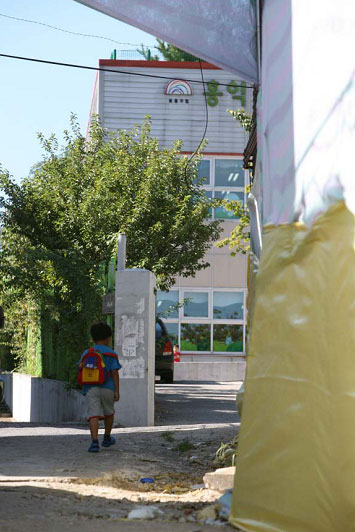 Hong-Ik nursery school is in Sungdong-Gu, Seoul, in an area targeted for re-development, as of 25 March 2009 (details in the letter below). According to a report by the Ministry of Labour, 131 buildings in the area were slated for the removal of asbestos, but approximately 120 children under the age of five were allowed to go to school every day in that area while the demolition was taking place.
Finding their children were affected by asbestos with sicknesses such as skin inflammation, coughs, phlegm, pneumonia, conjunctivitis parents have made several visits to the Seoul City administration, the Sungdong-Gu administration and the Ministry of Labour since April to make a civil appeal. However their concerns have been largely brushed aside.
The Ministry of Labour insisted that it has no duty to residents who might be affected by the removals, only to workers’ safety. Yet both the Seoul City and Sungdong-Gu administrations told parents to complain and appeal to that particular ministry; they also claimed that there was no place to relocate the school to. At one point Sungdong-Gu administration intended to relocate the school in early May, but this has not happened.
Tenants and parents commissioned their own investigation using the Citizen’s Institute for Environmental Studies and the Institute of Specialized Analysis for Asbestos (ISAA), which has tested the area seven times since April. ISAA, which is authorized by the Ministry of Labour, concluded that nine out of 18 places investigated had levels of asbestos beyond the standard. This includes the area around the nursery school and the passage to the school, which were tested on 19 June and 27-28 August, proving that the children had been exposed.
In response to this the Seoul City administration turned to an institute that is not authorized by the Ministry of Labour, the Technical Institute for Working Environment. A single investigation done by them on 5 September produced results claiming that the asbestos intensity in the air is of acceptable standards. Yet tenants allege that water spraying in the demolished area before the investigation affected the results.
Ignoring the investigations conducted by the authorized ISAA, the Seoul city adminstration then proclaimed that levels of asbestos in the area were safe, only stopping the demolition in Wang-ship-li area I after intense pressure from parents and environmental groups, on 13 September. Yet demolition in Wang-ship-li area II has continued just 100 to 200 metres away from the nursery school, and is affecting the children’s health.
Residents have also testified that the government rebuffed their concerns when they reported the disposal of asbestos with other refuse by Korea Environment & Construction (KE&C), which is prohibited. KE&C claimed that an ‘unknown thief’ was responsible for this, and it was not punished. The Ministry of Labour responded to the parents’ complaint, lodged 22 June 2009, by claiming that such disposal was no longer being done and therefore was no longer an issue. These testimonies prove that the relevant authorities have attempted to justify their neglect and have not been monitoring seriously the process of asbestos removal.
Despite the serious violation of children’s right to health, the local administration has still taken no substantial action on its promise to relocate the school in September. On 17 September sixty people, including parents and teachers of the school, submitted a petition to the Ministry of Environment, calling for an investigation into the harmful health effects resulting from the exposure to dangerous materials. They cited their right to petition, which is enshrined in Article 17 of the Law on Environment and Health Care. According to the Petition Law, the Ministry of Environment should hold the relevant committee meeting and inform the results to the petitioners within 90 days. In part the parents have been forced to take this measure because they have repeatedly been denied a health assessment from the Seoul City administration.
BACKGROUND INFORMATION:
According to the report by World Health Organization (WHO), asbestos has been classified by the International Agency for Research on Cancer as carcinogenic to humans. It is reported that asbestos-containing materials are still in place in many buildings and exposure continues during maintenance, alteration, removal and demolition. Asbestos can lead to development of cancer which may stay latent for decades.
While many developed countries have been banning asbestos since the early 1990s, the government of Korea banned it only in 2009. As most of the current buildings contain asbestos, their demolition exposes residents and workers to asbestos. For example the ‘New Town Project’ launched by the Seoul City administration in 2003 as an example of equal and balanced development, has not been paying particular attention or arranging appropriate supervision to this issue.
The problem is reflected in the report of the Ministry of Labour in 2008, which says that asbestos removal licensed by the Ministry of Labour has increased to 6,893 cases, a 357% increase compared with 1,933 cases in 2007. On the contrary, only 3% (270 cases) out of the total were monitored by a supervisor and 26% (72 cases) of those were conducted by unauthorized agencies. As shown by this case, shortfalls exist in investigation as well as supervision.
In addition to this, although the government of Korea has prohibited the usage of asbestos, it is still being used in developing countries that cooperate in the construction industry with Korean companies. Thus construction companies with Korean ownership still profit from use of asbestos, despite its known dangers.
ADDITIONAL COMMENTS:
It is stated in article 35 of the Constitution that every citizen has a right to life with a healthy and clear environment and the State and citizens should make an effort to maintain an enjoyable environment.
The government of Korea, as a state party of International Covenant of Economic, Social and Cultural Rights (ICESCR), also has an obligation to respect, protect and fulfill those rights. However, the redevelopment project whose entire operation is performed by the government, completely fails to respect the right to health.
The Health and Environment Ministries’ meeting in the Asia-Pacific initiated by ASEAN and other countries including China, Korea, Japan, and Mongolia since 2003 aims to establish joint policy on health and environment affected by pollution and changes in environment. The meeting is scheduled to be held in South Korea next year. It is an absolute necessity for the issue of health security relating to asbestos exposure and redevelopment projects to be discussed, with a focus on government negligence.
SUGGESTED ACTION:
Please write to the officials listed below, calling for them to take immediate action in order to ensure the right to health of the children who have been exposed to asbestos, and to build an appropriate mechanism to remove asbestos in the process of demolition.
The AHRC has already written a separate letter to the UN Special Rapporteur on the right of everyone to the enjoyment of the highest attainable standard of physical and mental health.
To support this case, please click here: SEND APPEAL LETTER
SAMPLE LETTER
Dear __________,
Re: SOUTH KOREA: Please ensure 120 children’s right to health exposed to asbestos in the process of demolition
Name of the affected children: 120 children under age of five who are the students of Hong-Ik nursery school.
Relevant government authorities in charge:
1. Seoul City administration
2. Sungdong-Gu administration
3. Ministry of Labour
4. Ministry of Environment
5. Ministry of Health, Welfare and Family Affairs
Place of the incident: Wang Ship li-New Town area I, Hawang Ship li-Dong, Sungdong-Gu, Seoul
Date of the incident: Since 25 March, 2009
I am writing to express my deep concern about the exposure of 120 children under the age of five to asbestos, since March 2009.
I am informed that the children, students of Hong-ik nursery school run by the Sungdong-Gu administration, have been going to school while the demolition of buildings containing asbestos has been taking place nearby.
I am aware that asbestos has been classified by the International Agency for Research on Cancer as carcinogenic to humans. Asbestos can lead to development of cancer which may stay latent for decades. It also has many other known harmful effects on health, all the more to children.
I am surprised to learn that despite the fact that 131 buildings in this area were registered to the Ministry of Labour as requiring removal of asbestos, the Ministry of Labour neither notified people in the area regarding the removal of asbestos nor stopped running school so that the children would not be exposed. Parents and teachers only realized the danger when their children fell sick with maladies such as skin inflammation, cough, phlegm, pneumonia, conjunctivitis, etc.
I am informed that parents made several visits to Seoul City administration, Sungdong-Gu administration and Ministry of Labour to make civil appeals in April 2009. However, all these authorities refused the appeal saying that they did not have responsibility for the childrens health care. I am further surprised to learn how each authority made excuses to escape their duty to ensure right to health for all citizens.
The Ministry of Labour insisted that they are only responsible for workers’ safety in removing asbestos. Both Seoul City administration and Sungdong-Gu administration pointed parents to the Ministry of Labour. Even the Ministry of Environment denied responsibility.
The administration has since ignored parents’ complaints on the grounds that there is no place to relocate the school, and relocation offers have been continually delayed. Meanwhile children continue to be exposed to the asbestos.
I am informed also that tenants and parents commissioned their own investigation, using the Citizen’s Institute for Environmental Studies and the Institute of Specialized Analysis for Asbestos (ISAA), testing the area seven times since April. ISAA, which is authorized by the Ministry of Labour, concluded that nine out of 18 places investigated had levels of asbestos beyond the standard. This includes the area around the nursery school, and the passage to the school, which were tested on 19 June and 27-28 August, 2009, proving that the children had been exposed.
In response to this the Seoul City administration turned to an institute that is not authorized by the Ministry of Labour, the Technical Institute for Working Environment. A single investigation done by them on 5 September produced results claiming that the asbestos intensity in the air is of acceptable standards. Tenants allege that water spraying in the demolished area before the investigation affected the results.
I am therefore of the opinion that no government authority is concerned about right to health of children or taking responsibility to ensure this right. From the beginning no government authority paid attention to the asbestos exposure to the children and even after the asbestos exposure were discovered, no action has been taken, but rather each department has denied responsibility at the first instance. The investigation was a superficial action and no monitoring system has been set up. A few times of parents demands for medical check-ups for the children were refused by the government as well.
I have learned that the 2008 report of Ministry of Labour says that asbestos removal licensed by the Ministry of Labour increased up to 6,893 cases, which is a 357% increase compared with 1,933 cases of 2007. Yet only 3% (270 cases) out of the total were monitored by a supervisor, and 26% (72 cases) of even those were conducted by unauthorized agencies. As shown by this case, shortfalls exist in investigation as well as supervision.
I am informed that only after pressure of parents as well as environmental groups, did the local government discontinue demolition of the building in Wang ship li-area I, from 13 September. Yet demolition in Wang ship li-area II, which is only 100-200 meters away from the nursery school, has still been allowed and is continuing, and is allegedly still affecting the children’s health.
On 17 September, sixty people including parents and teachers of Hong-ik nursery school submitted a petition to the Ministry of Environment for investigation into the harmful effects on the health from the exposure to the dangerous materials, according to their right to petition which is enshrined in Article 17 of the Law on Environment and Health Care.
I am aware that while many developed countries have banned asbestos since the early 1990s, the Korean government banned it only in 2009. As many of the buildings still contain asbestos, the demolition of those buildings exposes residents as well as workers to asbestos. With the ‘New Town Project’ launched by the Seoul City administration since 2003, demolition of buildings in the projected areas has been carried out, but without proper attention to and supervision of the effect of asbestos exposure on health.
It is stated in article 35 of the Constitution that every citizen has a right to life with a healthy and clear environment, and that the State and citizens should make an effort to maintain an enjoyable environment. The government of Korea, as a state party of International Covenant of Economic, Social and Cultural Rights (ICESCR), also has an obligation to respect, protect and fulfill those rights. However, the redevelopment project, the entire operation of which is performed by the government, completely fails to respect the right to health.
I have learned that the Health and Environment Ministries’ meeting in the Asia-Pacific initiated by ASEAN and other countries including China, Korea, Japan, and Mongolia since 2003 aims to establish joint policy on health and environment affected by pollution and changes in environment. I have further learned that the meeting is scheduled to be held in South Korea next year. I am of the opinion that it is an absolute necessity to discuss health security violated by asbestos exposure and redevelopment projects, due to the neglect of the government.
I therefore urge you to protect the right to health of children and other residents in Korea, by taking the following steps:
1. Immediately relocating the Hong ik nursery school
2. Immediately halting demolition in the neighboring area
3. Immediately performing medical check-ups for the affected children and other residents
4. Providing constant medical support for the affected children and residents
5. Building up a responsible system for demolishing and monitoring asbestos in mutual cooperation with all relevant authorities, which considers the concerns of and effects on residents
6. Preventing Korean-owned construction companies from profiting in other developing countries from use of asbestos which does not consider and protect workers and residents right to health
All of the above should be at the expense of the government rather than of the families affected.
I look forward to your prompt and substantial action.
Yours sincerely,
—————
PLEASE SEND YOUR LETTER TO:
1. Lee, Myung-bak
President of South Korea
1 Sejongno Jonno gu
Seoul, Republic of Korea
110-820
Fax: +82 2 770 4943 / 2 770 2440
2. Oh, Se-hoon
Mayor of Seoul Metropolitan Government
Deoksugung-gil 15, Jung-gu,
Seoul 100-110,
Republic of Korea
3. Jeon, Jae-Hee
Minister
Ministry of Health, Welfare and Family Affairs
Hyundai Bldg., 75 Yulgong-ro, Jongno-gu,
Seoul, Republic of Korea
Fax: +82 2 2023 7234
4. Lee, Young-Hee
Minister
Ministry of Labor
Government Complex II, Jungang-dong1,
Gwacheon-si, Gyeonggi-do
Republic of Korea
427-718
Fax: +82 2 3679 6581
5. Lee, Maanee
Ministry
Minister of Environment
88 Guanmoon-road, Gwacheon City,
Gyeonggi Province
427-729
Fax: +82 2 504 9206
6. Lee, Ho-jo
Mayor of Seungdong-gu
10 GoSanJa-ro, 7 Hengdang-dong
Seungdong-gu
Seoul 133-701
Fax: +82 2 2286 5700
7. Young-woo Park
Regional Director and Representative
United Nations Environment Programme (UNEP)
Regional Office for Asia and the Pacific (ROAP)
2nd Floor, United Nations Building
Rajdamnern Nok Avenue
Bangkok 10200, Thailand
Fax: +66 2 280 3829
8. Director
United Nations Environment Programme
United Nations Avenue, Gigiri
PO Box 30552, 00100
Nairobi, Kenya
Fax: +254 20 7624489/90
9. Dr. Margaret Chan
Director-General
World Health Organization
Avenue Appia 20
1211 Geneva 27
Switzerland
Fax: + 41 22 791 31 11
10. The WHO Office in the Republic of Korea
Hyundai Building, 75 Yulgong-ro, Jongno-gu,
Seoul, Republic of Korea
Central P.O. Box 540,
Seoul, Republic of Korea
Fax: +82 2 2023 7858
Thank you.
Urgent Appeal Programme
Asian Human Rights Commission (ua@ahrc.asia)
