
Dear friends,
The Asian Human Rights Commission (AHRC) has received information that a human rights lawyer who offers free legal counsel to victims of the country’s harsh blasphemy laws, has escaped an attempt on his life and is receiving continual death threats from Muslim fundamentalist groups. Local police officers have repeatedly rebuffed his requests for help and protection. Announcements have been allowed to be published in newspapers that call for the lawyer’s murder as a service to Islam. The willful negligence by the police and the failure of the Pakistani government to address the rights of religious minorities is allowing radicals to intimidate and attack with impunity. The AHRC is gravely concerned for the safety of the victim, and of human rights defenders in Faisalabad.
CASE DETAILS:
Mr. Rao Zafar Iqbal is the executive director of the National Council for Human Rights. According to information provided by the Cathe Foundation Pakistan, a fatwa (religious declaration) was published in the local newspaper Daily Pavel on 4 August (pictured, click for larger image) which stated that Mr. Iqbal is liable to be killed for helping detainee Mohammad Ayube. Ayube is under arrest for claiming to be the prophet (peace be upon him), and a Fatwa was earlier published against him in the Daily Express newspaper and the Daily Pavel.
The fatwa also referred to Iqbals legal support of a Christian, Imran Masih, who was falsely charged and wrongly arrested under blasphemy laws earlier this year. (The AHRC issued UAC-089-2009 in support of Masih in July, and his case is currently being personally reviewed by the Chief Minister of Punjab). The fatwa declared that to murder Mr. Iqbal would be doing a service to Islam.
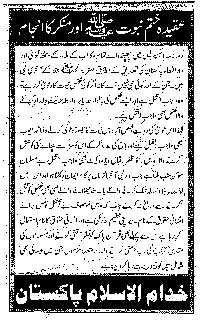 In late July two extremist groups, Jan Nisaran-e-Nabuwat and Aqeeda-e-Tahafuz-e-Kathme Nabuwat, sent threatening letters to the lawyer demanding that he stop giving legal help to religious minorities. Iqbal took one to the City Chief Police Officer (CCPO) in Faisalabad, Punjab province to apply for some form of protection, but says that he was soundly rejected. He suspects that this was because of a grudge held by the district’s high ranking police officers. (He has exposed the misconduct of local officers in the media as part of his human rights work).
Five days later the lawyer was shot at twice by two men near his house. A call to police received no response and a case was not lodged until Iqbal approached the CCPO Faisalabad to insist on one being taken against the gunmen (FIR#465 /09 under section 324 of the Pakistan Penal Code). But two months later no investigation has started. Iqbal continues to receive threats from anonymous callers who tell him that he will not escape so easily next time. He has tried to report them to the CCPO but says he has been met with dismissive remarks and advice to simply stop his activities as human rights defender.
This is a curious response from a senior law enforcement officer asked for protection by a victim of violent crime, and it shows how cleanly the system in Pakistan has broken from the path of law and order. It also begs the question: what exactly are the police for? To see almost no adherence to criminal procedure and no will to confront extreme acts of religious hatred–in the streets and in newspapers–is a grave sign, as is the apparent comfort of the official in this role and his easy abuse of his position to satisfy a vendetta. This incident of police inaction, like many reported by the AHRC (including recently, UAC-045-2009 and UAC-097-2009) makes a case for a widespread reform and review of policing.
However lasting change will not come until there is real political will behind it, and recent history has shown little interest from the Pubjab government in tackling radical religious discrimination. Instead political expediency appears to take priority. During the most recent provincial elections the chief minister ran uncontested; there were many reports alleging the intimidation of potential opposition candidates by groups such as Sipaha-e-sahaba, notorious for its virulent attacks against Shiite Muslims, Ahmadis and Christians.
Without political reform and stronger restrictions to prevent ministerial corruption, religious minorities and human rights defenders will continue to live and operate in fear.
SUGGESTED ACTION:
Please write to the relevant authorities urging them to investigate the attack on Mr. Rao Zafar Iqbal, and reminding the government and law enforcement officials of their responsibilities to protect minority groups and human rights defenders.
The AHRC has written to the UN Special Representative of the Secretary General for human rights defenders informing her of this case
To support this case, please click here: SEND APPEAL LETTER
SAMPLE LETTER
Dear ____________,
Re: PAKISTAN: Newspaper advertisements call for the murder of a human rights lawyer in Punjab; police silently spectate
Name of the victim:
Mr. Rao Zafar Iqbal, advocate; executive director of National Council for Human Rights; resident of Faisalabad district, Punjab province
Names of fundamentalist organisations involved:
1. Khuddam-e-Islam Pakistan, Faisalabad district, Punjab province
2. Jan Nisaran-e-Nabuwat, Faisalabad district, Punjab province
3. Aqeeda-e-Tahafuz-e-Kathme Nabuwat, Faisalabad district, Punjab province
Negligent officials involved:
1. Station House Officer (SHO), Mansoorabad Police station, Faisalabad District, Punjab province,
2. The City Chief Police Officer (CCPO), Faisalabad City, Punjab province
Place of incident: Faisalabad, Punjab
Date of incident: July 2009
I am concerned to hear that police in Faisalabad are doing nothing to protect a human rights lawyer who offers free legal counsel to victims of the country’s harsh blasphemy laws, despite an attempt having recently been made on his life.
Mr. Rao Zafar Iqbal is the executive director of the National Council for Human Rights. According to information provided by the Cathe Foundation Pakistan, an NGO, Mr. Rao Zafar Iqbal is the executive director of the National Council for Human Rights. According to information provided by the Cathe Foundation Pakistan, an NGO, a general fatwa was published in the Daily Express on 3 July, and another in the Daily Pavel on 4 August which stated that Mr. Iqbal is liable to being killed for helping detainees Mohammad Ayube and Imran Masih, a Christian.
On July 22 two extremist groups, Jan Nisaran-e-Nabuwat and Aqeeda-e-Tahafuz-e-Kathme Nabuwat, wrote Iqbal threatening letters and yet his application for protection to the Chief Police Officer (CCPO) in Faisalabad was soundly rejected. Five days later the lawyer was shot at twice by two men near his house. A call to police received no response and a case was not lodged until Iqbal approached the City Chief Police Officer (CCPO) of Faisalabad to insist on it (FIR 465/09 under section 324 of the Pakistan Penal Code). I have heard that two months on, no investigation has started.
I am aware that Iqbal has been receiving anonymous telephone calls telling him that he won’t escape so easily next time, and that he has tried to report them to the CCPO, only to be advised to simply stop his activities as a human rights defender.
This is a curious response from a senior law enforcement officer asked for protection by a victim of violent crime, and it shows how cleanly the system in Pakistan has broken from the path of law and order. It also begs the question: what exactly are the police for? To see almost no adherence to criminal procedure and no will to confront extreme acts of religious hatred, in the streets and in newspapers, is a grave sign, as is the apparent comfort of the official in this role and his easy abuse of his position to satisfy a vendetta. This incident of police inactionlike many reported by the AHRC– makes a case for a widespread reform and review of policing.
However I believe that change will not come until there is real political will, and recent history has shown little interest from the Pubjab government in tackling radical religious discrimination. Instead political expediency appears to take priority.
Without political reform and stronger restrictions for ministerial corruption, religious minorities and human rights defenders will continue to live in fear.
I demand that you arrange immediate protection for Mr. Rao Zafar Iqbal, and would like to remind you of the state’s responsibility to protect minority groups and human rights defenders according to the rights enshrined in the constitution. I expect an investigation to be launched immediately into the members of Muslim extremist groups who are openly harassing Mr. Iqbal and publicly spreading messages of hatred and hostility, and into the publishing houses that have allowed incitements to murder to be printed nation-wide.
The UN Special Representative of the Secretary General for human rights defenders has been informed of this case. Human rights defenders are precious commodities. They deserve respect and protection.
Yours sincerely,
————–
PLEASE SEND YOUR LETTERS TO:
1.Mr. Syed Yousaf Raza Gillani
Prime Minister
Prime Minister House
Islamabad
PAKISTAN
Fax: +92 51 922 1596
Tel: +92 51 920 6111
E-mail: secretary@cabinet.gov.pk
2. Minister for Interior
R Block Pak Secretariat
Islamabad
PAKISTAN
Tel: +92 51 9212026
Fax: +92 51 9202624
E-mail: ministry.interior@gmail.com or interior.complaintcell@gmail.com
3. Mr. Mian Shahbaz Sharif
Chief Minister of Punjab
H-180 Model Town
Lahore
PAKISTAN
Fax: +92 42 5881383
4. Mr.Syed Mumtaz Alam Gillani
Federal Minister for Human Rights
Ministry of Human Rights
Old US Aid building
Ata Turk Avenue
G-5, Islamabad
PAKISTAN
Fax: +9251-9204108
Email: sarfaraz_yousuf@yahoo.com
5. Minister of Law
Government of Punjab
Punjab Secretariat
Ravi Road
Lahore
PAKISTAN
E-mail: law@punjab.gov.pk
6. Chief Secretary of Government of Punjab
Punjab Secretariat
Lahore
PAKISTAN
Fax: +92 42 7324489
E-mail: chiefsecy@punjab.gov.pk
7. Mr. Salman Taseer
Governor of Punjab
Governor House
Mall Road
Lahore
PAKISTAN
8. Dr. Faqir Hussain
Registrar
Supreme Court of Pakistan
Constitution Avenue
Islamabad
PAKISTAN
Fax: + 92 51 9213452
E-mail: mail@supremecourt.gov.pk
——————————
Thank you.
Urgent Appeals Programme
Asian Human Rights Commission (ua@ahrc.asia)
