
Dear friends,
 The Asian Human Rights Commission (AHRC) has learned that an anti corruption activist in Jakarta has been attacked with a machete by unknown assailants. The activist had helped to produce a recent controversial report for Indonesia Corruption Watch (ICW) on bank accounts held by high ranking police. There are concerns that the attack was related to the activists work and will not be credibly investigated. There are also fears that the violence is connected to the attack on a newspaper office two days ago that had run a cover story on the report in its latest issue.
CASE NARRATIVE:
According to the information we have received, Tama Satrya Langkun and a friend were forced from the road by a car while they were riding a motorcycle in Kalibata, South Jakarta at about 4am on 8 July 2010. In a press conference the ICW reported that the car feigned ramming the bike from behind, causing the men to crash. Two men on another motorcycle then arrived on the scene, took off Tama’s helmet and slashed him a number of times with a machete.
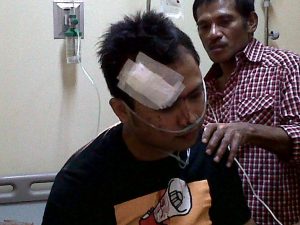
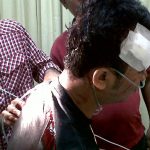 Tama was taken to hospital where he received 29 stitches to his head, back and hands (see more pictures here and here). ICW has reported that the activist believed he had been targeted prior to the attack, since in the past few days he had complained of several suspicious phone calls, and the impression that he was being stalked by an unidentified man.
As a researcher at ICW, Tama was one of several activists who filed the complaint to the national Corruption Eradication Commission (KPK) in late June and early July 2010, which detailed suspicions about a number of bank accounts owned by high ranking police officers. The connection between the report and the attack has not been proven, however it has caused serious concerns among human rights defenders in Indonesia, who often feel unprotected and unsupported by their government in issues relating to police corruption.
An immediate, thorough investigation must be conducted and the perpetrators charged, to reassure the community. The ICW is in the process of filing complaints about the assault with the police, the National Human Rights Commission (Komnas HAM) and the Witnesses and Victims Protection Agency (LPSK).
ADDITIONAL INFORMATION:
 The issue of the mysterious bank accounts has become both widespread and controversial among the Indonesian public during the last few weeks, both due to the content of the report and the unexplained violent incidents that have followed its publication.
Early on the morning of 6 July, unidentified men threw Molotov cocktail bombs at the office of Tempo Magazine in Jakarta, which as we reported in UAC-097-2010, had just carried a front page story on the bank accounts. As also noted, on the day of the magazine’s publication organized groups of men reportedly visited most of the magazine’s vendors in the city and bought all of the copies. The events have raised fears that the right to free expression is under systematic attack and is not being institutionally protected. Only an immediate, thorough and transparent investigation resulting in the conviction of the perpetrators will prove otherwise.
SUGGESTED ACTION:
Please write to relevant authorities listed below to call for a credible investigation on this case, followed by the punishment of those responsible in conformity with the law.
The Asian Human Rights Commission also wrote to UN Special Rapporteur on the situation of human rights defenders.
To support this case, please click here: SEND APPEAL LETTER
SAMPLE LETTER
Dear __________,
INDONESIA: Anti-corruption activist maimed in South Jakarta
Name of victim: Tama Satrya Langkun
Names of alleged perpetrators: Unidentified
Date of incident: 8 July 2010
Place of incident: Kalibata, South Jakarta
I am writing to express my deep concerns regarding the attack against Mr. Tama Satrya Langkun, an anti-corruption activist works for Indonesian Corruption Watch (ICW) which took place at early morning on 8 July 2010. Based on information I have received, Mr. Tama and his friend were on motorcycle in Kalibata, South Jakarta when a car and a motorcycle forced them off the road, where they crashed. After Mr. Tama fell from the motorcycle, two unidentified men, also on a motorcycle, removed his helmet and slashed him with a machete. The other passenger was not attacked.
Mr. Tama has received 29 stitches to his head, back, and hands, and remains in hospital.
The issue of the mysterious bank accounts has become both widespread and controversial among the Indonesian public during the last few weeks, both due to the content of the report and the unexplained violent incidents that followed its publication. This includes an attack on the officers of Tempo Magazine on 6 July, shortly after it ran a front page story on the bank accounts. You may also be aware that on the day of the magazine’s publication, organized groups of men reportedly visited most of the magazine’s vendors in the city and bought all of the copies.
The events have raised fears that the right to free expression is under systematic attack and not being institutionally protected. Only an immediate, thorough and transparent investigation resulting in the conviction of the perpetrators will reassure the public that this is not the case, and it is now your obligation, on behalf of the State, to ensure that such an investigation is carried out.
As mentioned in Article 1 paragraph (3) of the 1945 Constitution, Indonesia is country which is ruled by law. Ignoring this case, or not taking it seriously, will not only violate the constitution itself but will show that the State is failing to act in the protection of the basic rights of its citizens.
I urge you to act swiftly on this case, according to the means available to you under your authority.
Yours sincerely,
—————-
PLEASE SEND YOUR LETTERS TO:
1. General Bambang Hendarso Danuri
Chief of Indonesian National Police
Jl. Trunojoyo No. 3
Jakarta Selatan
INDONESIA
Tel: +62 21 721 8012
Fax: +62 21 720 7277
Email: polri@polri.go.id
2. Mr. Adnan Pandu Praja
Chairman of the National Police Commission (Kompolnas)
Jl. Tirtayasa VII No. 20 Komplek PTIK Jakarta Selatan
INDONESIA
Tel: +62 21 739 2352
Fax: +62 21 739 2317
3. Ms. Harkristuti Harkrisnowo
General Director of Human Rights
Department of Law and Human Rights Republic of Indonesia
Jl. HR Rasuna Said Kav.6-7 Kuningan, Jakarta 12940
Tel: +62 21 525 3006, 525 3889, 526 4280
Fax: +62 21 525 3095
4. Mr. Abdul Haris Semendawai
Chairman of Witnesses and Victims Protection Agency
Gedung Perintis Kemerdekaan Lt. 1
Jl. Proklamasi No. 56 Jakarta Pusat 10320
INDONESIA
Tel: +62 21 3192 7881
Fax: +62 21 3192 7881
Email: lpsri@lpsk.go.id
5. Mr. Susilo Bambang Yudhoyono
President of Republic of Indonesia
Presidential Palace,
Jl. Medan Merdeka Utara Jakarta Pusat 10010
INDONESIA
Tel: +62 21 384 5627, ext. 1003
Fax: +62 21 231 4138, 345 2685, 345 7782
Thank you.
Urgent Appeals Programme
Asian Human Rights Commission (ua@ahrc.asia)
