
Dear friends,
The Asian Human Rights Commission (AHRC) has been documenting cases of illegal arrest, detention and prosecution since the nationwide protests in Burma last September. In this appeal we give the details of the case of one young man who was arrested because of having some publications linked to those events and after a short closed trial in which he was wrongly charged, did not have a lawyer, could not call any witnesses and had a forged confession read out against him he was sentenced to 22 years in jail.
CASE DETAILS:
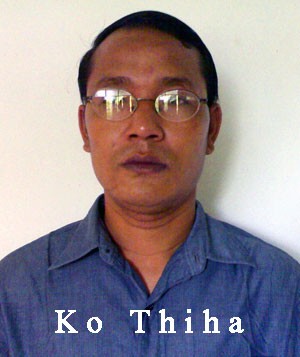 On 7 September 2007, a man named Soe Khaing Win left four publications at a photocopy shop in Mandalay. The publications, which had titles like “The people awake! Time to take to the streets”, were described as “inflammatory” and “anti-government”. Later, two others, Ye Min Zaw and Ko Thiha, came to collect them. Thereafter, the police went looking for the three; however, the first two were able to evade arrest. They only captured 34-year-old Ko Thiha that night when he was south of Mandalay, near the town of Wundwin, on the road to his hometown of Meikhtila.
The police brought Thiha to the district court in Mandalay on September 14 and charged him with sedition and upsetting public tranquillity. This is despite the fact that lawyers question the legality of the current government charging anyone with sedition because the law requires that this charge be lodged by a lawyer for a constitutional government; however, Burma has been without a constitution since 1988. It is also despite the fact that the case against him should have been opened in the court in Wundwin, where he was arrested, not in Mandalay.
The trial was held at a special court inside the Mandalay Prison. Thiha did not have a lawyer to represent him, even though he was facing a life sentence. He was not able to call any witnesses or defend himself in court. Meanwhile, the witnesses that the police called were not the ones present when Thiha was actually arrested. The police did not present any evidence to strongly support the charge of sedition and instead called another judge who briefly testified that Thiha had made a confession before him, which was presented as evidence. However, Thiha claims to have never seen that judge before the trial.
The hearings were all completed in a single day, and on September 17 after only ten days of investigation and trial the presiding judge sentenced Thiha to 22 years in prison. He ordered warrants of arrest for the other two accused. Thiha was sent to the central prison.
ADDITIONAL INFORMATION:
According to a report by Democratic Voice of Burma radio in November 2007, unidentified Special Branch police in Meikhtila had called and interrogated Ko Thiha’s then-seven-months-pregnant wife, Ma The The, on suspicions that she was also involved in anti-government activities. They took a statement from her and also photographed her before allowing her to go home.
BACKGROUND INFORMATION:
This is yet another case that speaks to the “legal dementia” that exists in Burma whereby neither the police nor courts appear capable of following even their domestic laws and procedures, to say nothing of international standards, which the AHRC’s sister organisation has described in a recent comprehensive report on Burma: “Burma, political psychosis and legal dementia“. See for instance another recent appeal concerning a case in which the young woman accused, Ma Thida, was charged with the same offence of sedition: AHRC-UAC-048-2008.
This dementia has been particularly evident in the handling of the protests of last August and September 2007. See for instance the case of Khin Sanda Win, who is being held in solitary confinement: AHRC-UAC-022-2008. See also a recent appeal on the status of monks, nuns and some ordinary civilians detained since the protests: AHRC-UAC-024-2008.
The AHRC is following the detention and trials of persons after last September very closely and will issue more appeals on these cases in coming weeks. It also set up a webpage with links to statements, appeals and media on the protests and their aftermath: http://campaigns.ahrchk.net/burmaprotests/
Ko Thiha may have been targeted in part because he is a member of the Human Rights Defenders and Promoters (HRDP) group. The AHRC has also issued a number of cases on other members of the HRDP who have been jailed in recent times, including the Hinthada 6 (http://campaigns.ahrchk.net/hinthada6/) and tuition teacher Min Min (UA-108-2007); see also AHRC-OL-035-2007.
For further general information on Burma see also the 2007 AHRC Human Rights Reportchapter on Burma, and visit the AHRC Burma homepage: http://burma.ahrchk.net.
______________________________
SUGGESTED ACTION:
Please write to the persons listed below to call for a thorough review and retrial of the case against Ko Thiha. Please note that for the purpose of the letter, the country should be referred to by its official title of Myanmar, rather than Burma.
Please be informed that the AHRC is writing a separate letter to the UN Special Rapporteurs on Myanmar and independence of judges and lawyers as well as the UN Special Representative on human rights defenders, the UN Working Group on arbitrary detention and the regional human rights office for Southeast Asia, calling for interventions into this case.
To support this case, please click here: SEND APPEAL LETTER
SAMPLE LETTER
Dear ___________,
MYANMAR: Young man denied fair trial and proper criminal investigation
Details of victim: Ko Thiha, 34, traditional medicine practitioner, son of U Khin Maung Swe, resident of Ward 1, Meikhtila, Mandalay Division; member of the Human Rights Defenders and Promoters (HRDP) group and National League for Democracy (NLD) youth wing member
Arrested on: 7 September 2007
Charge and trial: Charged with sedition, Penal Code sn. 124A, and upsetting public tranquility, sn. 505(b), by Deputy Superintendent Win Myint on 14 September 2007, case before the Mandalay District Court, Judge Win Htay presiding, convicted on both charges and sentenced to one life term (20 years) and two years rigorous imprisonment respectively, to be served consecutively, on 17 September 2007
I am writing to express my concern at the case of Ko Thiha, who has been imprisoned for 22 years on charges of sedition and upsetting public tranquility after he allegedly went in September to collect publications from a photocopy shop that were deemed to be “anti-government”.
According to the information that I have received, on 7 September 2007 Ko Thiha went with Ye Min Zaw to collect four publications and photocopies from a shop on Bhedar Road in Maha-aungmyay Township in Mandalay. Later he was arrested near Wundwin, to the south. The other two men escaped arrest. Ko Thiha was brought to the Mandalay District Court on September 14 and after a one-day hearing sentenced three days later.
I am informed of a many serious violations of criminal procedure that I believe are cause for this case to be reviewed:
1. The charge of sedition is not applicable as it requires that the government against which the act is alleged to have been committed is a constitutionally-formed government, whereas the current government in Myanmar has no constitutional basis.
2. The case should have been lodged in the Wundwin Township Court and then transferred to the Mandalay District Court (CrPC sections 177, 178; Court Manual sn. 20[3]), but it was opened directly in Mandalay.
3. Ko Thiha was not able to hire a lawyer as is his right, nor make a proper defence (section 340, CrPC, Judiciary Law 2000 section 2[f]).
4. Ko Thiha was not able to call witnesses as his case was tried in a closed court within Mandalay Prison, in violation of the Judiciary Law (section 2[e]) and the CrPC (section 352).
5. None of the witnesses brought to court by the police, including the police, were present when Ko Thiha was arrested.
6. The prosecutor called Batheingyi Township Judge, U Mya Sein, to testify that he had taken a confession from the accused (Evidence Act, sn. 26). However, according to Ko Thiha he had never seen that judge before he came to the court.
The court also compounded the penalties for the two offences rather than allowing them to be served consecutively.
In view of the above irregularities, I urge you to review this case in accordance with your powers under the Attorney General Law 2001 (sections 4[b] and 9[h]), in particular given that Ko Thiha was not tried in an open court and was not given access to a lawyer, in violation of his basic rights (Attorney General Law, section 3[i]).
I also take this opportunity to call more generally for attention to be paid to adhering to basic criminal procedure in Myanmar. Where police officers and courts are responsible for repeated and flagrant violations of the basic provisions of law in handling cases such as this, it makes a mockery of the entire legal process and all but eliminates the possibility of any kind of fair judicial inquiries or legal redress for victims of abuses. If even the domestic law cannot be properly enforced, then there can be few if any expectations that Myanmar can ever comply with international standards.
Yours sincerely
—
PLEASE SEND YOUR LETTERS TO:
1. Maj-Gen. Maung Oo
Minister for Home Affairs
Ministry of Home Affairs
Office No. 10
Naypyitaw
MYANMAR
Tel: +95 67 412 079/ 549 393/ 549 663
Fax: +95 67412 439
2. Lt-Gen. Thein Sein
Prime Minister
c/o Ministry of Defence
Naypyitaw
MYANMAR
Tel: + 95 1 372 681
Fax: + 95 1 652 624
3. U Aung Toe
Chief Justice
Office of the Supreme Court
Office No. 24
Naypyitaw
MYANMAR
Tel: + 95 67 404 080/ 071/ 078/ 067 or + 95 1 372 145
Fax: + 95 67 404 059
4. U Aye Maung
Attorney General
Office of the Attorney General
Office No. 25
Naypyitaw
MYANMAR
Tel: +95 67 404 088/ 090/ 092/ 094/ 097
Fax: +95 67 404 146/ 106
5. Brig-Gen. Khin Yi
Director General
Myanmar Police Force
Ministry of Home Affairs
Office No. 10
Naypyitaw
MYANMAR
Tel: +95 67 412 079/ 549 393/ 549 663
Fax: +95 67412 439
6. Mr. Patrick Vial
Head of Delegation
ICRC
No. 2 (C) – 5 Dr. Ba Han Lane
Kaba Aye Pagoda Road, 8th Mile
Mayangone Township
Yangon
MYANMAR
Tel.: +951 662 613 / 664 524
Fax: +951 650 117
E-mail: yangon.yan@icrc.org
7. Mr. Shariq Bin Raza
Representative
UN Office on Drugs and Crime
11A Malikha Road
Ward 7, Mayangone Township
Yangon
MYANMAR
Tel: +951 666 903/ 660 556/ 660 538/ 660 398/ 664 539
Fax: +951 651 334
E-mail: fo.myanmar@unodc.org, shariq.raza@unodc.org, camila.vega@unodc.org
Thank you.
Urgent Appeals Programme
Asian Human Rights Commission (ua@ahrchk.org)
