
Dear friends,
The Asian Human Rights Commission (AHRC) has received information from Jagaran Media Center (JMC), a human rights organisation in Nepal concerning the case of a Dalit woman who was assaulted, publically humiliated and forced to eat her own excreta by the villagers. It is reported that Mrs. Kalli Kumari was accused of practising witchcraft by the villagers, who confined Kumari in a room for two days, tortured and forced her to confess that she practiced witchcraft.
CASE DETAILS
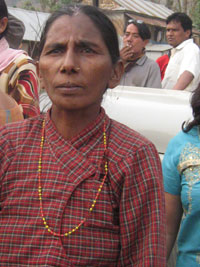 Kalli Kumari B.K is aged 45 years and is a Dalit woman. On March 20, Kumari was accused of practicing witchcraft by the villagers, and was mercilessly beaten up and forced to eat her own excreta in public. Kumari is the resident of Pyutar-07, Thangsingtole, Lalitpur district of Nepal, a neighbouring district of Kathmandu, about 40 kilometres away from the capital city. Ms. Bimala Lama, a member of the indigenous community in the village and the Headmistress of the Gadhibhanjyang Primary School, thrashed and force-fed Kumari her own excreta in the presence of the villagers.
Kumari was kicked, punched and hit with a stone by Bimala Lama, her sister and others who shouted, “a witch should be killed like this.” Kumari sustained severe injuries in the incident, particularly on her nose, mouth and forehead. Kumari was accused of practicing witchcraft on Bimala, her daughter and other villagers. Bimala also received support from the local Shaman, Sunwar Lama. The villagers also threatened Kumari’s husband that if he spoke in support of his wife, he would also face the same treatment.
Prior to the incident, Kumari and her husband were confined in a room in one of Bimala’s relatives for two days. There, they tortured Kumari and forced her to accept that she was a witch.
“I accepted that I am a witch when they threatened to chop my breasts using blades,” said Kumari after she was rescued by the staff members of the JMC. When JMC rescued Kumari, they found that her inner and outside garments have been cut using blades by the mob. Kumari was made to agree that some animals in the village died because she practiced witchcraft upon them. Kumari also informed JMC that she had to sign an agreement, taking responsibility for the death of the animals that may die in the village in the future.
Kumari filed a case at the Area Police Office – Ashrang on March 23, but the police have failed to arrest the victims. In spite of the pressure generated by the Dalit organisations and civil society groups, the Chief District Officer (CDO) and Superintendent of Police (SP) of Lalitpur district claim that they are searching for the culprits and their efforts to arrest the accused were foiled by the protesting villagers.
Coming to know about the incident the JMC along with the representatives from different human rights organisations and the media, went to Pyutar on March 25 accompanied by the representatives from the National Dalit Commission, National Women’s Commission and a Dalit member of the Constitutional Assembly. The team, after seeing the hostile environment posed by the villagers rescued Kumari, her husband Chet Bahadur, and her 17-year-old daughter. The villagers tried to attack them with stones and sticks. Kumari and her family are sheltered in Maiti Nepal, a NGO working for the rights of women, in Kathmandu.
A meeting was organised in the premises of the National Women’s Commission where the representatives of Dalit civil society and other organisations were present. The meeting formed a working committee to help the victim and her family. A press conference was organised at the National Womens Commission in which Kumari narrated the details of her ordeal. The participants were overwhelmed after listening to her narrative. The following day, news was disseminated through newspapers, radio and television channels.
The working committee formed to support Kumari with her case approached the CDO on March 29 to request the officer to arrest the culprits, obtain compensation and to assist in resettling the victim’s family. The committee requested the CDO that his office should ensure that the culprits are arrested within a week’s time. However the authorities have failed to do so. The committee has decided to take further actions if the culprits are not arrested.
In the meanwhile, Kumari is provided medical care by the JMC, which in fact is the responsibility of the government. But the government has failed to do so. It appears that the authorities are failing to take any action because the Lama is the dominant community in Pyutar village and further, due to the caste prejudice entertained by the authorities in Nepal. It is common in Nepal, for the members of the Dalit community to be accused of witchcraft. Additionally, the Dalits are considered to be of less significance and lower in status in the country due to caste-based discrimination.
SUGGESTED ACTION:
Please write letters to the authorities listed below, urging them to take immediate actions in this case, in particular to arrest the culprits, record a statement of the victim and further to provide protection to the victim until a case registered upon the crime is decided by a competent court.
The AHRC is also writing a separate letter to the UN Special Rapporteur on violence against women, its causes and consequences calling for intervention in this case.
To support this case, please click here: SEND APPEAL LETTER
SAMPLE LETTER
Dear _________,
NEPAL: The case of Dalit woman forced to eat human excreta must be investigated
Name of victims:
1. Mrs. Kalli Kumari, aged 45 years, Pyutar-07 village, Thangsingtole, Lalitpur district, Nepal
2. Mr. Chet Bahadur, Pyutar-07 village, Thangsingtole, Lalitpur district, Nepal
Name of alleged perpetrators:
1. Bimala Lama, Pyutar-07 village, Thangsingtole, Lalitpur district, Nepal
2. Sunwar Lama, Pyutar-07 village, Thangsingtole, Lalitpur district, Nepal
Date of incident: 18-20 March 2009
I am writing to express my concern about the case of Mrs. Kalli Kumari B.K who was forced to eat human excreta on 20 March 2009 at Pyutar-07 village, Thangsingtole, Lalitpur district, Nepal.
I am informed that Kumari is a Dalit woman and it is one of the reasons why the villagers accused her of being a witch. I am informed that on March 20, Kumari was accused of practicing witchcraft by the villagers, and was mercilessly beaten up and forced to eat her own excreta in public. It is reported that Ms. Bimala Lama, a member of the indigenous community in the village and the Headmistress of the Gadhibhanjyang Primary School thrashed and force-fed Kumari her own excreta in the presence of the villagers. I am concerned to know that in spite of repeated requests, the authorities in Nepal have failed to take any action against the culprits involved in this case. I am of the opinion that such failure is not only a failure of the state responsibility to punish crime, but further promotes impunity against the acts of discrimination against the Dalits in this case in a most inhuman form, to continue unabated in Nepal.
Kumari was thrashed, kicked, punched and hit by a stone by Bimala Lama, her sister and others accusing her, that, “a witch should be killed like this”. Kumari reportedly sustained severe injuries on her nose, mouth and forehead and other parts of the body. Kumari was accused of practicing witchcraft on Bimala, her daughter and other villagers. For this, Bimala received support from the local Shaman, Sunwar Lama. The villagers also threatened Kumari’s husband that if he spoke in support of his wife, he would also face the same ordeal.
Prior to the incident, Kumari and her husband were confined in a room in one of Bimala’s relatives for two days. There, they tortured Kumari and forced her to accept that she was a witch.
When the staff members of the Jagaran Media Center (JMC) rescued Kumari, they found that her inner and outside garments were torn by blades. Kumari also informed JMC that she had to sign an agreement, taking responsibility for the death of the animals that may die in the village in the future.
I am aware that Kumari has filed a case at the Area Police Office–Ashrang on March 23, but I am informed that the police have failed to arrest the victims. In spite of the pressure generated by the Dalit organisations and civil society groups, I am informed that the Chief District Officer (CDO) and Superintendent of Police (SP) of Lalitpur district have failed to arrest the culprits.
I am further informed that the JMC along with different organisations and the media, went to the Pyutar on March 25, accompanied by the representatives from the National Dalit Commission, National Women’s Commission and a Dalit member of the Constitutional Assembly. The team after seeing the hostile environment posed by the villagers rescued Kumari, her husband Chet Bahadur, and her 17-year-old daughter though the villagers tried to attack the team with stones and sticks. Kumari and her family are now sheltered by Maiti–Nepal, a NGO working for the rights of women, in Kathmandu.
A working committee formed to support Kumari has approached the CDO on March 29 to request the officer to arrest the culprits, obtain compensation and to assist in resettling the victim’s family. However the authorities have failed to arrest the culprits in the case.
I therefore request you to ensure that:
1. the police record the statement of the victims;
2. the police conduct an impartial investigation in the case based on the statement;
3. the police arrest the perpetrators and bring them to trial before a competent court, and;
4. the authorities provide medical and other forms of assistance to the victim to help the family to relocate to a safer village.
Yours sincerely,
—-
PLEASE SEND YOUR LETTERS TO:
1. Mr. Om Bikram Rana
Inspector General of Police
Police Head Quarters, Naxal
Kathmandu
NEPAL
Fax: +977 1 4415593
Tel: +977 1 4412432 (Secretary to IGP)
E-mail: ranaob@nepalpolice.gov.np or info@nepalpolice.gov.np
2. Mr. Raghav Lal Vaidya
Attorney General
Office of Attorney General
Ramshahpath
Kathmandu
NEPAL
Fax: +977 1 4262582
E-mail: attorney@mos.com.np
3. Ms. Pampa Bhusal
Minister for Women, Children and Social Welfare
Singha Durbar
Kathmandu
NEPAL
Fax: +977 1 4241516
4. Ms. Nainkala Thapa
Chairperson
National Women’s Commission
Bhadrakali Plaza
Kathmandu
NEPAL
Fax: +977 1 4256783
5. Mr. Bamdev Gautam
Minister of Home Affairs
Ministry of Home Affairs
Singha Darbar, Kathmandu
NEPAL
Fax: +977 1 4211264 or 4211232
Tel: +977 1 4211261, 4211212, 4211274, 4211249 or 4211224
6. Mr. Dev Gurung
Minister of Law, Justice and Parliamentary Affairs
Ministry of Law, Justice and Parliamentary Affairs
Singha Durbar, Kathmandu
NEPAL
Fax: +977 1 4220684
Tel: +977 1 4223727, 4224633 or 4220672
7. Mr. Kedar Nath Upadhaya
Chairperson
National Human Rights Commission
Pulchowck, Lalitpur
NEPAL
Fax: +977 1 55 47973
E-mail: complaints@nhrcnepal.org or nhrc@nhrcnepal.org
8. SSP Mr. Binod Singh
Police HR Cell
Human Rights Cell
Nepal Police
Kathmandu
NEPAL
Fax: +977 1 4415593
E-mail: hrcell@nepalpolice.gov.np
9. Mr. Richard Bennet
OHCHR Representative
OHCHR, United Nations, PO Box 107
Kathmandu
NEPAL
Fax: +977 1 4670712 or 4670713
Thank you.
Urgent Appeals Programme
Asian Human Rights Commission (ua@ahrc.asia)
